Stellar Lifetimes
The luminosity of a star is a measure of its energy output, and therefore a measure of how rapidly it is using up its fuel supply. The lifetime of a star would be simply proportional to the mass of fuel available divided by the luminosity if the luminosity were constant. Beyond these statements, one must rely on the empirical data collected and models of that data to estimate the lifetime of a given star.
One useful step toward modeling stellar lifetimes is the empirical mass-luminosity relationship.
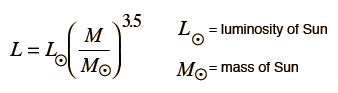
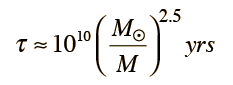
Since the mass of the star is the fuel for the nuclear fusion processes, one could then presume that the lifetime on the main sequence is proportional to the stellar mass divided by the luminosity. It depends upon the fraction of mass that is actually available as nuclear fuel, and considerable effort has gone into modeling that fraction for the Sun to yield a solar lifetime of 10 x 109 years. Using that projected lifetime, the stellar lifetime can then be expressed as
Star processes
Galaxy concepts
Reference
Harwit
Ch 8
| HyperPhysics***** Astrophysics
HyperPhysics ***** 天体物理学 | R Nave |