Introduction to Periodic Motion
All methods of production of musical sound depend upon the ability to produce periodic motion in some mechanical device which in turn produces sound. The important terms associated with periodic motion are frequency, period and amplitude. The frequency (f) is in cycles per second or Hertz and the period (T) is the number of seconds to complete one cycle or "seconds/cycle". The period, T, in seconds per cycle = 1/f. The amplitude is the maximum displacement away from the equilibrium position (the place where the object would normally rest). For example, the normal rest position of a violin string is its equilibrium position. The intensity produced by the string is related to the amplitude of its motion.
One of the most common examples of periodic motion is the pendulum. Although it is not directly related to a sound source, it will serve to demonstrate some of the features of periodic motion. We will study the frequency of the pendulum as a function of the mass, length, and amplitude and plot graphs of the dependence upon these parameters.
Procedure
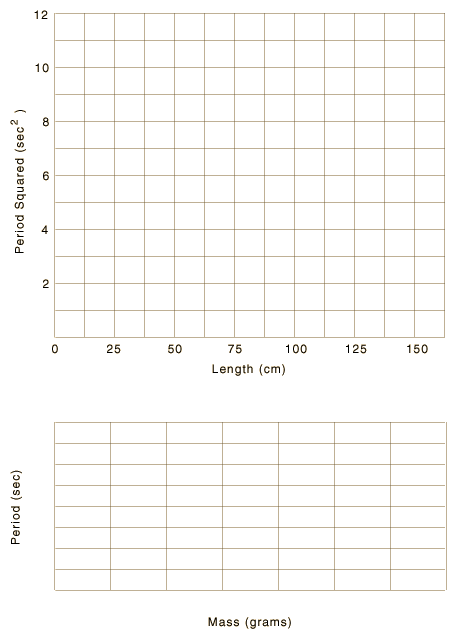
1. Suspend the 200g mass provided to form a pendulum of length 150cm (measure from the center of mass to the point of support). Measure the time required to complete 10 full cycles to the nearest tenth of a second. Repeat for pendulum lengths of 100, 75, 50, and 25 cm. Calculate the period in seconds/cycle and the squares of the periods. Plot the period squared vs the length on the graph paper provided.
Length Total Time Period Period Squared
150 cm __________ ________ ____________
100 cm __________ ________ ____________
75 cm __________ ________ ____________
50 cm __________ ________ ____________
25 cm __________ ________ ____________
2. Using successive masses 100, 200, and 500 grams, make a pendulum of length 50 cm and determine the corresponding periods. Since different masses cause different amounts of stretching of the string, the length should be adjusted to exactly 50 cm and remeasured for each mass. The length should be measured to the center of the hanging mass.
Mass 100 gm 200 gm 500 gm
Period __________ ________ ____________
Plot the period as a function of the mass.
3. Using the 100 gm mass and a length of 50 cm, pull the pendulum bob
out a distance of approximately 15 cm (straight line measure) and measure
the period of the resulting motion when released. Repeat for 30,
45, and 60 cm. These distances may be measured by placing one end
of the meter stick at the equilibrium point and measuring the straight
line distance to the mass. Record the period.
Amplitudes: 15 cm _______ 30 cm _______
45 cm ________ 60 cm ________
4. Using the graph made in part 1, predict the period of a 125 cm pendulum. Measure the period and compare. What mass and amplitude should you use?
Predicted period ____________
Measured period ____________
5. How strongly does the period of a pendulum depend upon the mass of
the bob and the amplitude of the swing?
6. If you had a pendulum type clock which was running too slow what could you do to correct it?
Equipment: Periodic Motion
- Vertical rod, pendulum hanger, table clamp.
垂直杆、摆挂架、台式夹持器
- Set of masses including 100, 200 and 500 grams.
包含100克、200克和500克的物体组。
- 2-meter stick
2米的尺子
- Stopwatch
秒表