Resonance Tube: Velocity of Sound
Object: To observe the resonance phenomenon in an open ended cylindrical tube. To use the resonance to determine the velocity of sound in air at ordinary temperatures.
Introduction: The velocity with which sound travels in any medium may be determined if the frequency and the wavelength are known. The relationship between these quantities is:
| v = fl where
其中,$ v = f l $ |
v = velocity of sound propagation f = frequency l = wavelength v = 声音传播的速度 f = 频率 l = 波长 |
In this experiment the velocity of sound in air is to be found by using tuning forks of known frequency. The wavelength of the sound will be determined by making use of the resonance of an air column.
|
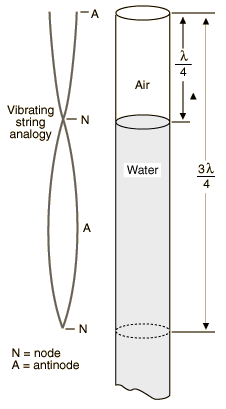
The apparatus for the experiment consists of a long cylindrical plastic tube attached to a water reservoir. The length of the water column may be changed by raising or lowering the water level while the tuning fork is held over the open end of the tube. Resonance is indicated by the sudden increase in the intensity of the sound when the column is adjusted to the proper length. The resonance is a standing wave phenomenon in the air column and occurs when the column length is: 实验装置包括一个长而细的塑料管,连接到一个水槽。通过提升或降低水位,可以在管的开口端上方调节水柱长度。当管长调节到适当长度时,声音的强度会突然增加,这表明发生了共振。共振是空气柱中的驻波现象,当管长满足以下条件时会发生:
where l is the sound wavelength. 其中 l 是声波波长。
The water surface constitutes a node of the standing wave since the air is not free to move longitudinally. The open end provides the conditions for an antinode, but the actual antinode has been found to occur outside the tube at a distance of about 0.6 r from the end, where r is the tube radius. This end correction may be added to get a more accurate value if only one resonance can be measured, but it is usually more convenient to eliminate this "end effect" by subtracting the resonance length for l/4 from those for 3 l /4, 5l /4, etc. 水面上构成了驻波的节点,因为空气不能自由纵向移动。开口端提供了抗节点的条件,但实际的抗节点被发现发生在管子外约0.6 r处,其中r是管子半径。如果只能测量一个共振,这个端修正可以加到结果中以获得更准确的值,但通常更方便的是通过减去l/4的共振长度来消除这个'端效应',那些对于3l/4、5l/4等的共振长度。
|
|
Procedure:
1. Fill the tube nearly full of water. Strike one of the tuning forks with the rubber mallet supplied and hold it above the water column. Hold it as close as you can without hitting the tube in order to get the maximum sound power down into the column.
2. Using the moveable water reservoir, lower the water surface slowly, listening for amplification of the tone. When a resonance is found, a pronounced reinforcement of the sound will be heard. Move the water surface up and down several times to locate the point of maximum sound intensity and note that point using the numerical scale on the tube .
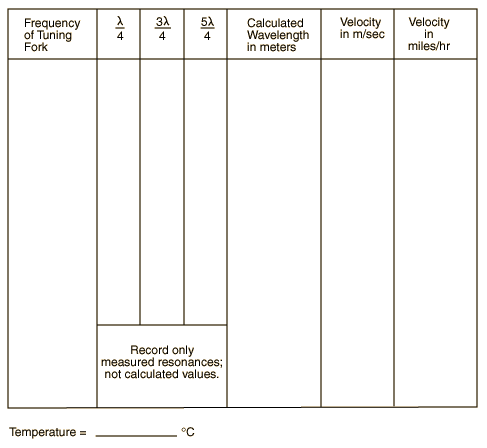
3. Lower the water further to find the next resonant length. Continue in this manner as far as the length of the tube will permit. Obtain the lengths l/4, 3l/4, etc. in meters from your measurements. You will need to check to see if your column lengths follow the progression 1, 3, 5, 7, -- since you may have missed a resonance or counted one of the fainter spurious resonances which sometimes occur. Calculate the wavelength and velocity of sound.
4. Repeat the procedure for the other tuning forks supplied. The velocity in miles per hour may be found by multiplying the velocity in m/sec by the factor 2.24. Please record the room temperature for reference since the velocity of sound increases with increasing air temperature.
Equipment: Resonance Tube
- Three different tuning forks for each
三种不同调谐的叉子
- hammer for tuning forks
调谐锤
- Resonance tube apparatus
共振管装置
- Plastic beaker for each and a few of the bulbs for removing water
每个一个塑料烧杯,以及几个灯泡用于去除水分
Apparatus movie