Loudspeaker Resonance
An open-cone dynamic loudspeaker will generally exhibit a single resonant frequency at which it most readily responds to an electronic signal. The purpose of this experiment is to measure the resonant frequency of a speaker and plot the response curve of the speaker over the audible frequency range.
In many applications, resonance is desirable because it provides an enhanced response to a particular frequency, but in loudspeaker design it is in general not desirable. An ideal speaker should respond equally to all audible sound-frequencies so that it will accurately reproduce the sound programming supplied to it. Any change in the relative intensities of the various frequencies present in the sound will change the quality (timbre) of the sound and therefore represents a distortion. Much of the effort in designing a good speaker system is directed toward broadening and smoothing of the open-cone resonance so that the speaker will respond more uniformly to a broad range of frequencies.
In this experiment an audio frequency oscillator (signal generator) will be used to drive the speaker and an oscilloscope will be used to measure the voltage supplied to the speaker coil. The connections are shown in the sketch.
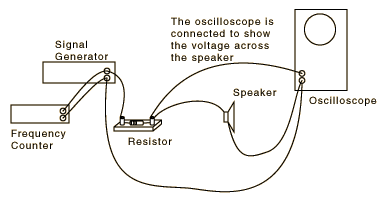
A resistor is to be placed in series with the speaker as indicated in the diagram. Its purpose is to maintain a more nearly constant "load" on the signal generator. The speaker impedance is nominally some value like 4 ohms, 8 ohms, etc., but it varies considerably near resonance. The oscilloscope will be used to measure the voltage across the speaker. The voltage will reach its maximum value at the resonant frequency of the speaker.
PROCEDURE 1. Wire up the circuit as shown and get a sine wave display on the oscilloscope. The lab instructor will explain the oscilloscope controls.
2. With the signal generator output set to its maximum range, adjust the frequency to 20 Hz using the frequency dial and the multiplier switch. Sweep the frequency up slowly to 1000 Hz, watching the oscilloscope display. When the vertical height (voltage) of the display peaks and then diminishes, you have passed through the resonant frequency. Adjust the oscilloscope control labelled 'volts/cm' until the vertical height nearly fills the screen. Be sure you know what scale factor you are using on this control. Record the voltage (height in cm times the scale factor in volts/cm) and the resonant frequency.
3. Reset the frequency to 20 Hz and record the voltage from the oscilloscope. (Do not adjust any of the controls on the signal generator except the frequency for the remainder of the experiment).
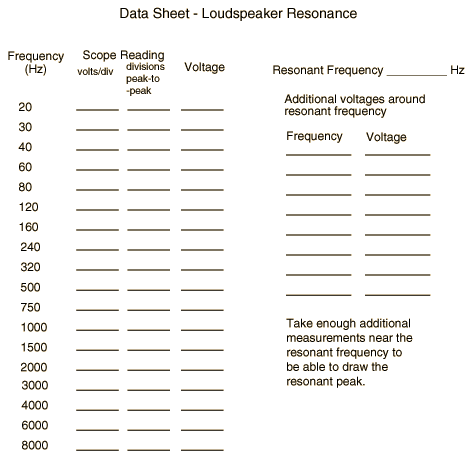
4. Take voltage readings at one-half octave intervals over the frequency range 20 - 8,000 Hz as outlined on the data sheet. Take additional measurements at several frequencies near the resonant frequency, so that the behavior near resonance can be followed more closely.
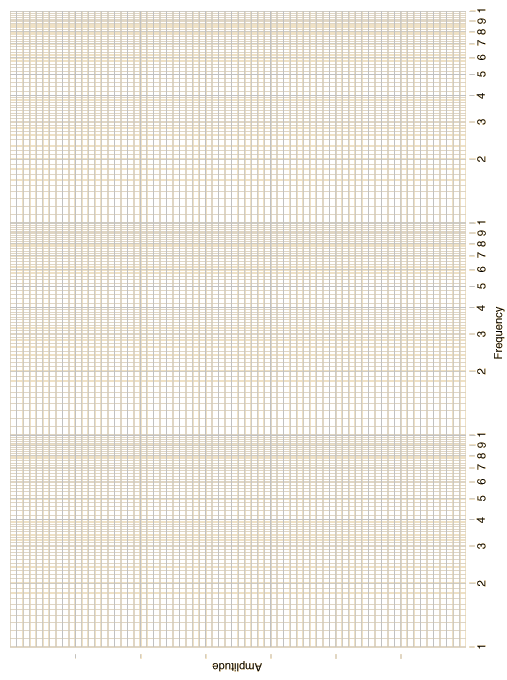
5. On the semi-log paper provided, plot your measured frequency and voltage data. The frequency is to be placed on the logarithmic axis. On the other axis, choose a scale such that the voltage at resonance will nearly reach the top of the scale. Draw small circles around your plotted points and then draw a smooth curve through your points to produce a frequency response for your speaker.
Equipment: Loudspeaker Resonance
- Small loudspeaker
小扬声器
- 240 ohm resistor to buffer signal generator
240欧姆电阻用于缓冲信号发生器
- Oscilloscope
示波器
- Signal generator/frequency counter
信号发生器/频率计
- Banana leads: 2 red, 1 black.
香蕉皮:2红,1黑。
- 2 BNC to double banana lead adapters
2 BNC到双香蕉铅适配器