The Oboe
奥boe
由 Phil Freihofner 编写
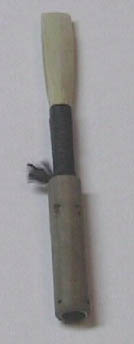
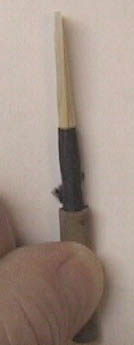
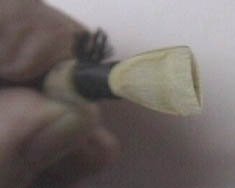
The oboe, the soprano member of the orchestral double reed family, is known for its distinctive tone color and expressive quality. The oboe has a narrow conical bore [1] with a flaring bell and a double reed mouthpiece made of opposing arc-shaped blades that beat together when producing a tone. A conical bore (unlike the cylindrical bore of the clarinet) allows for the production of every harmonic, contributing to the oboe's rich tone. From reed tip to bell, the modern oboe measures approximately 62 centimeters. The playing compass ranges from Bb3 (233 Hz) to A6 (1760 Hz).[2]
双簧管是管弦乐中双簧管族的女高音乐器,以其独特的音色和表现力而著称。双簧管有一个狭窄的圆锥形管身[1],配有扩大的喇叭口,以及由两个相对弧形片组成的双簧片,当发出声音时这两片相互敲击。圆锥形管身(不同于单簧管的圆柱形管身)允许产生所有谐波,这有助于双簧管丰富的音色。从簧片到喇叭口,现代双簧管的长度约为62厘米。演奏音域从Bb3(233 Hz)到A6(1760 Hz)[2]。
Close relatives of the oboe, sharing the same fingering system and reading the same clef, but having a bulb-shaped rather than a flaring bell, include the oboe d'amore (pitched in A, a minor 3rd lower than the oboe), the English horn or cor anglais (pitched in F, a fifth lower than the oboe) and the baritone oboe, also known as the bass oboe (pitched one octave below the oboe). The English horn is a regular member of the modern symphonic orchestra, the other two siblings are much less frequently heard there.[3] The bassoon is a bass member of the orchestral double reed family, but more a cousin than a sibling, as it has different bore and keyhole ratios, and a significantly different fingering system.
与双簧管有亲缘关系的乐器,具有相同的指法系统和调号,但其喇叭口形状不是扩张的,而是呈球状,包括音高为A的双簧管(比标准双簧管低一个小三度)、音高为F的英国管(或称为法国管,比标准双簧管低一个五度)以及音高比标准双簧管低一个八度的次男高音双簧管,也称为低音双簧管。英国管是现代交响乐团的常规成员,而另外两种乐器在交响乐团中则较少听到。[3] 低音管是管弦乐双簧管家族中的低音成员,但更像亲戚而非兄弟,因为它具有不同的管径和按键孔比例,以及显著不同的指法系统。
The breath pressure required to play oboe is considerable, ranging from 25 mmHG to as much as or over 90 mmHG. Notes that are either louder or in the upper register of the oboe require more pressure than those that are quieter or are pitched in a lower register. In comparison, the breath pressure required to play a clarinet typically ranges from 15 mmHG to a little under 45 mmHG.[4] The opening of the reed is small, typically measuring in the vicinity of 4 2/3 mm2 when at rest, though some oboists prefer reeds that are either more or less open than this.[5] As a consequence of the small aperture, and despite the high pressure used to play, very little air passes through the reed, and oboists often find themselves needing to exhale stale air prior to taking in a new breath.[6]
演奏双簧管所需的吹奏压力相当大,范围从25毫米汞柱到多达或超过90毫米汞柱。音调更响或处于双簧管高音区的音需要比 quieter 或处于低音区的音更大的压力。相比之下,演奏单簧管所需的吹奏压力通常在15毫米汞柱到略低于45毫米汞柱之间。[4] 音栓开口较小,通常在静止时测量约为4 2/3平方毫米,尽管有些双簧管演奏者更喜欢开口更大或更小的音栓。[5] 由于开口较小,尽管使用了较高的压力,通过音栓的空气量非常有限,因此双簧管演奏者常常需要在吸气前先呼出 stale 空气。[6]
Changes to either the air pressure or the reed opening size (which can be altered via the embouchure), affect volume, pitch, and timbre.[7] Because of this, learning to coordinate embouchure with breath is a key skill. One of the exercises commonly used to develop this skill is the deceptively simple task of playing a note that slowly ranges from pp to ff and back while keeping the pitch steady. This practice of playing long tones also helps the oboist develop strength and endurance.[8]
改变空气压力或哨片开口大小(可通过嘴唇控制改变),会影响音量、音调和音色。[7] 因此,学会协调嘴唇控制与呼吸是关键技能之一。一种常用来培养这一技能的练习是看似简单的任务:在保持音调稳定的情况下,缓慢地从pp到ff再回到pp演奏一个音。这种长时间演奏的练习也有助于木管乐器演奏者增强力量和耐力。[8]
The oboe reed serves as a valve, modulating the flow of air into a series of puffs. When these puffs coordinate with the standing pressure waves within the bore, continuous tones are maintained.[9] The pressure changes that result and radiate from the oboe constitute the sound that we hear. The degree of difference between the high and low pressure points in the cycle correlates to the perceived loudness. The time taken for the wave to travel from the reed to the first open key holes or bell, in combination with pitch-related properties of the reed and how it is being blown, gives us the frequency of the note. The shape of the emitted wave translates to the perceived tone, e.g., wave patterns that transition abruptly between low and high peaks will have higher frequency content than patterns that are smoother or more sinusoidal.
单簧管簧片起到阀门的作用,调节空气流入一系列气流。当这些气流与管身内的驻波协调时,可以维持连续的音调。[9] 由单簧管产生的压力变化并辐射出的声音就是我们听到的声音。高压力点与低压力点之间的差异程度决定了感知到的响度。簧片将波从簧片传到第一个开放音孔或喇叭口所需的时间,结合簧片的音调相关特性以及吹奏方式,决定了音符的频率。发出的波形决定了感知到的音调,例如,波形在低峰和高峰之间突然过渡的比那些更平滑或更正弦的波形具有更高的频率成分。
Frequency content of about 1.5 kHz and below radiates mostly out of the first two open tone holes, and to a gradually lesser extent from the remaining open tone holes. Higher frequencies radiate from all the tone holes and the bell, and in general are more directional than the lower frequencies.[10] The oboe bore's walls primarily serve as a rigid container for the standing waves, unlike a violin where the body walls are intentionally set into vibratory motion (see wood resonance).[11] Thus, when the player stops a note, the sound immediately stops, unlike an instrument with a resonant sounding box that decays gradually.[12] The air pressure waves within the bore are longitudinal, moving from end to end, rather than latitudinal, moving side-to-side as with a violin string. The pressure variations are greatest at the reed (pressure antinode) and at a minimum just outside the open tone holes (pressure node). The longitudinal standing wave interacts with the reed to lock it into a frequency that is a function of both the length of the bore and pitch-related properties of the reed.[13]
约1.5 kHz及以下的频率内容主要从第一个两个开放音孔辐射出去,随后从其余开放音孔辐射的程度逐渐减少。较高频率的声波则从所有音孔和铃铛部分辐射,总体上比低频声波更具方向性。[10] 萨克斯管管身的壁主要作为刚性容器来容纳驻波,这与小提琴不同,小提琴的共鸣箱壁是故意设置为振动的(见木头共振)。[11] 因此,当演奏者停止一个音符时,声音会立即停止,这与具有共鸣发声箱的乐器不同,后者的声音会逐渐衰减。[12] 管身内的空气压力波是纵向的,从一端传到另一端,而不是横向的,像小提琴弦那样侧向传播。压力变化最大在reed(压力波腹点)处,而在开放音孔外侧则最小(压力波节点)。纵向驻波与reed相互作用,使其锁定在由管身长度和reed与音调相关的性质共同决定的频率上。[13]
Variations in the bore shape and in the size and undercutting of the tone holes affect not just pitch and volume, but tone color and response as well. Benade (1990/1976, p. 449) describes how the different tone hole sizes and shapes result in a cutoff frequency which relates to the brightness or darkness of the tone color. He places the cutoff frequency for the oboe, with its relatively small tone holes, at about 1.5 kHz.
气筒形状的变化以及音孔大小和凹陷程度的变化不仅影响音调和音量,还影响音色和响应。Benade(1990/1976,第449页)描述了不同音孔尺寸和形状会导致一个截止频率,该频率与音色的明亮或暗淡有关。他将双簧管的截止频率,其音孔相对较小,定在约1.5 kHz。
The body material must be strong enough to support an elaborate keywork, and able to resist warping or cracking.[14] Of currently used materials, Grenadilla (Dalbergia melanoxylon), and plastic are the most common. Other options include Violetwood, Rosewood, and composites of ground grenadilla in resin, as well as the combination of wood with a plastic inner lining. A metal oboe was made in the early 1800's with a thin wall and built up tone hole cylinders, but the tone was considered inferior and production was abandoned (Burgess & Haynes, 2004, p. 143).
材料必须足够坚固,能够支撑复杂的键工工艺,并且能够抵抗变形或开裂。[14] 在目前使用的材料中,花梨木(Dalbergia melanoxylon)和塑料是最常见的。其他选项包括紫檀木、玫瑰木,以及树脂复合的花梨木,还有木材与塑料内衬的组合。19世纪初曾制造过一种金属制巴洛克管,其壁薄且有堆叠的音孔圆柱体,但音色被认为较差,生产因此被放弃(Burgess & Haynes, 2004, p. 143)。
There are differences ascribed to the different materials. However, the effect of wall materials in general, and the plastic versus wood question in particular, is not settled science. The superior sound commonly ascribed to wood over plastic oboes may reflect the particular bore and keyhole dimensions of the models being compared rather than inherent acoustic properties of plastic. For example, Loree (maker of the majority of oboes used in U.S. orchestras today) offers a plastic top joint that most consider to be on a par with its wood top joint.[15]
由于材料不同而存在差异。然而,壁材的影响,尤其是塑料与木材的对比,尚未成为定论。通常认为木材优于塑料的音质可能更多是由于所比较模型的管身和钥匙孔尺寸不同,而非塑料本身的声学特性。例如,Loree(目前美国交响乐团主要使用的木管乐器制造商之一)提供的一种塑料顶部关节,大多数人都认为其性能与木制顶部关节相当。[15]
Notes
注释
[1] "The conical semiangle for an oboe is small, typically only about 0.7 degrees..." (Fletcher & Rossing, 1998, p. 493).
双簧管的圆锥半顶角很小,通常仅约0.7度...
[2] Some oboes are fitted with an extension or keywork that allows low A3. A6 is the highest note that is playable with normal embouchure technique. A few higher notes can be obtained by putting the teeth on the reed in combination with special fingerings (Goosens & Roxburgh, 1993, pp. 168-169).
[2] 一些双簧管装有延伸件或按键,可以发出低音A3。A6是用正常嘴唇技巧可以演奏的最高音。通过将牙齿放在簧片上并配合特殊指法,可以演奏出一些更高的音(Goosens & Roxburgh, 1993, pp. 168-169)。
[3] See "The extended oboe family" (Burgess & Haynes, 2004, pp. 183-191).
[3] 参见“扩展的双簧管家族”(Burgess & Haynes, 2004, 第183–191页)。
[4] These figures (converted from kPA to mmHG) come from Fig. 15.9 in (Fletcher & Rossing, 1997, p. 483) which in turn cites data from a paper of Fuks & Sundberg from 1996. It is possible, of course, with a particularly stiff reed, to blow even harder, but at some point one reaches systolic blood pressure, and fainting becomes the likeliest outcome.
这些图(换算自kPA到mmHg)来自(Fletcher & Rossing, 1997, 第483页)中的图15.9,该图又引用了1996年Fuks与Sundberg的一篇论文中的数据。当然,如果使用特别坚硬的哨片,可以吹得更用力,但到了某个程度,就会达到收缩压,晕厥便成为最可能的结果。
[5] This estimate was obtained by measuring a number of commercial and home-made reeds. A reed is typically about 7 mm wide or slightly less, and has a separation of about 1 mm at the most open point. Both width and opening size preferences vary for different players. For a rectangle circumcising a narrow arc of a circle, the area inside the arc is approximately 2/3rds the size of the rectangle (Nederveen, 1998, p.41). Thus for the two blades we have 2 * 0.5 mm * 7 mm * (2/3)) = 4 2/3 mm^2.
[5] 这个估算值是通过测量一批商业产品和自制的芦苇得到的。通常,芦苇的宽度约为7毫米或稍小,其最大开口处的分离距离约为1毫米。不同演奏者对宽度和开口尺寸的偏好有所不同。对于一个包围圆周狭窄弧段的矩形,弧段内部的面积大约是矩形面积的2/3(Nederveen, 1998, p.41)。因此,对于两片 blades,我们有 2 * 0.5 mm * 7 mm * (2/3) = 4 2/3 mm²。
[6] This issue is discussed maybe most famously by Joseph Robinson (1996/1987) in his article "Oboists, Exhale Before Playing!" R. J. Koch (1990, pp. 5-24) devotes an entire section of an etude book to a series of progressive breathing exercises with separately designated spots for inhaling and exhaling.
这个问题可能最著名地由Joseph Robinson(1996/1987)在其文章《Oboists, Exhale Before Playing!》中讨论。R. J. Koch(1990,第5-24页)专门用一本练习曲集的一整节来介绍一系列渐进的呼吸练习,其中分别设有吸气和呼气的指定位置。
[7] Marcel Tabuteau was one of the most influential oboists in America. His students and students' students continue to dominate the profession. His teachings on the interrelationship of pitch, volume, breath and embouchure are summarized by Joseph Robinson (1996/1987). Useful additional material on this theme can be found written by Arthur Weisberg (2007/1993, pp. 3-15), and David Ledet (2000/1981, p.30). A more formal, physics-oriented description of the effect of "a tighter clamping of the reed" can be found in Nederveen (1998, p. 35).
[7] 马塞尔·塔布特是美国最具有影响力的双簧管演奏家之一。他的学生及其学生继续主导这一职业。他关于音调、音量、呼吸和嘴唇控制之间相互关系的教学被约瑟夫·罗伯逊(1996/1987)总结。有关此主题的补充材料可参见阿瑟·韦斯伯格(2007/1993,第3-15页)和戴维·莱德(2000/1981,第30页)的著作。关于“更紧的簧片夹紧”效应的更正式、以物理学为导向的描述,可参见内德维恩(1998,第35页)。
[8] Examples in oboe pedagogy include Schuring (2009, pp. 76-77) and an essay by Jay Light (1994, pp. 35-43) titled: "Long Tones - Milk for Oboists; You Never Outgrow Your Need For It."
[8] 举例来说,有关管乐教学的文献包括Schuring(2009,第76-77页)以及Jay Light(1994,第35-43页)的一篇题为『长音——管乐演奏者永远需要的营养品』的论文。
[9] Paraphrasing Benade (1990/1976, p. 430) and Nederveen (1998/1969, p. 29).
[9] 参见 Benade (1990/1976, p. 430) 和 Nederveen (1998/1969, p. 29) 的表述。
[10] See section 15.5 "Directionality" (Fletcher & Rossing, 1998, pp. 480-481). One implication is the resulting importance of reflective surfaces in a reverberant space that allow the various frequency components of the tone to blend together for the listener.
[11] Nederveen (1998, p. 94) writes that the walls do vibrate, but at a very low level: 40dB (10,000 times) less energy radiates from the walls than from the bell and open tone holes.
[11] Nederveen(1998,第94页)指出,墙壁确实振动,但振幅非常低:从墙壁辐射出的能量比从钟形管和开放音孔少40分贝(即10000倍)。
[12] An important technique for oboists (and other winds) is the ability to mimic sounding box resonances. A resonant-sounding taper, for example, can be executed with a slight constriction of the embouchure combined with a lessening of air pressure just prior to closing off the note (Weisberg, 2007/1993, pp. 33-45).
对于双簧管演奏者(及其他管乐器演奏者)来说,一个重要技巧是能够模仿共鸣箱的共振。例如,通过轻微收缩嘴唇配合在闭音前减少气压,可以实现共振效果(Weisberg, 2007/1993, pp. 33-45)。
[13] The oboe bore is a truncated cone. Benade (1990/1976, p. 469-470) writes "If the total air column is to have properly placed resonances for setting up good regimes of oscillation, it must have at least the overall behavior of a conical air column." Both Benade and Nederveen (1998/1969, p. 41) point out that the cavity within the oboe reed is too small to account for the missing apex section of the cone. Each refers to the reed as functionally substituting for this missing section. The size of the "fictitious cavity" that is mimicked by the reed is dependent not only upon the space within the reed, but on mechanical factors such as the distance that the blades must travel to close, blowing pressure, and the strength, resilience and damping properties of the cane blades.
[13] 长笛管是一个截断的圆锥体。Benade(1990/1976,第469-470页)写道:‘如果整个空气柱要具有适当放置的共振以建立良好的振动状态,它必须至少表现出一个圆锥形空气柱的整体行为。’ Benade 和 Nederveen(1998/1969,第41页)都指出,长笛哨片内部的腔体太小,无法解释圆锥体中缺失的顶点部分。两人均指出哨片在功能上替代了这一缺失的部分。所谓‘虚构腔体’的大小不仅取决于哨片内部的空间,还取决于机械因素,如哨片 blades 必须移动的距离、吹奏压力以及木片的强度、弹性和阻尼特性。
[14] While cracking remains a hazard with grenadilla and other woods, the technology for repairing cracks has advanced significantly, and is no longer considered an automatic "death blow" for an oboe.
尽管 grenadilla 和其他木材仍存在开裂的风险,但修复开裂的技术已取得显著进展,因此不再被视为双簧管的自动“致命一击”。
[15] Nederveen (1998, pp. 94-95, 134) acknowledges that different materials may have different vibrational patterns which could, possibly, impact tone and response. Certainly, many top-level musicians, and instrument makers, claim that there are differences based upon materials. But a scientific model has not yet been made that adequately explains all the reported perceptions.
[15] Nederveen(1998年,第94-95页,第134页)承认,不同材料可能具有不同的振动模式,这可能在某种程度上影响音色和响应。当然,许多顶级音乐家和乐器制造者都声称,材料确实存在差异。但尚未有科学模型能够充分解释所有报告的感知现象。
Bibliography
参考文献
Benade, A. H. (1990). Fundamentals of Musical Acoustics, Second, Revised Edition. New York, NY: Dover Publications, Inc. (Original work published 1976).
Benade, A. H. (1990). 基础音乐声学,第二版,修订版. 纽约,NY: Dover Publications, Inc. (原版出版于1976年)。
Burgess, G., & Haynes, B. (2004). The Oboe. New Haven, CT, and London, UK.: Yale University Press.
Burgess, G., & Hayes, B. (2004). The Oboe . New Haven, CT, and London, UK.: Yale University Press.
Fletcher, N. H., & Rossing, T. D. (1998). The Physics of Musical Instruments, 2nd Edition. New York, NY: Springer Science+Business Media, Inc.
Fletcher, N. H., & Rossing, T. D. (1998). 物理学中的音乐乐器,第二版. 纽约,纽约:Springer Science+Business Media, Inc.
Goosens, L., & Roxburgh, E. (1993). Yehudi Menuhin Music Guides: Oboe. London, UK.: Kahn & Averill.
Goosens, L., & Roxburgh, E. (1993). Yehudi Menuhin Music Guides: Oboe. 英国伦敦:Kahn & Averill.
Koch, R. J. (1990). Technik des Oboenspiels: The Technique of Oboe Playing. Mainz, Germany: Schott.
Koch, R. J. (1990). 技术与双簧管演奏: 双簧管演奏的技术。德国美因茨: Schott.
Ledet, D. A. (2000). Oboe Reed Styles, Theory and Practice. Bloomington, IN: Indiana University Press. (Original work published 1981).
Ledet, D. A. (2000). 音管哨笛簧片风格,理论与实践 . 印第安纳州布卢明顿: 印第安纳大学出版社。 (原版出版于1981年。)
Light, J. (1994). Essays for Oboists. Fort Myers, FL: Alborada Publications.
光,J. (1994). 为长笛演奏者写的散文。佛罗里达州弗ort迈尔斯:Alborada出版社。
Nederveen, C. J. (1998). Acoustical Aspects of Woodwind Instruments, Revised Edition. DeKalb, IL: Northern Illinois University Press. (Original work published 1969).
Nederveen, C. J. (1998). 木管乐器的声学特性,修订版. 德Kalb, IL: 北方伊利诺伊大学出版社. (原版出版于1969年。)
Robinson, J. (1996). Oboists, Exhale Before Playing, The Double Reed, Vol. 19, No. 3, International Double Reed Society (Original paper published in DR 10, #3, 1987, pp. 16-19).
Robinson, J. (1996). 吹管乐演奏者应在演奏前呼气,《双簧管乐器》, 第19卷第3期,国际双簧管乐器协会 (原载于DR 10, #3, 1987, pp. 16-19)。
Schuring, M. (2009). Oboe, Art & Method. New York, NY: Oxford University Press.
Schuring, M. (2009). 长笛、艺术与方法. 纽约, NY: 哥伦比亚大学出版社。
Weisberg, A. (2007). The Art of Wind Playing. Delray Beach, FL: Meredith Music. (Original work published 1993).
Weisberg, A. (2007). 《风笛演奏艺术》. 弗吉尼亚州德尔雷海滩: Meredith Music. (原版出版于1993年。)
[10] 参见第15.5节‘方向性’(Fletcher & Rossing, 1998, 第480-481页)。一个结果是,在允许不同频率成分混合的回声空间中,反射表面的重要性凸显出来。 |