Algebraic Properties of Real Numbers实数的代数性质
The basic algebraic properties of real numbers a,b and c are: 实数 a、b 和 c 的基本代数性质为:
1. Closure: a + b and ab are real numbers2. Commutative: a + b = b + a, ab = ba 3. Associative: (a+b) + c = a + (b+c), (ab)c = a(bc) 4. Distributive: (a+b)c = ac+bc 5. Identity: a+0 = 0+a = a 6. Inverse: a + (-a) = 0, a(1/a) = 1 7. Cancelation: If a+x=a+y, then x=y 8. Zero-factor: a0 = 0a = 0 9. Negation: -(-a) = a, (-a)b= a(-b) = -(ab), (-a)(-b) = ab
1. 闭合性:a + b 和 ab 都是实数 2. 交换性:a + b = b + a, ab = ba 3. 结合性:(a+b) + c = a + (b+c), (ab)c = a(bc) 4. 分配性:(a+b)c = ac+bc 5. 单位元:a+0 = 0+a = a 6. 逆元:a + (-a) = 0, a(1/a) = 1 7. 消去性:如果 a+x = a+y,则 x=y 8. 零因子:a0 = 0a = 0 9. 取反:-(-a) = a, (-a)b = a(-b) = -(ab), (-a)(-b) = ab |
Index
索引 | ||
|
Go Back
返回 |
Algebraic Combinations代数组合
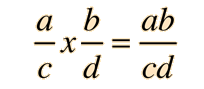
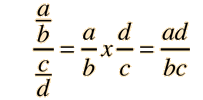
Factors with a common denominator can be expanded:![]() Fractions can be added by finding a common denominator: ![]() Products of fractions can be carried out directly: ![]() Quotients of fractions can be evaluated by inverting and multiplying: ![]() 具有共同分母的因数可以展开:分数可以通过找到共同分母进行加法运算:分数的乘积可以直接进行运算:分数的商可以通过取倒数再相乘来计算: |

Index
索引 | ||
|
Go Back
返回 |
Algebraic Equations代数方程
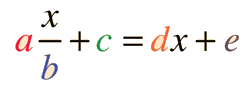
The role of a basic algebraic equation is to provide a formal mathematical statement of a logical problem. A first order algebraic equation should have one unknown quantity and other terms which are known. The task of solving an algebraic equation is to isolate the unknown quantity on one side of the equation to evaluate it numerically. Using x as the unknown and other letters to represent known quantities, consider the following example equation: 基本代数方程的作用是用正式的数学语句表述一个逻辑问题。一个一阶代数方程应包含一个未知量和其他已知的项。解代数方程的任务是将未知量孤立到方程的一边,以便进行数值计算。使用x作为未知量,其他字母表示已知量,考虑以下示例方程:
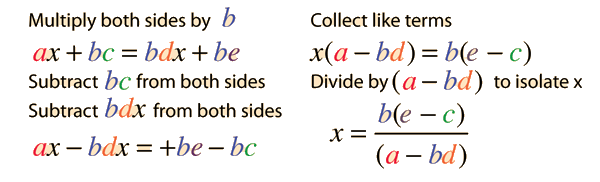
![]() The strategy for solving this equation is the repeated application of the golden rule of algebra to collect like terms and isolate the quantity x on one side of the equation. 解这个方程的策略是反复应用代数的黄金法则,将同类项合并,从而将量x孤立到方程的一边。
![]()
|
Index
索引 | ||
|
Go Back
返回 |
Algebra Practice Equation代数练习方程
Solving a basic algebraic equation involves repeated applications of the golden rule of algebra to isolate the unknown quantity on one side of the equation. Using x as the unknown and other letters to represent known quantities, consider the following example equation:
![]() ![]() Note that there are a number of circumstances where a solution does not exist. If b=0, then the first term is infinite, so the calculation defaults to the value b=1 if no value of b is entered in order to avoid this condition for an infinity. Any set of values for which a=bd will also give an infinity, as can be seen from the expression for x above. 需要注意的是,在某些情况下,解可能不存在。如果b=0,那么第一个项会是无限大的,因此计算会默认使用b=1的值,以避免出现这种无限大的情况。任何满足a=bd的数值组合也会导致无限大,这可以从上面x的表达式中看出。
解一个基本的代数方程涉及反复应用代数的黄金法则,以将未知量孤立到方程的一边。使用x作为未知数,其他字母表示已知量,考虑以下示例方程: 中文译文中的待填/计算数值依次对应:1:a 2:b 3:c 4:d 5:e 6:f。实际数值以上方原输入框为准。 |
Index
索引 | ||
|
Go Back
返回 |
Golden Rule of Algebra代数的黄金法则
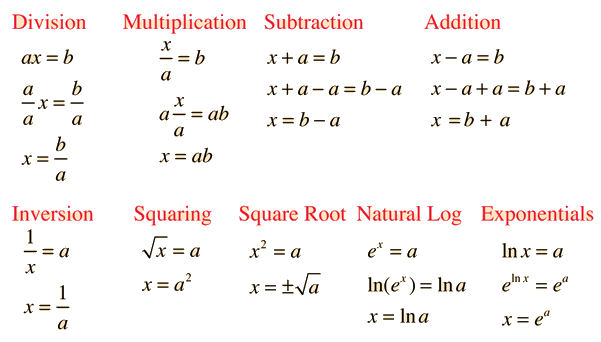
Any mathematical operation can be performed on one side of an equation so long as the identical operation is performed on the other side of the equation.只要在等式的两边进行相同的数学运算,任何数学运算都可以在等式的一边进行。
The solution of basic algebraic equations is accomplished by applying this rule repeatedly in order to isolate the unknown quantity and evaluate it. The application of this rule - proceeding by doing clear symmetric operations on the two sides of an equation - can help avoid most common mistakes in solving algebraic equations. 通过反复应用这一规则,可以解决基本的代数方程,从而将未知量孤立出来并求解。对等式两边进行清晰对称操作的应用,可以帮助避免大多数解代数方程时的常见错误。
|
Index
索引 | ||
|
Go Back
返回 |