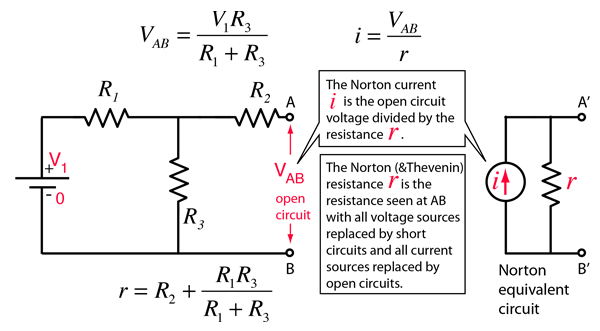
Norton's Theorem诺顿定理
Any collection of batteries and resistances with two terminals is electrically equivalent to an ideal current source i in parallel with a single resistor r. The value of r is the same as that in the Thevenin equivalent and the current i can be found by dividing the open circuit voltage by r. 任何具有两个端点的电池和电阻的组合在电气上等效于一个理想电流源i与一个电阻r并联。r的值与Thevenin等效电路中的相同,电流i可以通过开路电压除以r来计算。
![]()
|
Index DC Circuits 索引:直流电路 | ||||
|
Go Back
返回 |
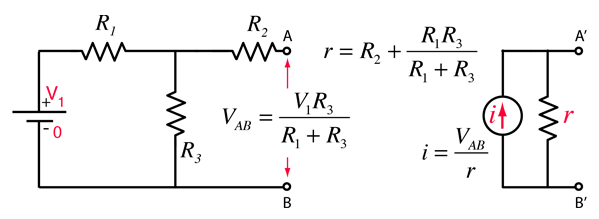
Norton Current诺顿电流
The value i for the current used in Norton's Theorem is found by determining the open circuit voltage at the terminals AB and dividing it by the Norton resistance r. 用于诺顿定理的电流值i是通过确定AB端口的开路电压并将其除以诺顿电阻r来确定的。
![]()
|
Index DC Circuits 索引:直流电路 | |||
|
Go Back
返回 |
Norton Example诺顿示例
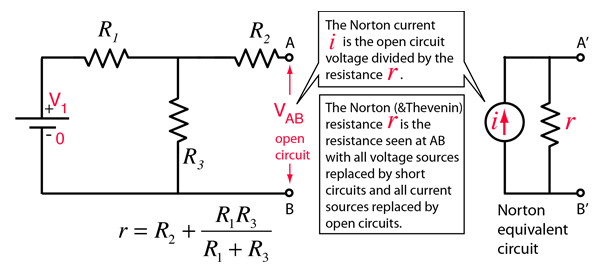
Replacing a network by its Norton equivalent can simplify the analysis of a complex circuit. In this example, the Norton current is obtained from the open circuit voltage (the Thevenin voltage) divided by the resistance r. This resistance is the same as the Thevenin resistance, the resistance looking back from AB with V1 replaced by a short circuit.
将网络替换为其诺顿等效电路可以简化复杂电路的分析。在这个例子中,诺顿电流是通过开路电压(即诺顿电压)除以电阻 r 得到的。这个电阻与诺顿电阻相同,即从 AB 看向的电阻,当 V 1 用短路代替时的电阻。 中文译文中的待填/计算数值依次对应:1:et 2:rt 3:ni。实际数值以上方原输入框为准。 |
Index DC Circuits 索引:直流电路 | ||
|
Go Back
返回 |