Bilingual edition: English is preserved and Chinese follows each unit. Terminology uses the confirmed v20260916 glossary; automated semantic review remains traceable.
中英双语版:英文原文完整保留,中文紧随对应单元;术语采用 v20260916 确认表,自动语义审校结果可追溯。

Force Equilibrium Example

力的平衡示例

Force equilibrium problems like this can be analyzed by drawing a free-body diagram of the point of attachment of the mass m, since it must be at equilibrium. The tensions should be resolved into horizontal and vertical components to apply the force equilibrium condition.

这类力平衡问题可以通过绘制质量m的连接点的受力图进行分析,因为该点必须处于平衡状态。张力应分解为水平和垂直分量,以便应用力平衡条件。
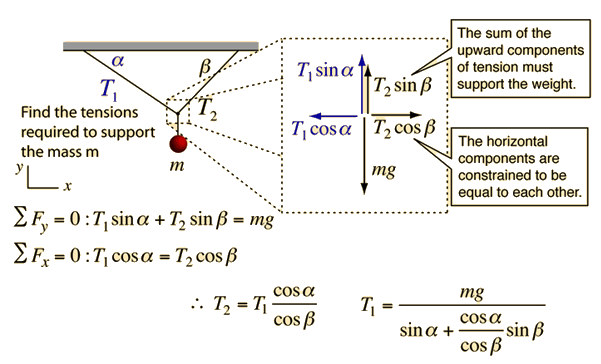
An object of mass kg and weight N can be supported by the following combination of tensions and angles of cables:

一个质量为kg、重量为N的物体可以由以下缆绳的张力和角度的组合来支撑:
中文译文中的待填/计算数值依次对应:1:m 2:w。实际数值以上方原输入框为准。
Tension T1 =N, α = degrees
张力 T₁ = N,α = 度
中文译文中的待填/计算数值依次对应:1:t1 2:alpha。实际数值以上方原输入框为准。
Tension T2 = N, β =degrees
张力 T 2 = N,β = 度
中文译文中的待填/计算数值依次对应:1:t2 2:beta。实际数值以上方原输入框为准。
You may explore the effect of changing the angles upon the required tensions in the cables. Making both angles smaller will increase the required tensions. Why is that?
你可以探索角度变化对缆绳所需张力的影响。将两个角度都减小会增加所需的张力。为什么会出现这种情况?
Index

Force equilibrium examples
索引 力 平衡示例
 
HyperPhysics***** Mechanics
力学
R Nave
Go Back
返回