Impact Force from Falling Object
从坠落物体产生的力
Even though the application of conservation of energy to a falling object allows us to predict its impact velocity and kinetic energy, we cannot predict its impact force without knowing how far it travels after impact.
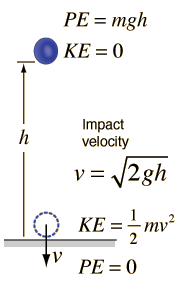 |
若一个质量为 m=kg 的物体从高度 h=m 处下落,则撞击前的速率为 v=m/s。撞击前的动能等于其从下落高度处的引力势能:K.E.=J。但仅凭此无法计算撞击力!如果此外还知道撞击后物体移动的距离为 d=m,则可利用功-能原理计算出平均撞击力:平均撞击力 = F=N。 中文译文中的待填/计算数值依次对应:1:m 2:h 3:v 4:ke 5:d 6:f。实际数值以上方原输入框为准。 |
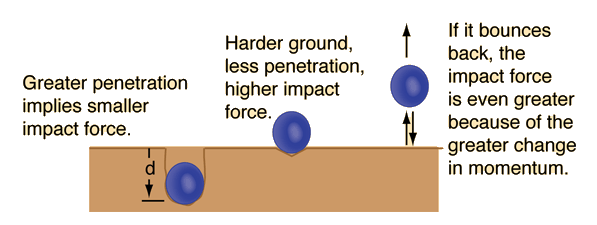
Note that the above calculation of impact force is accurate only if the height h includes the stopping distance, since the process of penetration is further decreasing its gravitational potential energy.
需要注意的是,上述冲击力的计算仅在高度h包括停止距离时才是准确的,因为穿透过程进一步减少了其重力势能。
The average impact force calculated here is the average over distance, which can be presumed to be proportional to, but not the same as, the average over time.
这里计算的平均冲击力是在距离上的平均值,可以假设它与时间上的平均值成正比,但并不相同。
尽管将能量守恒定律应用于下落物体可以预测其撞击速度和动能,但要预测其撞击力,必须知道物体撞击后移动的距离。
索引
| HyperPhysics***** Mechanics
力学 | R Nave |
返回