Geiger Counter
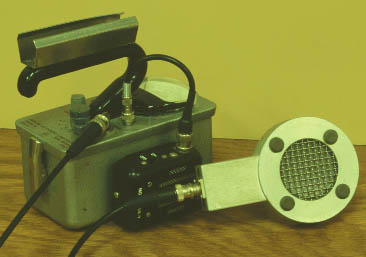
The meter shown is a sensitive survey meter which is used in a research lab to detect low levels of radiation. Geiger counters are ionization detectors which operate at a high voltage, in the region where an avalanche pulse is produced by a single event.
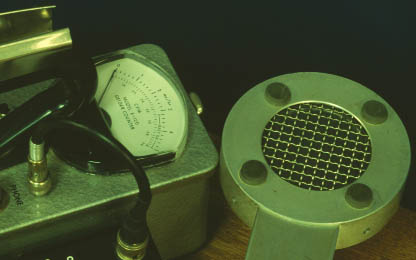
This is a closer view of the scale and the detector head. A thin molybdenum window is often used on the detector heads.
A typical configuration for Geiger counters has been a wire on the centerline of a cylinder. A high voltage is maintained between the wire and the cylinder. When a high energy particle enters the cavity and ionizes a few air molecules, the free electrons are accelerated strongly toward the wire. In the process, those electrons ionize many more air molecules, producing a current pulse. Survey meters like the one shown often convert the current pulses into audible clicks, producing the sound popularly associated with Geiger counters.
| Radiation detection
辐射检测 |
| HyperPhysics***** Nuclear
HyperPhysics ***** 核物理 | R Nave |