Sodium and Hydrogen/Deuterium DoubletsA Fabry-Perot interferometer is used to separate the spectral lines of hydrogen from those of deuterium. The expected interference fringe pattern from a single spectral line is a "bullseye" of concentric light and dark rings. If another spectral line is present, a series of independent darker and lighter concentric rings can be seen. The appearance of these rings depends upon the separation of the elements of the interferometer, i.e., the thickness of the air film between the surfaces. Appropriate data can then yield the separation of the spectral wavelengths. Since the measurement of the H/D doublet requires a well-aligned interferometer, it is good practice to align the spectrometer and measure the sodium doublet as preparation for the H/D measurement. The recommended experimental procedure below offers some helpful steps in the process. Measurement of the small H/D doublet requires high resolvance with the Fabry-Perot interferometer, so the following steps are recommended. 1. Carefully align the mirrors with the aid of a helium-neon laser. 2. Measure the separation of the sodium doublet. 3. Carefully optimize the fringes for the H/D doublet and make several measurements of the wavelength separation.
|
Index | |
| HyperPhysics***** Class Home ***** Physics 3901 | Go Back |
Equipment NeededFabry-Perot interferometerHeavy metal base for mounting Sodium light and helium-neon laser for test sources Hydrogen and deuterium spectrum tubes Spectrum power supply. Colored filters, red and blue (the red hydrogen interference filter is good for the red lines) Lab jacks Small lamp so room can be kept dark magnifying lens for viewing fringes Operating instructions for the M4 Spectrometer, Cenco Company Bulletin GB163-73A from Gaertner, which describes their Modular Interferometer (the one used in this experiment) Ground glass to aid focusing of line source (spectrum tube) Masking tape |
Index |
| HyperPhysics***** Physics 3901 ***** H/D Doublet | Go Back |
Sodium Doublet MeasurementMeasurement of the sodium doublet with the Fabry-Perot interferometer is good preparation for the more difficult hydrogen/deuterium doublet measurement. Some of the steps involved are: 1. Align the mirrors with use of He-Ne laser. 2. Place sodium lamp on side opposite micrometer screw. This extended source can be used directly, so that no condensing lens or ground glass screen is needed. Adjust the interferometer until you can see the bullseye interference pattern. 3. The doublet produces two bullseye patterns which overlap. One line of the doublet is twice as intense as the other, so that pattern is brighter. By moving the micrometer screw in one direction only to avoid the backlash problem, find a point where the dimmer bullseye lines are halfway between the brighter ones. Make a measurement. 4. Being carefull to turn the micrometer consistently in the same direction, advance the micrometer until you reach the next point at which the dimmer bullseye lines are at the halfway point and make another measurement. 5. Using the fact that you have now advanced one set of fringes one full order compared to the other, calculate the wavelength separation. |
Index |
| HyperPhysics***** Physics 3901 ***** H/D Doublet | Go Back |
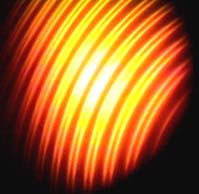
Sodium Doublet on Fabrey-PerotThe image below shows the appearance of the interference fringes of the sodium doublet produced by Fabry-Perot optics. This is the appearance at one position.
|
Index | |||
| HyperPhysics***** Physics 3901 ***** H/D Doublet | Go Back |
Optimizing H/D FringesMeasurement of the H/D doublet is a difficult task and requires an optimized Fabry-Perot Interferometer. The following are helpful experimental steps. 1. Use a spectra tube with a mixture of hydrogen and deuterium. Although such a tube should not be left on at maximum intensity for long periods, it will be helpful to have maximum brightness during your actual measurements. Darkening the room as much as possible will help. 2. Using a piece of ground glass clamped in the mirror stand closest to the spectral tube will spread the light and help make the fringes visible. Without the ground glass, you tend to just see the shape of the spectral tube and it is difficult to see the fringes. 3. Use the interference filter which is centered on the hydrogen red line to eliminate other light. It can be mounted on a threaded rod. |
Index |
| HyperPhysics***** Physics 3901 ***** H/D Doublet | Go Back |
H/D DoubletAt first glance it would appear that hydrogen and deuterium would have identical spectra since the energy levels are determined by the electromagnetic force and would not appear to depend upon nuclear mass. There is a slight effect, however, caused by the fact that the nucleus about which the electron orbits is not an infinite mass. The Bohr model of the atom predicts that transitions will occur by electron transition between energy levels, leading to wavelengths: ![]() where m is the mass of the electron. However, since the nucleus has finite mass, this should be replaced by the reduced mass: |
Index |
| HyperPhysics***** Physics 3901 ***** H/D Doublet | Go Back |
Data Collection for DoubletsWhen two closely spaced doublets exist in the light falling on the Fabrey-Perot mirrors, the interference pattern will be a superposition of two interference patterns. If this pattern is observed and the micrometer screw advanced to move one of the mirrors, you can find a position where the rings due to the weaker line are halfway between those of the stronger line. The procedure is then: |
Index |
| HyperPhysics***** Physics 3901 ***** H/D Doublet | Go Back |
Setting Up the MirrorsThe pair of mirrors which make up the adjustable Fabry-Perot interferometer are on separate magnetic bases which are mounted to a large steel plate. Care must be taken to not bump the mirrors together. A reasonable procedure is as follows: 1. Attach one of the mirrors to the steel plate using its magnetic base. |
Index |
| HyperPhysics***** Physics 3901 ***** H/D Doublet | Go Back |
Making Mirrors ParallelOnce you have done the initial mirror setup for the Fabry-Perot interferometer, adjust the mirrors to be parallel by the following procedure: 1. Set up a helium-neon laser on a lab jack so that it shines through the mirror pair from the side opposite the micrometer adjustment. 2. Turn the adjustment screws until only one point of light is seen leaving the mirror pair. This happens only when the mirrors are parallel. When the mirrors are not parallel, you see a series of bright red dots. As you adjust the screws (two on each mirror), you can get the red dots to converge to one red dot. You also get some much fainter multiple reflection red dots, which will be there even when adjusted to parallel by the above procedure. |
Index |
| HyperPhysics***** Physics 3901 ***** H/D Doublet | Go Back |
Mirror CareThe mirrors of the Fabrey-Perot interferometer are optically flat, half silvered mirrors. The performance of the interferometer depends upon the optical quality of the surfaces. They should never be touched or cleaned with anything except a soft lens brush to brush away dust. Take care not to bump the mirrors during mirror setup. Leave the mirrors a conservative distance apart, align them with a laser, and then bring them closer together using the micrometer screw. |
Index |
| HyperPhysics***** Physics 3901 ***** H/D Doublet | Go Back |
Micrometers and the Backlash ProblemMicrometers typically advance 0.5 mm in one turn of the micrometer head. If that head is divided into 50 divisions, then each division on the head corresponds to 0.01 mm or ten micrometers. Obtaining accurate measurements with a micrometer requires that the head is moved in only one direction during a measurement, because considerable error is introduced by reversing the screw. The slack in the mechanism is considerably larger than 0.01 mm, and the error introduced by reversing the screw is called "backlash error". The micrometer threads are very fine and of high precision, so they should be treated very carefully. Use a gentle, steady torque to rotate the head and never force it. Even a momentary backturn can introduce error, so be careful to apply torque always in the same direction. |
Index |
| HyperPhysics***** Physics 3901 ***** H/D Doublet | Go Back |

