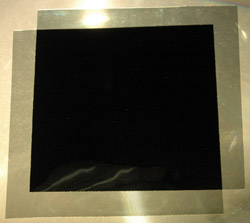
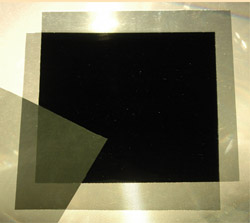
Crossed Polarizers
交叉偏振器
 | An ideal polarizer produces linearly polarized light from unpolarized light. Two ideal polarizers would eliminate all light if their transmission directions are placed at right angles. The two sheets of polaroid at left are crossed and placed on an overhead projector. Polaroid is not an ideal polarizer, so some light is transmitted even when the sheets are crossed. 理想偏振片可以从非偏振光中产生线偏振光。如果两个理想偏振片的透光方向相互垂直,那么它们会完全阻挡所有光。图中左侧的两个偏振片是交叉放置在投影仪上的。偏振片并不是理想的偏振片,因此即使两片交叉放置时,仍会有部分光通过。 |

Polaroid materials accomplish polarization by dichroism. At angles other than 90°, the transmitted intensity is given approximately by the Law of Malus.
偏振片通过双折射实现偏振。在非90°的角度下,透射光强近似由马吕斯定律给出。
| What happens if you put a third polarizer at 45° between them?
如果你在它们之间放置一个第三块偏振片,角度为45°,会发生什么? |
Polarization concepts
索引偏振概念
| HyperPhysics***** Light and Vision
HyperPhysics ***** 光与视觉 | R Nave |
返回