Galaxy Evolution Explorer (GALEX)
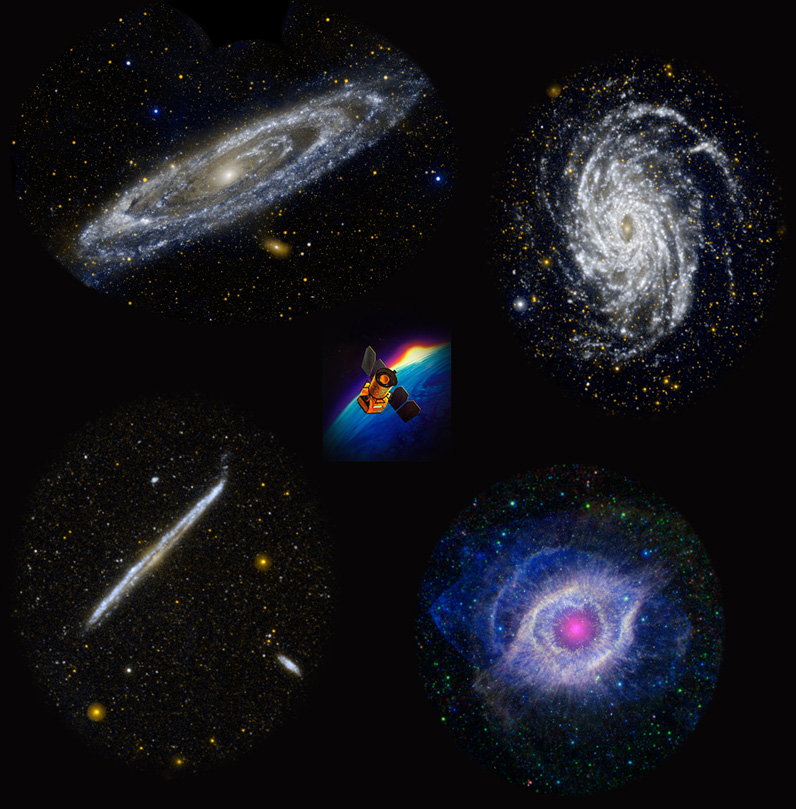
Galaxy Evolution Explorer (GALEX) operated for a decade in which the venerable space telescope used its ultraviolet vision to study hundreds of millions of galaxies across 10 billion years of cosmic time. "GALEX is a remarkable accomplishment," said Jeff Hayes, NASA's GALEX program executive in Washington. "This small Explorer mission has mapped and studied galaxies in the ultraviolet, light we cannot see with our own eyes, across most of the sky." Galex was decommissioned on June 28, 2013.
GALEX was launched using a Pegasus rocket which itself rode aloft on an L-1011 jumbo jet named Stargazer. Pegasus rockets are very small and can carry only a small spacecraft of mass less than 450 kilograms (1000 pounds weight). GALEX had a mass of only 280 kilograms (617 pounds). Stargazer takes the Pegasus up to about 12 kilometers (40,000 feet), about its maximum altitude. When released, Pegasus falls freely for a few seconds, waiting for the plane to get out of the way. Then Pegasus fires its first stage engine and heads for space, ferrying the spacecraft the rest of the way to Earth orbit. Once separated from the Stargazer, it took Pegasus only about 10 more minutes to boost GALEX all the way to orbit.
Sources:
Galex overview
Astronomical Instruments
| HyperPhysics********** Astrophysics
HyperPhysics ********** 天体物理学 | R Nave |