Moon Craters
The current story of the surface of the Moon is that of a heavily cratered surface. From the nature and appearance of these craters we can piece together part of the story of the Moon's history.

NASA Image
This is an oblique view of lunar farside photographed from the Apollo 11 spacecraft in lunar orbit on July 16, 1969. The view is looking southwest. The large crater in the center of the picture is International Astronomical Union crater (IAU) no. 308, which is located at 179 degrees east longitude and 5.5 degrees south latitude. IAU crater no. 308 has a diameter of about 50 statute miles. The ruggted terrain seen here is typical of the farside of the Moon (from the original NASA caption released with the image.)
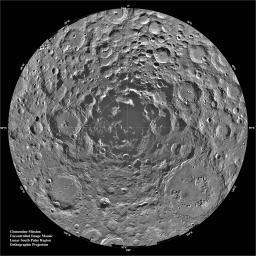 South Polar Image 南极极图像 | 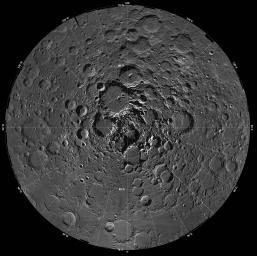 North Polar Image 北极图像 |
At left above is an image of the South polar region of the Moon constructed from about 1500 Clementine images. The projection is orthographc, centered on the south pole. The Schrodinger Basin (320 km in diameter) is located in the lower right of the mosaic. Amundsen-Ganswindt is the more subdued circular basin between Schrodinger and the pole. The polar regions of the moon are of special interest because of the postulated occurrence of ice in permanently shadowed areas. The south pole is of greater interest because the area that remains in shadow is much larger than that at the north pole.
At right above is a similar lunar mosaic of ~1500 Clementine images of the north polar region of the moon. The projection is orthographic centered on the north pole. The north pole of the moon is absent of the very rugged terrain seen at the south pole. These descriptions are excerpted from the original NASA captions released with the images.
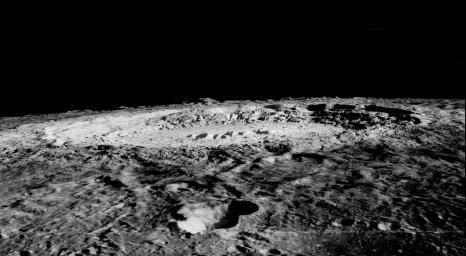
This image shows the limb of the Copernicus Impact Crater and was made by Lunar Orbiter II. Its creation date is listed as June 1, 1991. Copernicus is 93 km wide and is located within the Mare Imbrium Basin, northern nearside of the Moon (10 degrees N., 20 degrees W.). The image shows crater floor, floor mounds, rim, and rayed ejecta. Rays from the ejecta are superposed on all other surrounding terrains which places the crater in its namesake age group: the Copernican system, established as the youngest assemblage of rocks on the Moon (Shoemaker and Hackman, 1962, The Moon: London, Academic Press, p.289- 300). (From the original NASA caption released with the image.)

NASA Image from Apollo 8 Spacecraft
This rightly-rayed crater on the farside of the moon was photographed by Apollo 8 on December 24, 1968.The imaged area is near the subsolar point, where the sun was directly overhead as seen from the Apollo 8 spacecraft. Brightly-rayed craters are numerous on the lunar frontside; however, they had not been previously observed in such detail on the farside (excerpted from the original NASA caption released with the image.)
 NASA Image NASA 图像 |
Hubble Shoots the Moon. Views of the Copernicus impact crater. 哈勃拍摄月球。哥白尼撞击坑的视图
|
NASA's Hubble Space Telescope was aimed at one of the Moon's most dramatic and photogenic targets, the 58 mile-wide (93 km) impact crater Copernicus. The image creation date is listed as April 16, 1999 and the instrument was the Wide Field Planetary Camera 2. The image was taken while the Space Telescope Imaging Spectrograph (STIS) was aimed at a different part of the moon to measure the colors of sunlight reflected off the Moon. Hubble cannot look at the Sun directly and so must use reflected light to make measurements of the Sun's spectrum. Once calibrated by measuring the Sun's spectrum, the STIS can be used to study how the planets both absorb and reflect sunlight. The Moon is so close to Earth that Hubble would need to take a mosaic of 130 pictures to cover the entire disk. The upper left picture is a ground-based one from Lick Observatory. It shows the area covered in Hubble's photomosaic with the Wide Field Planetary Camera 2. In the center image, Hubble's crisp bird's-eye view clearly shows the ray pattern of bright dust ejected out of the crater over one billion years ago, when an asteroid larger than a mile across slammed into the Moon. Hubble can resolve features as small as 600 feet across in the terraced walls of the crater, and the hummock-like blanket of material blasted out by the meteor impact. The lower right image is a close-up view of Copernicus' terraced walls. Hubble can resolve features as small as 280 feet across. This description is excerpted from NASA's original picture captions. Further image credits listed: PHOTO NO.: STScI-PRC99-14 Credit: John Caldwell (York University, Ontario), Alex Storrs (STScI), and NASA.
Moon Concepts
Solar System Illustration
Solar System Concepts
| HyperPhysics********** Astrophysics
HyperPhysics ********** 天体物理学 | R Nave |