Retrograde Motion of Mars
Arising from the nature of the orbits of Earth and Mars around the Sun, there are times when Mars appears to be traveling backward for a short time compared to the "fixed stars". Below are NASA/JPL-Caltech illustrations from http://mars.jpl.nasa.gov/allabout/nightsky/nightsky04.html
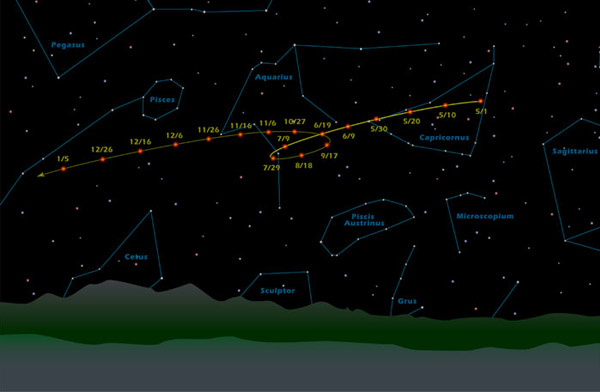
Looking up in the sky each night at the same time, you would usually observe that Mars is a little further east each night compared to the constellations. But about every two years there are a couple of months when Mars appears to move from east to west when observed at the same time (retrograde motion). The above is the pattern as observed in 2003.
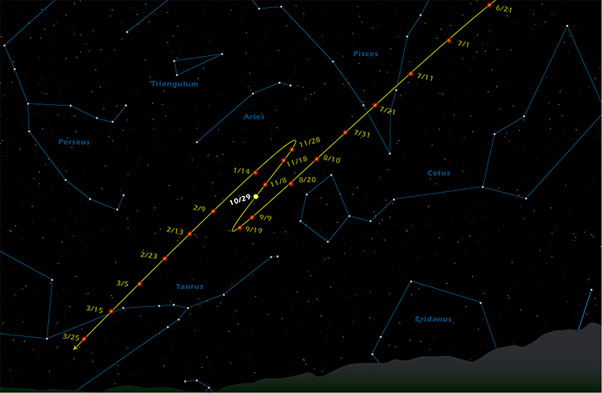
This is the apparent path of Mars during 2005 when it exhibited retrograde motion over about a two month period.
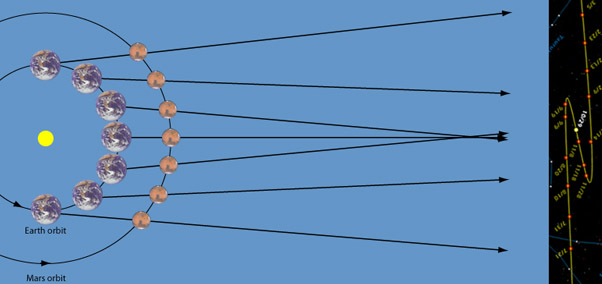
This backward or retrograde motion was mysterious to the early observers, and led to the use of the word "planet", from the Greek term which means "wanderer". With our current understanding that the Earth travels around the Sun in 1 year while the more distant Mars has a siderial period of 1.88 Earth years, it is clear that the Earth will periodically "catch up" to its more distant neighbor. As the Earth moves forward in its orbit, Mars will appear to slip backward compared to its more common eastward march across the sky.
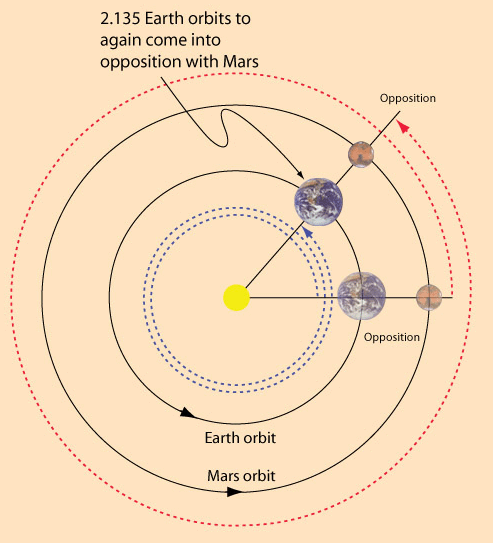
From one time that the Earth and Mars are on a line through the Sun (called being in "opposition") to the next opposition is 2.135 Earth orbits. It is in a short period including the time of opposition when Mars exhibits its retrograde motion to an observer on the Earth. The time period between oppositions is called the synodic period.
Solar System Illustration
Solar System Concepts
Mars Concepts
Reference
Carroll & Ostlie
Ch 1
| HyperPhysics********** Astrophysics
HyperPhysics ********** 天体物理学 | R Nave |