Beats with two tone generators
Two tunable tone generators were constructed to demonstrate beats.
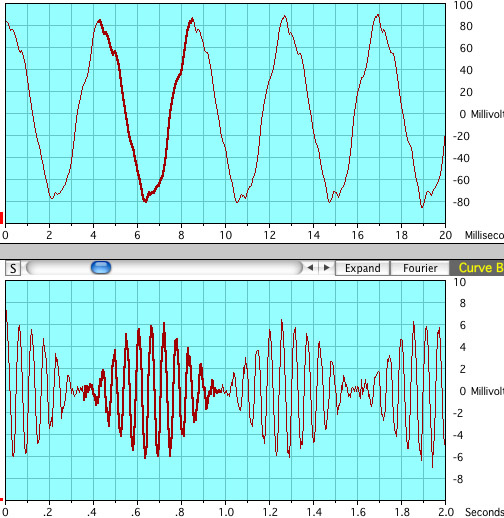
The tone generators were tuned to essentially the same pitch and then one was slowly tuned up or down. The result was a strong pulsating tone, the pulsations becoming more rapid as you tune farther away either upward or downward in pitch. The two displays above show the combined tones on a fast sweep to show the wave shape, and on a much slower sweep to show the rising and falling amplitude of the combined sounds.
Click on the player at right to play the tone which produced the above display. The composite tone has a frequency of about 238 Hz. The time between minima is about 0.62 seconds, corresponding to a beat frequency of about 1.6 Hz. This implies that the two tones were 1.6 Hz apart in frequency. 点击右侧的播放器播放产生上述显示的音调。复合音的频率约为238 Hz。两个波谷之间的时间约为0.62秒,对应一个拍频约为1.6 Hz。这表明两个音调的频率相差约1.6 Hz。 |
|

The above sound amplitude trace shows the beat phenomenon as one tone generator is tuned upward in pitch.
Click on the player at right to play the sound of the tone generators as one is tuned upward while the other remains at its original pitch. 点击右侧的播放器,聆听当一个音调发生器调高音调时,另一个保持原音调的声音。 |
|
Hearing concepts
Traveling wave concepts
| HyperPhysics***** Sound
HyperPhysics ***** 声音 | R Nave |