London Police Whistle
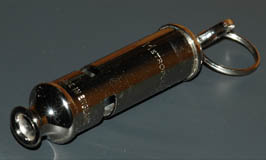
A London police whistle produces a sound with two high pitches and a lower third pitch, which is a good example of the production of subjective tones. Within the compact whistle are two short pipes which produce two separate high frequencies when blown.
 |
These two high frequency tones interfere with each other and produce a beat frequency. The beat frequency is equal to the difference between the frequencies of the two tones and is perceived by the human ear as a third tone, called a "subjective tone" or "difference tone".
这两个高频音相互干涉,产生一个拍频。拍频等于两个音的频率之差,并被人类听觉感知为一个第三音,称为‘主观音’或‘差频音’。 |
The image below is the beat pattern produced by the whistle when both pipes are sounded simultaneously, producing a unique and piercing three-note sound.
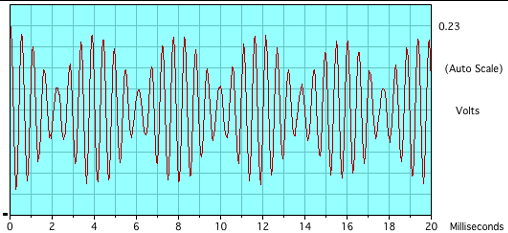
Measurement of the pattern gives a time between minima of about 3.89 ms, corresponding to a difference frequency of about 258 Hz between the two tones.
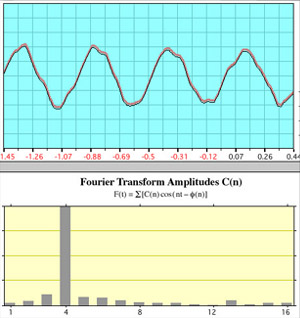 | Whistle A哨子 A Labeling the two pipes of the whistle A and B, the illustration at left shows the sound of Whistle A alone. The top graph is the ordinary display of signal voltage from the microphone vs time. The bottom graph is the fast Fourier transform (FFT) of that signal. It shows that most of the power is at one frequency, approximating a sine wave. The fact that the peak showing most of the power is at position four just reflects the fact that four periods were chosen for the FFT sample, 给哨子的两个管子标上A和B,左边的示意图显示了仅用Whistle A发出的声音。顶部的图是麦克风接收到的信号电压随时间的变化普通显示。底部的图是该信号的快速傅里叶变换(FFT)。它显示大部分的功率集中在某一频率,近似于正弦波。峰值显示大部分功率位于位置四,这仅仅反映了FFT样本中选择了四个周期。 |
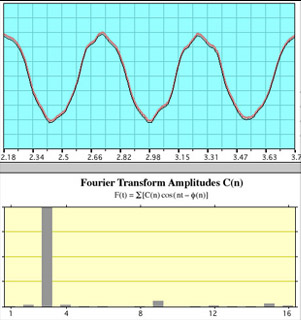 | Whistle B哨声 B This is the same kind of display with whistle B alone. Three periods were chosen for the FFT this time, resulting in a main peak at position 3. 这种显示与仅使用哨子B的情况相同。这次FFT选择了三个周期,结果在位置3处出现主峰。 |
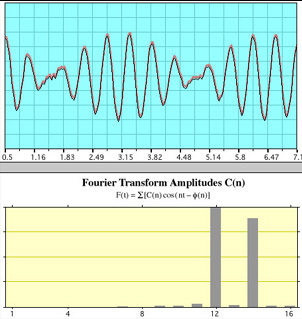 | Whistles A and B哨音A和B When whistles A and B are sounded simultaneously the time plot shows the characteristic beat frequency pattern. The FFT shows the two distinct frequencies of the individual pipes. 当A和B号哨子同时吹响时,时间图显示了典型的拍频模式。FFT显示了两个独立管乐器的 distinct 频率。 |
The interpretation of these illustrations would appear to be straightforward: two pure tones sounded simultaneously give a beat frequency which is the difference tone between the two frequencies. But experimentally the frequency of whistle A was 2168 Hz and that of whistle B was 1843 Hz. The difference between these is 325 Hz, but the beat tone frequency was measured to be 258 Hz. It may be that opening both holes and sounding the two pipes simultaneously affects both of their frequencies.
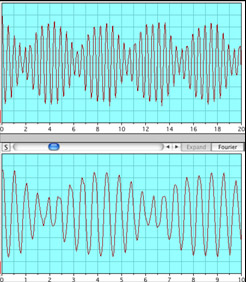 | The London police whistle sound from "The Science of Sound", Bell Telephone Laboratories, was analyzed and a plot of the interference pattern at two different time scales is shown at left. In that case, the measured beat frequency was 229 Hz. The stated single-pipe frequencies were 2136 Hz and 1904 Hz, leading to an expectation of 232 Hz as the difference tone. Our measured value is within experimental error of that value. Our actual measurements of the single tones were 2069 Hz and 1843 Hz, but the difference of 226 Hz between these is still within reasonable error of the measured 229 Hz beat frequency. This makes it puzzling why our more recent whistle experiment did not give a beat frequency equal to the difference of the single-pipe frequencies. 伦敦警察哨声来自《声音的科学》,贝尔电话实验室,已被分析,图中显示了在两个不同时间尺度上的干涉图样。在这种情况下,测得的拍频为229 Hz。所陈述的单管频率为2136 Hz和1904 Hz,导致预期的差频为232 Hz。我们的测量值在实验误差范围内。我们实际测得的单音频率为2069 Hz和1843 Hz,但这两者之间的差226 Hz仍与测得的229 Hz拍频在合理误差范围内。这让人困惑的是,为什么我们最近的哨声实验没有给出等于单管频率差的拍频。 |
Experimenters: Amber Bishop, Nicole Geiger, Ryan Hennings.
Hearing concepts
Traveling wave concepts
| HyperPhysics***** Sound
HyperPhysics ***** 声音 | R Nave |