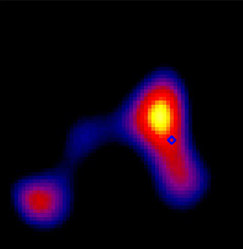
Groombridge 34格鲁姆布里奇34
Groombridge 34 is a binary star system that consists of two red dwarf stars in a nearly circular orbit with a separation of about 147 astronomical units. Both stars in this pair exhibit variability due to random flares, and they have been given variable star designations. (The brighter member Groombridge 34 A is designated GX And, and the other member is designated GQ And).(Wikipedia) Groombridge 34是一个双星系统,由两颗红矮星组成,它们的轨道近似圆形,分离距离约为147个天文单位。这对星体由于随机耀斑而表现出变星特性,并已获得变星编号。(较亮的成员Groombridge 34 A被指定为GX And,另一颗被指定为GQ And。(Wikipedia)
Groombridge 34 is located about 11.6 light-years (ly) from our Sun, Sol, in the north central part of (Aab=00:18:22.89+44:01:22.63, B=00:18:25.7+44:01:44:C~, ICRS 2000.0) in Constellation Andromeda, the Chained Maiden -- northwest of the Andromeda galaxy (M 31) and two of its satellite galaxies (M32 and M110). This binary star system was listed by Stephen Groombridge (1755-1834), whose "A Catalog of Circumpolar Stars" was published posthumously in 1838, but its large proper motion was not discovered and measured until 1860. Both visual members of the system are flare stars that have been given the variable star designations GX and GQ Andromedae.(Solstation) Groombridge 34 位于太阳(Sol)北中央区域,距离我们约11.6光年(ly),位于仙女座(Andromeda,The Chained Maiden)的天区,位于仙女座星系(M 31)西北方向,以及该星系的两个卫星星系(M32和M110)之间。这个双星系统由Stephen Groombridge(1755-1834)于1838年出版的《环绕极星星表》中列出,但其显著的自行直到1860年才被发现和测量。该系统的两个视觉成员均为耀星,已被赋予变星编号GX和GQ Andromedae。
Sources:
源:
|
Index Nearby Stars Star Concepts 索引 邻近恒星 恒星概念 | ||
|
Go Back
返回 |
Luyten 726-8 AB (UV Ceti)Luyten 726-8 AB (UV Ceti)(专名或术语)
"Luyten 726-8 AB is the sixth closest system to Sol. The system is located only about 8.7 light-years away in the southwestern part (01:39:01-17:57.0:C~, ICRS 2000.0) of Constellation Cetus, the Whale -- northeast of Deneb Kaitos or Diphda (Beta Ceti). However, this binary system of red dwarf stars is too faint to be seen with the naked eye. The stars were discovered in 1949 by Willem Jacob Luyten (1899-1994), who found the proper motions of over 520,000 stars despite the loss of sight in one eye since 1925 by building an automated photographic plate scanner and measuring machine. Although both stars have been found to be flare stars, the fainter member of the system is considered to be an extreme example; it has been given the variable star designation UV Ceti but is also referred to as "Luyten's Flare Star."(Solstation) Luyten 726-8 AB是太阳系第六近的恒星系统。该系统位于鲸鱼座(Cetus)西南部,距离太阳约8.7光年(01:39:01-17:57.0:C~,ICRS 2000.0),位于天琴座的东北方向(Deneb Kaitos或Diphda,Beta Ceti)。然而,这个双星系统中的红矮星太暗,无法用肉眼观测到。这两颗星于1949年由Willem Jacob Luyten(1899-1994)发现,他尽管自1925年起失去一只眼睛的视力,仍通过建造自动化胶片扫描仪和测量装置,发现了超过520,000颗恒星的自行运动。虽然两颗星都被发现是耀星,但较暗的成员被认为是极端的例子;它被命名为UV Ceti,也被称为“Luyten的耀星。”(Solstation)
UV Ceti (L 726-8 B) as the dimmer of the pair is main sequence red dwarf star (M6.0 Ve) may have only 10 percent of Sol's mass (Geyer et al, 1988; and RECONS estimate), 14 percent of its diameter (Johnson and Wright, 1983, page 649), and less than 4/100,000th of its luminosity. However, UV Ceti is an extreme example of a flare star that can boost its brightness by five times in less than a minute, then fall somewhat more slowly back down to normal luminosity within two or three minutes before flaring suddenly again after several hours. In 1952, UV Ceti was observed flaring to 75 times its normal brightness in only 20 seconds.(Solstation) UV Ceti (L 726-8 B) 作为双星系统中的暗星,是一颗主序星(M6.0 Ve),其质量可能仅是太阳的10%(Geyer等,1988;以及RECONS估计),直径为太阳的14%(Johnson和Wright,1983,第649页),其光度则小于太阳的4/100000。然而,UV Ceti 是一颗极端的耀星,可以在不到一分钟的时间内将亮度提升五倍,然后较缓慢地回落到正常光度,再在数小时后再次突然爆发。1952年,UV Ceti 被观测到在20秒内亮度达到正常值的75倍。
Sources:
源:
|
Index Nearby Stars Star Concepts 索引 邻近恒星 恒星概念 | ||
|
Go Back
返回 |
Tau Ceti天琴座
Tau Ceti star is located only about 11.9 light-years (ly) away. It lies in the south central part (01:44:04.08-15:56:14.93, ICRS 2000.0) of Constellation Cetus, the Whale -- southwest of Baten Kaitos (Zeta Ceti) and northeast of Deneb Kaitos or Diphida (Beta Ceti). While smaller and cooler than our own Sun, Sol, Tau Ceti is somewhat more like a sister star than nearby Epsilon Eridani. In Earth's night sky, it is clearly visible to the naked eye. In July 2004, astronomers announced that they had imaged a relatively large and dense disk of cold dust around this star (further discussion below -- RAS press release). As Tau Ceti has become one of the top 100 target stars for NASA's planned Terrestrial lanet Finder (TPF), images of this star and its position relative to the Milky Way in Earth's night sky are now available from the TPF-C team.(Solstation> 参宿一星距离我们仅约11.9光年(ly)。它位于鲸鱼座——南中部分(01:44:04.08-15:56:14.93,ICRS 2000.0)——西南方向是巴坦·凯托斯(仙后座的ζ星),东北方向是德内·凯托斯或迪菲达(仙后座的β星)。虽然比我们的太阳小而冷,但 Tau Ceti 更像是一颗姐妹星,而不是附近的 Epsilon Eridani。在地球的夜空中,它显然可以用肉眼看到。2004年7月,天文学家宣布他们已经拍摄到围绕这颗星的相对较大且密集的冷尘盘(进一步讨论见下文——皇家天文学会新闻稿)。由于 Tau Ceti 已成为 NASA 计划中的 Terrestrial Planet Finder(TPF)计划中前100个目标恒星之一,这颗星及其在地球夜空中位置相对于银河系的图像现在可以从 TPF-C 团队获得。
Tau Ceti is a main sequence, yellow-orange dwarf (G8 Vp) that may be as much as 10 billion years old. It has about 81 to 82 percent of Sol's mass, around 77 percent its diameter (Pijpers et al, 2003), but only 59 percent of its luminosity (Saumon et al, 1996, page 17). The star does not appear to be as enriched as Sol in elements heavier than hydrogen ("metals") because it has only 22 to 74 percent of Sol's abundance of iron (Cayrel de Strobel et al, 1991, page 6). Dust has been detected around Tau Ceti, as has been found in the Solar System (Kuchner et al, 1998 -- in pdf). There also may be an optical companion star seen in telescopes that is not actually bound by gravity to Tau Ceti, and the star does not appear to have a dim stellar or substellar companion based on astrometric measurements (Lippincott and Worth, 1980) or radial velocity variations (Campbell et al, 1988). (Solstation) 参宿四是一颗主序星,黄橙色矮星(G8 Vp),可能有100亿年的年龄。它拥有约81到82%的太阳质量,直径约为太阳的77%(Pijpers等,2003),但其光度仅为太阳的59%(Saumon等,1996,第17页)。该星不似太阳那样富含重元素(“金属”),因为它仅拥有太阳铁丰度的22到74%(Cayrel de Strobel等,1991,第6页)。在参宿四周围已检测到尘埃,这在太阳系中也有所发现(Kuchner等,1998 -- 电子版)。此外,可能还存在一个光学伴星,通过望远镜可见,但并非真正受重力束缚于参宿四。根据视差测量(Lippincott和Worth,1980)或径向速度变化(Campbell等,1988),该星似乎没有暗淡的恒星或亚恒星伴星。(Solstation)
Tau Ceti, only 12 light years away, is the nearest sun-like star and is easily visible without a telescope. It is the first star to be found to have a disk of dust and comets around it similar in size and shape to the disk of comets and asteroids that orbits the Sun. But the similarity ends there explains Jane Greaves, Royal Astronomical Society Norman Lockyer Fellow and lead scientist: 'Tau Ceti has more than ten times the number of comets and asteroids that there are in our Solar System. We don't yet know whether there are any planets orbiting Tau Ceti, but if there are, it is likely that they will experience constant bombardment from asteroids of the kind that is believed to have wiped out the dinosaurs. It is likely that with so many large impacts life would not have the opportunity to evolve.'(Joint Astronomy Centre, 2004) 参宿四,仅12光年之外,是最近的太阳系类恒星,无需望远镜即可轻易观测到。它是最先被发现拥有类似太阳周围彗星和小行星盘的恒星,其大小和形状与太阳系的彗星和小行星盘相似。但这种相似性到此为止,Jane Greaves,皇家天文学学会Norman Lockyer研究员及首席科学家解释道:‘参宿四周围有超过十倍于太阳系的彗星和小行星。我们目前还不知道参宿四周围是否有行星,但如果有的话,这些行星很可能经历持续的陨石撞击,这种撞击被认为曾导致恐龙灭绝。如此频繁的大型撞击,生命可能没有机会进化。’(联合天文中心,2004)
Sources:
源:
|
Index Nearby Stars Star Concepts 索引 邻近恒星 恒星概念 | ||
|
Go Back
返回 |
Epsilon EridaniEpsilon Eridani(专名或术语)
This star is located only about 10.5 light-years (ly) away in the northeastern part (03:32:55.84-09:27:29.74, ICRS 2000.0) of Constellation Eridanus, the River -- west of Rana (Delta Eridani) and northwest of Zaurak. Somewhat smaller and cooler than our own Sun, Sol, Epsilon Eridani is also less luminous. In Earth's night sky, however, it is clearly visible to the naked eye as the third closest star viewable without a telescope. On August 7, 2000, astronomers announced the discovery (a possible confirmation of earlier detections) of a Jupiter-like planet around this Sun-like star (press release -- details below). On October 9, 2006, a team of astronomers (led by G. Fritz Benedict and Barbara E. McArthur) working with the Hubble Space Telescope announced "definitive evidence" for the existence of a Jupiter-class planet around Epsilon Eridani using astrometic measurements (NASA press release -- more below). (Solstation) 这颗恒星位于天琴座(河)东北部(03:32:55.84-09:27:29.74,ICRS 2000.0),距离地球仅约10.5光年(ly),位于Rana(Delta Eridani)以西,Zaurak以西北。它比我们的太阳稍小、稍冷,也较不发光。然而,在地球的夜空中,它可以用肉眼看到,是除太阳以外第三近的恒星。2000年8月7日,天文学家宣布发现了一颗类似木星的行星围绕这颗太阳般的恒星(新闻稿——详情见下文)。2006年10月9日,由G. Fritz Benedict和Barbara E. McArthur领导的天文学家团队,利用哈勃太空望远镜进行的测光测量,宣布了围绕Epsilon Eridani存在的木星类行星的“确凿证据”(NASA新闻稿——更多详情见下文)。(Solstation)
This main sequence, orange-red dwarf (K2 V) is a relative young star that may be only around 660 to 800 million years old, within the range between 500 million to a billion years old (Benedict et al, 2006; and Saffe et al, 2005). It may have about 83 (+/- 0.05) to 85 percent of Sol's mass (Benedict et al, 2006; and RECONS), 84 percent of its diameter (Johnson and Wright, 1983, page 653), but only about 27.8 percent of its luminosity (Saumon et al, 1996, page 17). The European Space Agency has used ultraviolet spectral flux distribution data to determine stellar effective temperatures and surface gravities, including those of Epsilon Eridani.(Solstation) 这颗主序星,橙红色矮星(K2 V),是一颗相对年轻的恒星,可能只有大约660至800百万年,处于500百万年到10亿年之间的范围(Benedict等,2006;和Saffe等,2005)。它可能有约83(±0.05)至85%的太阳质量(Benedict等,2006;和RECONS),84%的直径(Johnson和Wright,1983,第653页),但仅约27.8%的光度(Saumon等,1996,第17页)。欧洲航天局已利用紫外光谱通量分布数据来确定恒星的有效温度和表面重力,包括水仙座ε的。
The measured effective temperature for Epsilon Eridani was 5500K 天琴座ε的测量有效温度为5500K
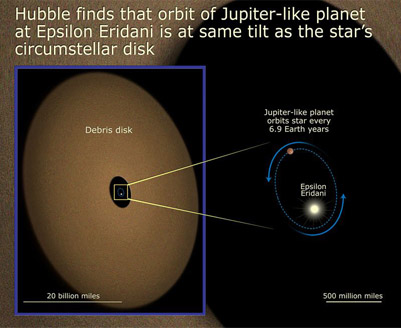
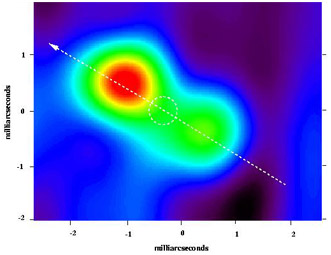
On October 9, 2006, a team of astronomers (led by G. Fritz Benedict and Barbara E. McArthur) working with the Hubble Space Telescope announced "definitive evidence" for the existence of a Jupiter-class planet around Epsilon Eridani using astrometic measurements combined with those made at the University of Pittsburgh's Allegheny Observatory (NASA press release). Coming astrometric with radial-velocity measurements to determine the tilt of the planet's orbit, the astronomers were able to estimate the "true mass" of planet b as about 1.55 +/- 0.24 times the mass of Jupiter. Located at an average distance (semi-major axis) of 3.39 +/- 0.36 AUs from Epsilon Eridani, the planet takes about 6.9 (6.85 +/- 0.03) years to complete its highly eccentric orbit (e= 0.702 +/- 0.039). Approaching as close as 2.4 and as far as 5.8 AUs from its host star, the planet's orbit is also tilted about 30.1 +/- 3.8 degrees from Earth's line of sight (Benedict et al, 2006). Although the planet's orbit takes it so far from Epsilon Eridani that oceans on any moons would freeze, life could potentially survive on a moon if it is massive enough to hold onto a dense heat-trapping atmosphere like Saturn's moon, Titan, according to astronomer G. Fritz Benedict. Astronomers hope to image the planet in 2007, when its orbit is closest to Epsilon Eridani and may reflect sufficient starlight for an image.(Solstation) 2006年10月9日,由G. Fritz Benedict和Barbara E. McArthur领导的一组天文学家,利用哈勃太空望远镜进行的测光测量,结合匹兹堡大学阿勒格尼天文台的观测结果,宣布了围绕天琴座ε星存在一颗类木星行星的“确凿证据”(NASA新闻稿)。通过测光与径向速度测量来确定行星轨道的倾斜度,天文学家们能够估算出行星b的“真实质量”约为木星质量的1.55±0.24倍。该行星平均距离(半长轴)为3.39±0.36天文单位,其轨道偏心率为0.702±0.039,需要约6.9(6.85±0.03)年才能完成。该行星的轨道离其宿主星最近时仅2.4天文单位,最远时达5.8天文单位,其轨道相对于地球视线倾斜约30.1±3.8度(Benedict等,2006)。尽管该行星的轨道离天琴座ε星如此之远,以至于任何卫星上的海洋都会冻结,但根据天文学家G. Fritz Benedict的说法,如果该卫星质量足够大,能够保持一个稠密的温室效应大气层,如土星的卫星泰坦,生命可能在卫星上生存。天文学家希望在2007年,当该行星轨道最接近天琴座ε星时,能够拍摄到它的影像。(Solstation)
Sources:
源:
|
Index Nearby Stars Star Concepts 索引 邻近恒星 恒星概念 | ||
|
Go Back
返回 |