Omicron Ceti - Mira
 |
The cool red giant star historically known as Mira but officially named Omicron Ceti has been known for about 400 years. It was discovered on August 13, 1596, by Dutch astronomer David Fabricus, who mistook it for a nova because it later faded from view. The name Mira means "The Wonderful". It is considered to be the first case of a variable star. 历史上被称为Mira的红巨星,正式名称为Omicron Ceti,已知约400年。它于1596年8月13日由荷兰天文学家David Fabricus发现,他误将其视为新星,因为该星随后亮度下降。Mira的意思是‘奇妙的’。它被认为是第一颗变星的案例。
|
Mira is a binary system with separation about 70 times more than that between Earth and the Sun, (equal to an angular size of only 0.6 arcseconds -- the apparent diameter of a dime at four miles away). It is the prototype for an entire class of stars known as "Mira-type variables." Although once like our Sun, Mira is now at the end of its life, and has evolved into a cool red giant star that is highly variable in brightness. Contracting and expanding every 332 days, Mira sheds vast amounts of material through its powerful "wind" of gas and dust. The orbital period of the companion star is about 400 years. (NASA)
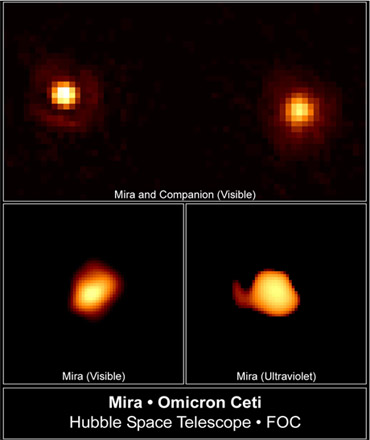
The top image above is a NASA Hubble Space Telescope image of the cool red giant star Mira A (right) and its binary companion taken on December 11, 1995 in visible light using the European Space Agency's Faint Object Camera (FOC). At bottom left isHubble's visible-light image of the disk of Mira, revealing an odd, asymmetrical shape resembling a football. This may be tied to dramatic changes occurring during its expansion-contraction cycles, or to the presence of unresolved spots on its surface. Hubble measurements show the red giant star is 700 times larger than our Sun. The lower right image is made in UV light. Hubble resolves a small hook-like appendage extending from Mira, in the direction of the companion that could be material from Mira being gravitationally drawn toward the smaller star. Alternately, it could be that material in Mira's upper atmosphere is being heated due to the companion's presence. PHOTO CREDIT: Margarita Karovska (Harvard-Smithsonian Center for Astrophysics), and NASA
If Mira were at the center of our solar system, it would extend out more than 300 million miles, well beyond Mars' orbit and nearly two-thirds of the way to Jupiter. Mira's companion is a white dwarf that is surrounded by material captured from Mira's wind. At a distance of about 400 light-years, Mira is the closest wind-accreting binary system to Earth.
"Mira is the brightest and most famous long-period pulsating variable in the sky, and gave the name to this whole class of stars. It changes its brightness normally between maxima of about 3rd magnitude and minima of about mag 10, but occasionally brighter maxima up to mag 2.0 are observed (e.g. by William Herschel), or fainter when Mira stays at about magnitude 5. At a distance of about 400 light years, this corresponds to absolute magnitudes of about -2.5 near the maxima and +4.7 near its minima, so giant cool Mira is only about as, or even less luminous than our sun near its minima, but brightens up to about 700 and occasionally even over 1500 solar luminosities near the maximum of its cycle."(seds.org).
A whole class of variable stars have been named after Mira. "Mira-type" stars are variables with a period of around 100 - 1000 days and with visual light variations of more than 2.5 magnitudes. Over 6000 "Mira variables" are now known.
 | This light curve from AAVSO shows the variation in intensity from the Mira binary system. 这张来自AAVSO的光变曲线显示了Mira双星系统的光强变化。 |
Sources
- http://www.xs4all.nl/~carlkop/mirahu.html
- http://hubblesite.org/gallery/album/entire_collection/pr1997026b/
- http://www.seds.org/~spider/Spider/Vars/mira.html
- http://www.aavso.org/vstar/vsots/1298.shtml
Star concepts
| HyperPhysics***** Astrophysics
HyperPhysics ***** 天体物理学 | R Nave |
