Lalande 21185Lalande 21185(专名或术语)
Lalande 21185 is a dim red dwarf star which is the fourth closest system to our Sun, after Alpha Centauri, Barnard's Star and Wolf 359. It is located about 8.3 light-years away in the constellation Ursa Major. It's coordinates are (11:03:20.19+35:58:11.55, ICRS 2000.0) . It is named for its discoverer. Lalande 21185是一颗暗淡的红矮星,是太阳系第四近的恒星系统,仅次于半人马座α、巴纳德星和沃尔夫359。它位于大熊座,距离太阳约8.3光年。其坐标为(11:03:20.19+35:58:11.55,ICRS 2000.0)。该星以发现者命名。
This star generated considerable excitement in 1996 when the discovery of associated planets was announced. "This cool and dim, main sequence red dwarf (M2.1 Vne) has about 46 percent of Sol's mass (RECONS estimate), 46 percent of its diameter (Johnson and Wright, 1983, page 671), but less than 6/1,000th of its brightness. The star is less enriched in elements heavier than hydrogen ("metals") compared to our Sun, with around 63 percent of Sol's abundance of iron (Cayrel de Strobel et al, 1991, page 292). It is suspected to have at least one, but perhaps as many as three, Jupiter-class planets."(Arnold O. Benz, Institute of Astronomy, ETH Zurich) 这颗恒星于1996年引起广泛关注,当时关联行星的发现被公布。"这颗冷而暗的主序红矮星(M2.1 Vne)的质量约为太阳的46%(RECONS估计),直径约为太阳的46%(Johnson和Wright,1983,第671页),但其亮度不到太阳的千分之六。这颗恒星比太阳更少富集重于氢的元素('金属'),其铁的丰度约为太阳的63%(Cayrel de Strobel等,1991,第292页)。它可能至少拥有一颗,或许多达三颗,类似木星质量的行星。"(Arnold O. Benz,苏黎世联邦理工学院天文学研究所)
Gatewood, G. D. "Lalande 21185," Bulletin of the Aerican Astronomical Society, 28, 885 (1996). Gatewood, G. D. 'Lalande 21185,' Bulletin of the Aerican Astronomical Society, 28, 885 (1996).
"Lalande 21185 is about three times too faint to be seen with the naked eye. Although Lalande 21185 is almost 200 times dimmer than the Sun, it is among the brightest red dwarfs in the solar neighborhood. Moving perpendicular to the galactic plane at a high velocity of 47 km/s, Lalande 21185 appears to belong to the Galaxy's thick disk population and to be considerably older than the Sun. It has both a high radial velocity, of 86 km/s toward the Sun, and a high tangential velocity (proper motion) of 57 km/s. The former is bringing the star 0.028 light-year closer to us each century and to a closest approach of about 4.6 light-years in 22,000 AD."
(http://www.daviddarling.info/encyclopedia/L/Lalande21185.html)
Lalande 21185的亮度大约是人眼无法看到的三倍。尽管Lalande 21185比太阳暗200倍,但它却是太阳邻近区域中最亮的红矮星之一。垂直于银河平面以高速度47 km/s运动,Lalande 21185似乎属于银河盘的厚盘群体,并且比太阳年长得多。它既有朝向太阳的高径向速度,为86 km/s,也有较高的切向速度(自行),为57 km/s。前者使这颗星每世纪接近地球0.028光年,预计在22,000年时会接近到约4.6光年。 |
Index Nearby Stars Star Concepts 索引 邻近恒星 恒星概念 | ||
|
Go Back
返回 |
Discovery of Lalande 21185兰兰德21185的发现
The star Lalande 21185 " was first listed by Joseph-JÈrome Lefrançais de Lalande (1732-1807), who became director of the Paris Observatory in 1795, produced the most comprehensive catalog for his time of 47,390 star positions (the Histoire CÈleste Française) in 1801, and was actually the first person to add Flamsteed numbers to designate the brighter stars within each constellation in a French edition of John Flamsteed's (1645-1719) star catalog." http://www.solstation.com/stars/la21185.htm) 恒星Lalande 21185首次被列出是在Joseph-JÈrome Lefrançais de Lalande(1732-1807)于1795年成为巴黎天文台主任时,他于1801年出版了当时最全面的星表,共包含47,390个星位(《法国天文学史》),并且实际上是第一个在法国版的约翰·弗拉姆斯蒂德(1645-1719)星表中为每个星座内较亮的恒星添加弗拉姆斯蒂德编号的人。
Gatewood, G. D. "Lalande 21185," Bulletin of the Aerican Astronomical Society, 28, 885 (1996). Gatewood, G. D. 'Lalande 21185,' Bulletin of the Aerican Astronomical Society, 28, 885 (1996).
|
Index
索引 | ||
|
Go Back
返回 |
Wolf 359沃尔夫359
This extremely faint red dwarf star is the third closest to Sol after Alpha Centauri 3 and Barnard's Star. It is located only about 2.4 pc (7.8 light-years) away in the east central part (10:56:29+07:00.7, ICRS 2000.0) of Constellation Leo, the Lion -- south of Chertan or Coxa (Theta Leonis). However, the star is much too dim to be visible to the naked eye. It was discovered photographically by Max (Maximilian Franz Joseph Cornelius) Wolf (1863-1932), a pioneer of astrophotography who discovered hundreds of variable stars and asteroids, and about 5,000 nebulae by analyzing photographic plates and developing the "dry plate" in 1880 and the "blink comparator" in 1900 with the Carl Zeiss optics company in Jena, Germany. (Solstation) 这颗极其暗淡的红矮星是太阳系之后距离太阳第三近的恒星,仅次于半人马座α星三号和巴纳德星。它位于天琴座(狮子座)的东-central区域(赤经10:56:29,赤纬+07:00.7,ICRS 2000.0),距离太阳约2.4 pc(7.8光年)。然而,这颗星太暗,无法用肉眼看到。它是由马克斯(马克斯·弗朗茨·约瑟夫·科内利乌斯)·沃尔夫(1863-1932年)发现的,他是天体摄影的先驱,通过分析摄影底片发现了数百颗变星和小行星,以及大约5000个星云。他于1880年发明了“干板”,1900年发明了“blink comparator”,并与德国耶拿的蔡司光学公司合作。
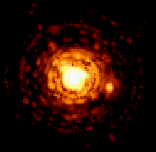
"A very cool, main sequence red dwarf (M5.8Ve), Wolf 359 is our Sun's dimmest stellar neighbor within 10 ly, with less than 2/100,000th of Sol's luminosity. If our Sun, Sol, were replaced by Wolf 359, then an observer on Earth would need a telescope to see its round shape clearly, and daylight would be very dim with only ten times the brightness of full moonlight with Sol. On the other hand, Wolf 359 is a Flare Star (that has been designated with the variable star name CN Leonis) and so can brighten dramatically from time to time. Flares on Wolf 359, however, are rarer and not as violent as those observed on Proxima Centauri, Kruger 60 B, or UV Ceti."(solstation) Wolf 359是一颗非常凉爽的主序红矮星(M5.8Ve),是太阳系内10光年以内最暗的恒星邻居,其光度仅为太阳的2/100,000。如果太阳被Wolf 359取代,那么地球上的观察者就需要望远镜才能清晰地看到它的圆形形状,而白天的光照将非常微弱,仅相当于满月光的十倍。另一方面,Wolf 359是一颗耀斑星(已被命名为CN Leonis变星),因此它有时会突然变亮。然而,Wolf 359的耀斑较少且不如Proxima Centauri、Kruger 60 B或UV Ceti上的耀斑剧烈。
Sources:
源: |
Index Nearby Stars Star Concepts 索引 邻近恒星 恒星概念 | ||
|
Go Back
返回 |