Peacock Feather Colors
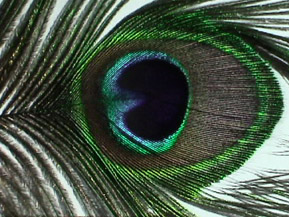 |
The vivid colors of a peacock feather do not arise entirely from pigments - in fact, the role of pigments may be minimal. The structure of the feather plays a role in the color according to investigations by Jian Zi, Xiaochan Liu and colleagues at Fudan University in Shanghai. Another group, Shinya Yoshioka and Shuichi Kinoshita of Osaka University in Japan had reported that there were structural arrays in the barbules of the peacock feather which were measurably different for the different colored regions. The barbules are described as straplike "twigs" which come off the branches of the peacock feather. 孔雀羽毛鲜艳的颜色并非完全来自色素——事实上,色素的作用可能微乎其微。根据复旦大学上海分校的詹志、刘晓Chan及同事的研究,羽毛的结构在颜色形成中起着作用。另一组研究人员,日本大阪大学的山田洋和金石修一发现,孔雀羽毛的羽枝上存在可测量差异的结构阵列,这些差异对应于不同颜色的区域。羽枝被描述为类似“带状的枝条”,从孔雀羽毛的枝干上脱落下来。
|
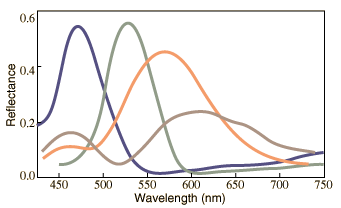
At right is a qualitative sketch of the measured reflectivity of four different regions of a peacock feather as a function of wavelength. The sketch is adapted from data by Zi, et al., taken with normally incident light. They investigated the differences in structure of the different colored regions and concluded that reflections from the front and back of the structures acted like a Fabry-Perot interference device to enhance color in a specific wavelength range. 右侧是一幅展示 peacock feather 不同区域在波长函数下的测量反射率的定性示意图。该示意图改编自 Zi 等人采用正常入射光获得的数据。他们研究了不同颜色区域的结构差异,并得出结论:结构前后面反射的作用类似于 Fabry-Perot 干涉装置,增强了特定波长范围内的颜色。 |
|
 |
The rows of colored elements become apparent in this image taken as 50x with a ProScope. These "barbules" contain nanoscale photonic lattices according to the researchers. 在这张使用50倍放大率拍摄的图像中,彩色元素的行变得清晰可见。这些‘细丝’据研究者称包含纳米尺度的光子晶格。
|
 |
At 100x the variations in the filaments are more evident. You can also begin to see why the colors seem to shimmer. The visible color will be different at different angles of view. The structures which produce the colors are described as arrays of melanin cylinders which in a green region were measured to have an array spacing of about 150 nm. The surface of the barbule is made of keratin, containing about 10 rows of the melanin cylinders in the green region. 在100倍放大下,丝状结构的差异更加明显。你也可以开始理解为什么颜色似乎在闪烁。从不同角度观察,可见颜色会有所不同。产生这些颜色的结构被描述为由黑色素圆柱体组成的阵列,在绿色区域测量到的阵列间距约为150纳米。羽毛丝的表面由角蛋白组成,其中在绿色区域含有约10行的黑色素圆柱体。
|
 |
This image and those below were shot at 200x. This is just a sampling of the color variations. The final images below show some of the small colored elements in the individual fibers, and seem to show some reinforced reflections. 这张图像及下面的图像是在200倍放大下拍摄的。这只是颜色变化的一个示例。下面的最终图像显示了单个纤维中的某些小色块,似乎显示出一些增强的反射。
|
 |
The blue regions in the barbules were found to have a melanin cylinder spacing of about 140 nm. Variations in the spacing and numbers of layers were distinctive for the different colors with yellow barbules having spacing of about 165 nm in a square lattice of about six periods. Brown barbules exhibited a rectangular lattice with about four periods. 条状物中的蓝色区域被发现其黑色素柱间距约为140纳米。间距和层数的差异对于不同颜色具有显著性,黄色条状物在约六周期的正方形晶格中具有约165纳米的间距。棕色条状物则表现出矩形晶格,约四周期。
|
 |
The larger number of periods in the melanin cylinder structures of the green and blue barbules is associated with the narrower wavelength range of the reflected light. The yellow and brown barbules exhibited the Fabry-Perot interference, to which is attributed the contributions to their reflectance at about 450 nm. 绿色和蓝色羽毛丝的黑色素圆柱结构具有更多的周期数,这与反射光的较窄波长范围有关。黄色和棕色羽毛丝表现出Fabry-Perot干涉,这解释了它们在约450 nm处的反射特性。
|
 |
This image and the two below show subtle variations in color as well as areas which seem to "fire" with more reflected intensity than neighboring regions. Irridescence in the colored regions is taken as evidence of color which is structural in its origin, as opposed to pigment color. This is an example of fiber optics in nature. 这张图像以及下面的两张图像显示了颜色的细微变化,以及似乎比邻近区域反射强度更高的区域。彩色区域中的虹彩现象被视作颜色源自结构的证据,而非色素颜色。这是一例自然界中的光纤现象。
|
 |

|
CIE concepts
Color vision concepts
References
Blau, Steven K
Zi, J.
Yoshioka and Kinoshita
| HyperPhysics***** Light and Vision
HyperPhysics ***** 光与视觉 | R Nave |