
Performing a 3D “CT Scan” on the Dam Lanzhou University Team Collaborates with Henan Zhongyuan Optoelectronics and Others to Complete Muon Imaging Test on Mangshan Reservoir Auxiliary Dam
Among China's nearly 100,000 reservoirs, earth-rock dams constitute the overwhelming majority. As these structures enter their long-term operational phase, issues such as internal structural degradation, the development of seepage pathways, and the accumulation of latent defects have gradually come to light. How to “see” inside the dam without drilling holes, damaging the structure, or disrupting operations has long been a technical challenge in the field of engineering safety.
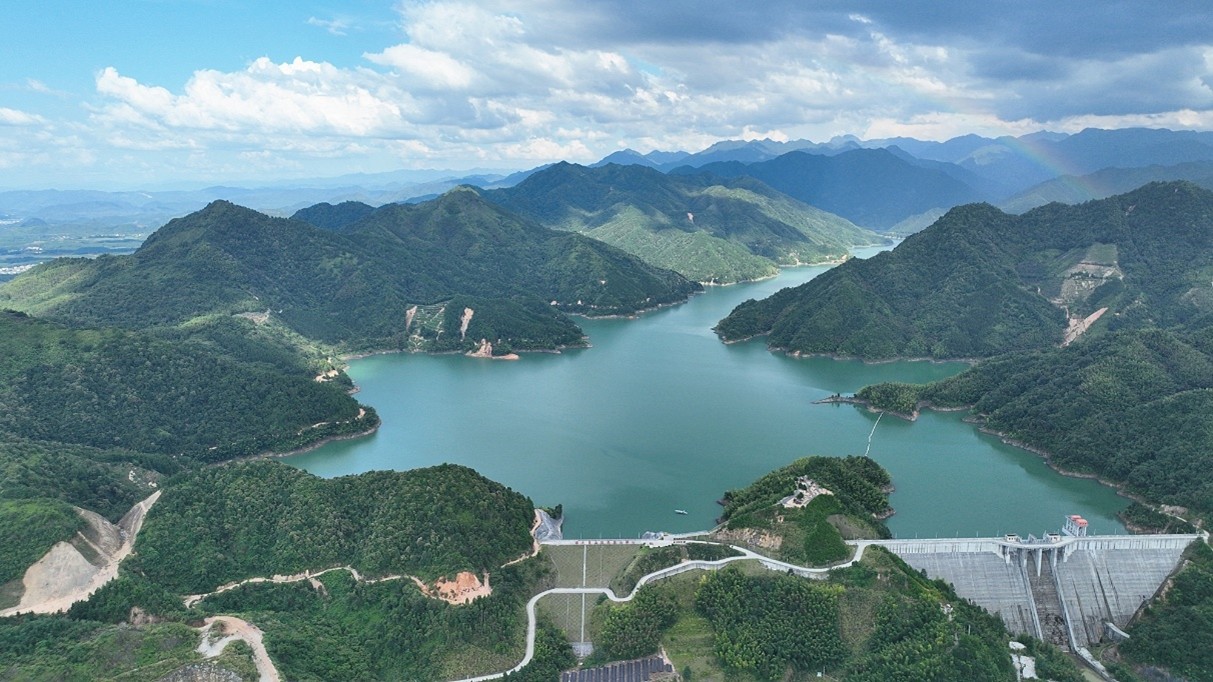
In September 2025, Lanzhou University collaborated with research teams from Henan Zhongyuan Optoelectronics and the Nanjing Institute of Hydraulic Research to successfully conduct an in-situ cosmic ray muon imaging experiment at the auxiliary dam of Mangshan Reservoir. This field test employed natural cosmic ray particles to perform a three-dimensional “CT scan” of the dam structure and surrounding mountains, achieving density imaging of complex earth-rock dams. This breakthrough provides a novel non-destructive technical approach for dam safety monitoring.
Uncovering the “Invisible” Internal Risks
Traditional dam safety monitoring primarily relies on borehole sampling, piezometer monitoring, deformation observation, and geophysical methods such as electrical and seismic techniques. While each approach has its advantages, they generally suffer from limitations including limited spatial coverage, disturbance to the dam structure, and significant susceptibility to environmental noise.
Natural muon imaging technology offers an alternative approach—utilizing naturally occurring high-energy muons as “safe probes.” Due to their exceptional penetration capabilities, muons can traverse hundreds of meters of rock and soil. By measuring the attenuation of muon flux before and after passing through the target material, researchers can reconstruct its internal density distribution and build a three-dimensional structural model—akin to performing a “natural CT scan” on engineering structures. Previously, international researchers including Oláh conducted exploratory work on sand control dams in Japan, validating the technique's feasibility within concrete dam structures. However, systematic engineering validation remains lacking for earth-rock dam systems, which exhibit greater material heterogeneity and structural complexity.
Multi-point Deployment, 3D Inversion: Successful Imaging of Earth-Rock Dam Density
This study selected the auxiliary dam of Mangshan Reservoir as its research subject. The dam structure is an asphalt concrete core wall rock-fill dam, tightly coupled with the surrounding granite mountain terrain. Its complex topography represents a typical dam-mountain composite system.
The research team deployed three measurement points around the dam structure and conducted continuous observations from September to November 2025 using domestically produced flat-panel plastic scintillator muon detectors. By applying normalized corrections to fluctuations in natural cosmic ray flux and constructing zoned material property models for both the dam and surrounding mountains, the team completed three-dimensional density inversion, achieving comprehensive imaging of the dam structure and adjacent mountainous terrain.
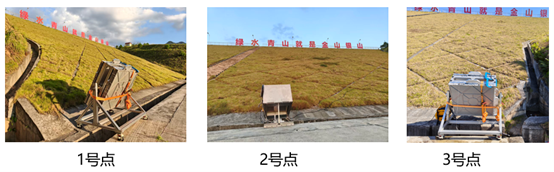
Detector Layout Diagram
Overall, the research findings indicate that muon imaging technology demonstrates a certain degree of sensitivity to density variations within dam bodies and adjacent mountain slopes under complex terrain conditions. This provides a reference basis for conducting comprehensive interpretations in conjunction with engineering data.
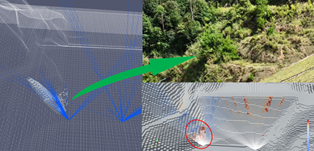
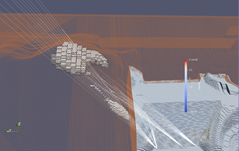
Anomaly Distribution Map
Pioneering New Approaches for Dam Safety Monitoring
Natural muon imaging technology can identify density anomalies within earth-rock dams and achieve spatial localization without disrupting engineering operations, serving as a vital supplement to existing safety monitoring systems.
Compared with traditional methods, this technology offers: non-contact, passive detection; zero disturbance to structures; large-scale coverage; and suitability for long-term continuous monitoring. In the future, if integrated into a multi-source fusion system alongside seepage monitoring, deformation monitoring, and conventional geophysical methods, it is expected to play a greater role in risk early warning and hidden hazard investigation for major water conservancy projects.
 QR Code