
A research team at Lanzhou University has published its latest findings on the application of natural muon technology
Xinhua News Agency Client (Gansu Channel), November 13 (Reporter Wang Zixuan) — Recently, a research team led by Professor Liu Zhiyi—based at the National Nuclear Industry Research Institute and the Frontier Science Center for Rare Isotopes at Lanzhou University—published their latest findings on the application of natural muon technology in the prestigious international journal *Tunnelling and Underground Space Technology*.
It is understood that the study was jointly conducted by Lanzhou University in collaboration with the Shenzhen Metro Group, China Construction Fifth Engineering Bureau Civil Engineering Co., Ltd., and China Railway Southwest Scientific Research Institute Co., Ltd., amongst others. Focusing on the challenges of underground space perception and risk early warning encountered during urban metro shield tunnelling, the study proposed and validated a three-dimensional dynamic imaging technology system utilising natural muons.
Natural muons are high-energy cosmic-ray particles with exceptional penetrating power. Compared with traditional detection technologies such as radar, electromagnetic and seismic methods, natural muons do not require the active transmission of signals and are unaffected by complex electromagnetic environments, enabling large-scale, non-intrusive, deep-penetrating underground imaging. For many years, natural muon technology has been primarily applied in fields such as mineral resource exploration, cultural heritage conservation and the monitoring of hydraulic dams.
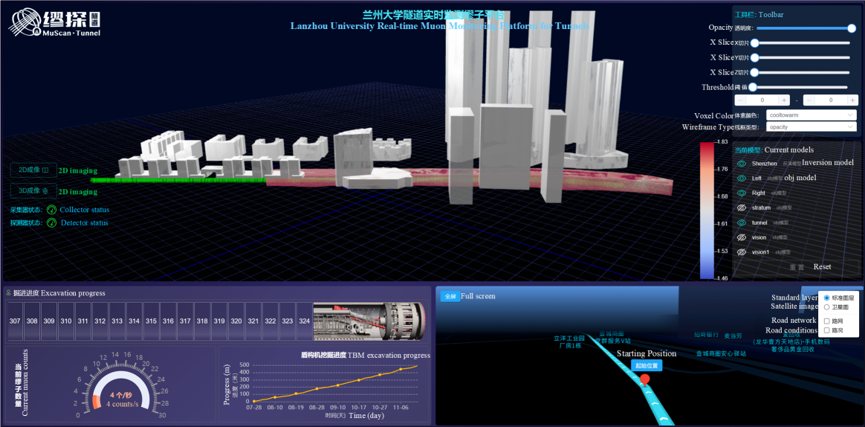
Professor Liu Zhiyi explained that achieving continuous dynamic monitoring in underground metro shield tunnelling environments has long been a technical challenge in international research. The research team independently developed detection equipment, dynamic data fusion algorithms and an automated imaging platform suitable for the complex environments encountered by shield tunnelling machines, thereby enabling the long-term, continuous and stable operation of natural muon technology at shield tunnelling sites.
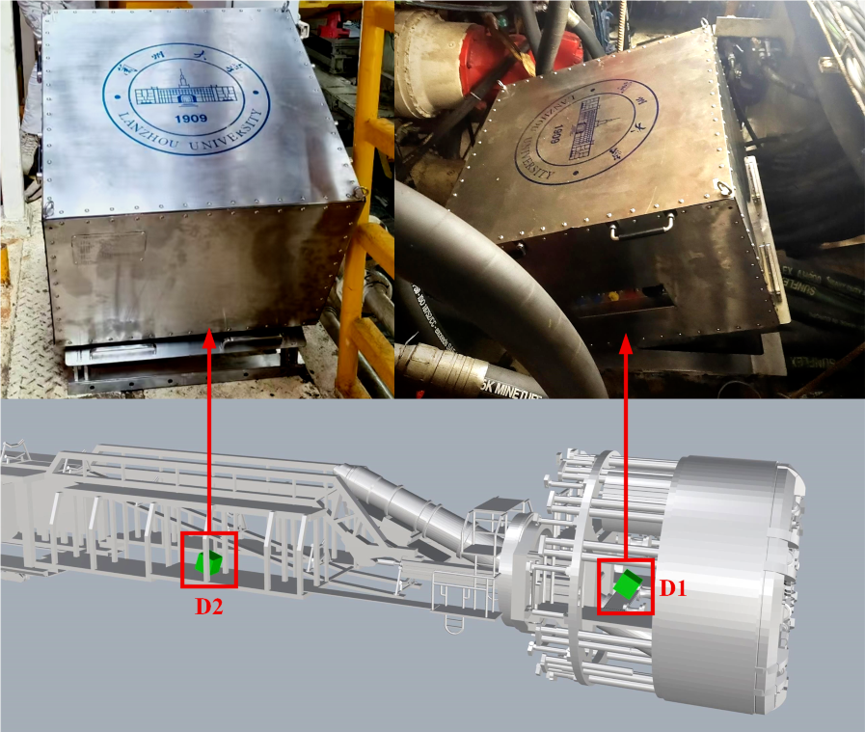
The research team also integrated the natural muon detection system into the interior of a tunnel boring machine (TBM), which operated continuously for over 120 days at the Shenzhen Metro construction site. It carried out dynamic monitoring of a 492-ring, approximately 737-metre TBM section, achieving fully automated operation throughout the entire process—from data acquisition and automatic processing to three-dimensional reconstruction. During the monitoring process, the system successfully detected and reconstructed the cavity structure formed by the intersection of underground utility tunnels located above the tunnel; the relevant results were subsequently verified through on-site inspection. This achievement demonstrates that natural muon technology has progressed from the laboratory validation stage to the stage of application in major engineering projects, and has attained a high level of engineering maturity.
According to reports, this technical framework is not only applicable to the construction phase but is also designed for use throughout the entire life cycle of metro projects; the relevant findings provide a new technical approach for establishing an intelligent sensing system for underground spaces that covers the entire process from 'planning' to 'construction' and 'operation'.
In recent years, Gansu Province and Lanzhou University have continued to prioritise research into natural muon science and technology, undertaking systematic research into detection principles, core equipment, imaging algorithms and industrial applications, and have gradually established a comprehensive technological chain spanning from fundamental research to engineering applications. (End)
 QR Code