Galaxy Pair NGC 3314
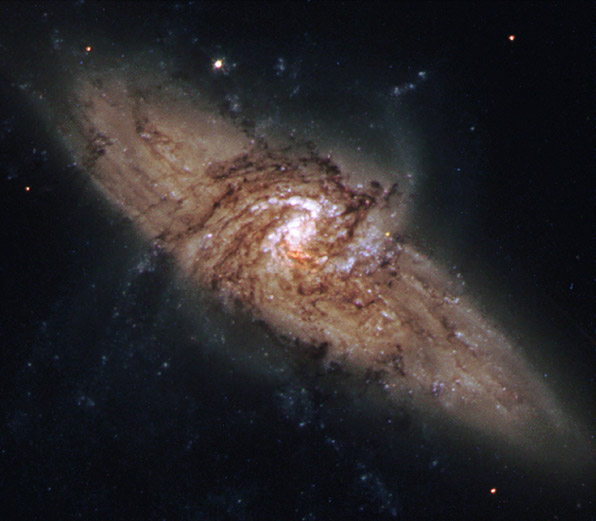
"This new image from NASA's Hubble Space Telescope and its Wide Field and Planetary Camera 2 (WFPC2) shows the unique galaxy pair called NGC 3314. Through an extraordinary chance alignment, a face-on spiral galaxy lies precisely in front of another larger spiral. This line-up provides us with the rare chance to visualize dark material within the front galaxy, seen only because it is silhouetted against the object behind it. Dust lying in the spiral arms of the foreground galaxy stands out where it absorbs light from the more distant galaxy. This silhouetting shows us where the interstellar dust clouds are located, and how much light they absorb. The outer spiral arms of the front galaxy appear to change from bright to dark, as they are projected first against deep space, and then against the bright background of the other galaxy. NGC 3314 lies about 140 million light-years from Earth, in the direction of the southern hemisphere constellation Hydra. The bright blue stars forming a pinwheel shape near the center of the front galaxy have formed recently from interstellar gas and dust. A small, red patch near the center of the image is the bright nucleus of the background galaxy, NGC 3314b. It is reddened for the same reason the setting sun looks red. When light passes through a volume containing small particles (molecules in the Earth's atmosphere or interstellar dust particles in galaxies), its color becomes redder. The Hubble Heritage color image of NGC 3314 was constructed from archival images taken with WFPC2 in April 1999 by Drs. William Keel and Ray White III (University of Alabama) in blue and infrared light, combined with new images obtained by the Heritage team in March 2000 using blue, green and red filters. " NASA description.
Image credit: NASA, The Hubble Heritage Team,
| Classification of galaxies
星系分类 |
Galaxy concepts
| HyperPhysics********** Astrophysics
HyperPhysics ********** 天体物理学 | R Nave |