Bilingual edition: English is preserved and Chinese follows each unit. Terminology uses the confirmed v20260916 glossary; automated semantic review remains traceable.
中英双语版:英文原文完整保留,中文紧随对应单元;术语采用 v20260916 确认表,自动语义审校结果可追溯。

Milky Way Galaxy

银河系

Various sources suggest that about two hundred billion stars make up our galaxy, stretching over some 100,000 light years or about 30 kiloparsecs in a flattened disk which is about 10,000 light years ( 3 kpc) thick at the center. The sun is some 8.5 kiloparsecs out from the galactic center. About 6000 stars are visible with the naked eye.

各种来源表明,我们的银河系大约由两百亿颗恒星组成,其直径约为100,000光年或约30千秒差距,呈扁平盘状,中心区域厚度约为10,000光年(3千秒差距)。太阳距离银河中心约8.5千秒差距。大约有6000颗恒星可以用肉眼看到。

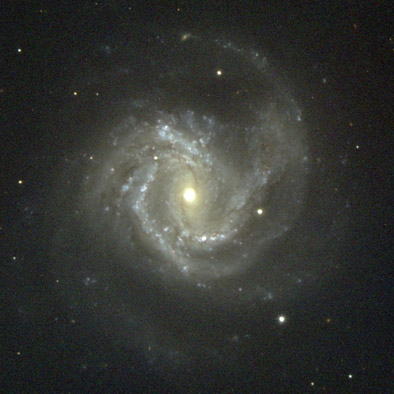
We can investigate the structure of our galaxy in various ways, but can't get outside of it to see what it looks like. Spiral arms have been detected, and it seems to have a structure similar to the image of galaxy M61 shown. Recent studies indicate that there may be more of a central bar than M61 shows.

我们可以通过多种方式研究银河系的结构,但无法离开银河系来观察它的全貌。螺旋臂已经被探测到,它似乎具有类似于银河系M61图像的结构。最近的研究表明,它可能比M61所示的更具有明显的中央棒状结构。

Galaxies similar to Milky Way?Galaxy M61
类似银河系的星系:星系M61
The Milky Way in infrared.

This is a photo toward the center of our galaxy taken by the COBE satellite in the infrared. In infrared you can see through some of the dust surrounding the galactic center and show the flattened shape of the galaxy with its central bulge. How many stars are in the Milky Way? Estimates are around 300 billion or 3 x 10¹¹, perhaps plus or minus a 100 billion. Estimates are obtained by obtaining a measure of mass by analyzing rotation times and subtracting dark matter, then obtaining an average star mass. Uniform projections from the Hubble Ultra Deep Field lead to an estimate of 100 billion (1011) galaxies in the universe.

这张照片是由COBE卫星在红外波段拍摄的,指向我们银河系的中心。在红外波段,你可以穿透围绕银河系中心的一些尘埃,显示出银河系扁平的形状及其中心的凸起。银河系中有多少颗恒星?估计数量约为3000亿或3×10¹¹,可能上下浮动1000亿。这些估计是通过分析旋转周期来测量质量,然后减去暗物质,再得到平均恒星质量来获得的。从哈勃超深场的均匀投影中得出的估计是宇宙中约有1000亿(10¹¹)个星系。

At right is an attempt to give a perspective of the Sun's location in the galaxy. It is based roughly on a sketch by Gonzalez and Richards. It shows the Sun as located between the Perseus and Sagittarius arms of the Milky Way. Gonzalez and Richards comment that this is one of the best locations in the galaxy for learning about stars, galactic structure and cosmology. There is considerable variation in the naming and visualization of the the spiral arms, so the details here should not be taken too seriously.

右侧是一幅试图展示太阳在银河系中的位置的示意图。它大致基于Gonzalez和Richards的草图。该图显示太阳位于银河系的人马臂和天鹅臂之间。Gonzalez和Richards评论说,这是银河系中了解恒星、银河结构和宇宙学的最佳位置之一。螺旋臂的命名和可视化存在相当大的差异,因此此处的细节不应被过于认真对待。

Two small irregular galaxies called the "Magellanic Clouds" are relatively near the Milky Way. The Large Magellanic Cloud is at about 160,000 light years and the Small Magellanic Cloud is at about 200,000 light years from us. The Andromeda galaxy is the nearest large galaxy at about 900 kiloparsecs or 2.9 million light years.

两个名为‘大麦哲伦星云’的较小不规则星系相对接近银河系。大麦哲伦星云距离我们约160,000光年,而小麦哲伦星云则约200,000光年。仙女座星系是最近的大型星系,距离我们约900千秒差距或290万光年。

Within our galaxy are some star clusters that may visually resemble galaxies because they form distinctly visible groups in a relatively small region of space. They may be open clusters such as the Pleiades or globular clusters such as M30.

在银河系中,有一些星团可能在视觉上类似于星系,因为它们在相对较小的空间区域内形成明显可见的群体。它们可能是疏散星团,如仙女座星团,或是球状星团,如M30。

Sources

  • COBE photo of Milky Way on Astronmy Picture of the Day
    COBE拍摄的银河系照片(天文每日图片)
  • COBE image discussion on NASA WMAP site.
  • M61, National Optical Astronomy Observatory posting.
    M61,国家光学天文台公告。
  • COBE图像讨论见NASA WMAP网站

    Varieties of galaxies
    星系的种类
    红外线中的银河系
    Index

    Galaxy concepts

    Reference
    Gonzalez & Richards
    Ch. 8
    索引 宇宙学概念 参考文献 Gonzalez & Richards 第8章
     
    HyperPhysics***** Astrophysics
    HyperPhysics ***** 天体物理学
    R Nave
    Go Back
    返回


    Galaxy Geometry

    星系几何
    NASA image

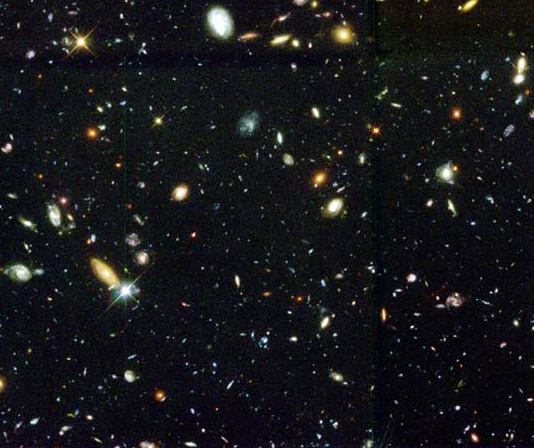
    There are many geometries of galaxies including the spiral galaxy characteristic of our own Milky Way. The above image is a segment of the remarkable deep field photograph made by the Hubble Space Telescope, every visible object except for the one obvious foreground star seems to be another galaxy. An even deeper view was obtained in the Hubble Ultra Deep Field in 2003-04. The Extreme Deep Field dated 2012 added greater resolution.

    银河有多种几何形态,包括我们银河系的旋涡状结构。上述图像是一张由哈勃太空望远镜拍摄的著名深场照片的一部分,除了显眼的前景恒星外,其他所有可见物体似乎都是其他星系。2003-04年,哈勃超深场拍摄得到了更深入的观测。2012年的极端深场照片提供了更高的分辨率。

    Elliptical galaxies usually have very little gas or dust and hence little evidence of new star formation. The spiral galaxies may have an abundance of gas and dust and show evidence of star formation in the form of lots of hot blue stars.

    椭圆星系通常含有非常少的气体或尘埃,因此缺乏新恒星形成的证据。旋涡星系可能含有大量的气体和尘埃,并以大量高温的蓝星的形式表现出恒星形成的证据。
    Andromeda galaxy
    仙女座星系
    Sombrero galaxy: M104
    Sombrero星系:M104
    Spiral galaxy: NGC 4414
    螺旋星系:NGC 4414
    Spiral galaxy: NGC 4603
    螺旋星系:NGC 4603
    Galaxy pair: NGC 3314
    星系对:NGC 3314
    NGC 6822
    M33
    M61
    M87
    Whirlpool galaxy, M51a
    涡旋星系,M51a
    Pinwheel galaxy, M101
    旋涡星系,M101
    Classification of galaxies
    星系分类
    Star Index
    星索引
    NASA图像
    Another Hubble deep space view
    另一幅哈勃空间视图
    Index

    U. Iowa

    Hubble's tuning fork, skyserver

    Hubble sequence, Wiki

    Galaxy concepts
    索引、爱荷华大学、哈勃调谐叉、skyserver 哈勃序列、维基百科星系概念
     
    HyperPhysics***** Astrophysics
    HyperPhysics ***** 天体物理学
    R Nave
    Go Back
    返回


    Seyfert Galaxies

    赛弗特星系

    The key to classifying a galaxy as a Seyfert Galaxy is the presence of broad emission lines from the bright, star-like nucleus. They are often strong radio and infrared sources. The first such active galaxies were discovered in 1943 by Carl Seyfert. Kaufmann cites the example of NGC 4151 which has 28% of its light concentrated in its emission lines. The emission lines include spectra of iron with 9 and 13 electrons stripped away, so the process involves very hot gases. The Seyfert galaxies exhibit variability and some have luminosities approaching the fainter quasars. Approximately 10% of the brightest galaxies in the sky are Seyferts. They are divided into Type 1 and Type 2 Seyferts.

    将星系分类为塞弗特星系的关键在于其明亮的、类似恒星的核区发出的宽发射线。它们通常也是强无线电和红外源。第一类这样的活跃星系是在1943年由卡尔·塞弗特发现的。卡弗曼举了NGC 4151的例子,该星系有28%的光集中在其发射线中。这些发射线包括铁的光谱,其中9个和13个电子被剥离,因此这一过程涉及非常热的气体。塞弗特星系表现出变异性,有些星系的亮度接近较暗的类星体。天空中亮度最高的星系中大约有10%是塞弗特星系。它们被分为类型1和类型2塞弗特星系。

    Seyferts are thought to be spiral galaxies with a quasar-like center.

    塞弗特星系被认为是有类星体中心的螺旋星系
    Index

    Galaxy concepts

    Reference
    Kaufmann
    索引星系概念参考Kaufmann
     
    HyperPhysics***** Astrophysics
    HyperPhysics ***** 天体物理学
    R Nave
    Go Back
    返回


    B L Lacertae Objects

    B L天琴座星体

    B L Lacertae objects are active galaxies characterized by rapid (days) luminosity variations and a lack of emission lines in their spectra. When variability takes place in periods less than a day, variable objects are sometimes called blasars.

    B L型天体是具有快速(天级)光变特征且其光谱中缺乏发射线的活动星系。当光变发生在不到一天的时期时,这类变星有时被称为 blasars。

    B L Lacertae objects are thought to be elliptical galaxies with quasar-like centers.

    B L天琴座星体被认为是有类星体中心的椭圆星系。
    Index

    Galaxy concepts
    索引星系概念
     
    HyperPhysics***** Astrophysics
    HyperPhysics ***** 天体物理学
    R Nave
    Go Back
    返回


    Blasars

    活动星系核

    A class of active galactic nuclei which show optical variability with periods on the order of a day or less are commonly referred to as blasars. They are further classified as radio-selected (RBL) and xray-selected (XBL). They are associated with the rapidly varying B L Lacertae objects.

    一类表现出日尺度或更短周期光学变异性活动星系核通常被称为BL Lac对象。它们进一步分为射电选定(RBL)和X射线选定(XBL)。它们与快速变化的BL天琴座对象相关。
    Index

    Galaxy concepts
    索引星系概念
     
    HyperPhysics***** Astrophysics
    HyperPhysics ***** 天体物理学
    R Nave
    Go Back
    返回