Hubble Deep Space Image
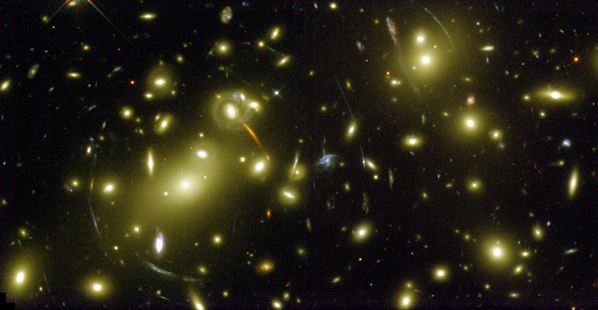
"Scanning the heavens for the first time since the successful December 1999 servicing mission, NASA's Hubble Space Telescope imaged a giant, cosmic magnifying glass, a massive cluster of galaxies called Abell 2218. This 'hefty' cluster resides in the constellation Draco, some 2 billion light-years from Earth. The cluster is so massive that its enormous gravitational field deflects light rays passing through it, much as an optical lens bends light to form an image. This phenomenon, called gravitational lensing, magnifies, brightens, and distorts images from faraway objects. The cluster's magnifying powers provides a powerful "zoom lens" for viewing distant galaxies that could not normally be observed with the largest telescopes. The picture is dominated by spiral and elliptical galaxies. Resembling a string of tree lights, the biggest and brightest galaxies are members of the foreground cluster. Researchers are intrigued by a tiny red dot just left of top center. This dot may be an extremely remote object made visible by the cluster's magnifying powers. Further investigation is needed to confirm the object's identity. The color picture already reveals several arc-shaped features that are embedded in the cluster and cannot be easily seen in the black-and- white image. The colors in this picture yield clues to the ages, distances, and temperatures of stars, the stuff of galaxies. Blue pinpoints hot young stars. The yellow-white color of several of the galaxies represents the combined light of many stars. Red identifies cool stars, old stars, and the glow of stars in distant galaxies. This view is only possible by combining Hubble's unique image quality with the rare lensing effect provided by the magnifying cluster." NASA description.
Image credit: NASA, A. Fruchter and the ERO Team, STScI, ST-ECF
| Classification of galaxies
星系分类 |
Galaxy concepts
| HyperPhysics********** Astrophysics
HyperPhysics ********** 天体物理学 | R Nave |