The Kepler Satellite
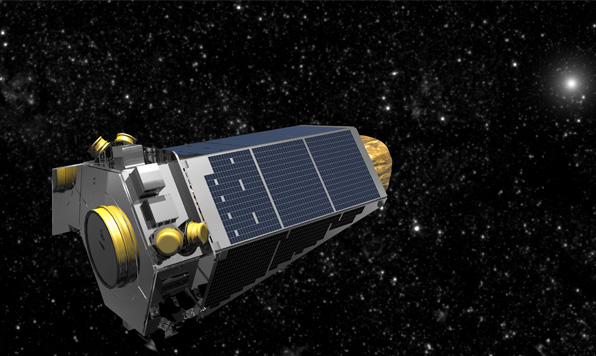
NASA Image
"The Kepler Mission was specifically designed to survey our region of the Milky Way galaxy to discover hundreds of Earth-size and smaller planets in or near the habitable zone and determine the fraction of the hundreds of billions of stars in our galaxy that might have such planets."
"The scientific objective of the Kepler Mission was to explore the structure and diversity of planetary systems. This is achieved by surveying a large sample of stars to:
- Determine the percentage of terrestrial and larger planets that are in or near the habitable zone of a wide variety of stars
确定宽种类恒星的适居带中或附近的大气行星和类地行星的百分比
- Determine the distribution of sizes and shapes of the orbits of these planets
确定这些行星轨道的大小和形状分布
- Estimate how many planets there are in multiple-star systems
估算多重星系中行星的数量
- Determine the variety of orbit sizes and planet reflectivities, sizes, masses and densities of short-period giant planets
确定短周期巨行星的轨道大小、行星反照率、大小、质量和密度的多样性
- Identify additional members of each discovered planetary system using other techniques
使用其他技术识别每个发现的行星系统中的其他成员
- Determine the properties of those stars that harbor planetary systems."
确定拥有行星系统的恒星的特性。
Kepler primarily used the transit method for detecting extrasolar planets. Kepler found planets by looking for tiny dips in the brightness of a star when a planet crosses in front of it - we say the planet transits the star. Once detected, the planet's orbital size can be calculated from the period and the mass of the star using Kepler's Third Law of planetary motion. The size of the planet is found from the depth of the transit (how much the brightness of the star drops) and the size of the star. From the orbital size and the temperature of the star, the planet's characteristic temperature can be calculated. From this the question of whether or not the planet is habitable (not necessarily inhabited) can be answered.
Launched on March 7, 2009, the Kepler satellite discovered more than 2,600 planets. The spacecraft was retired in a safe orbit on October 30, 2018. The role of hunting planets was transferred to the TESS satellite. Kepler took more data than could be immediately analyzed, so discoveries from that data were made years after the cessation of the mission. One of those discoveries was the planet Kepler-1649c orbiting around its host red dwarf star. This newly discovered exoplanet is in its star's habitable zone and is the closest to Earth in size and temperature found yet in Kepler's data.
References
Satellite Instruments
Kepler, NASA
Kepler 1649c
| HyperPhysics********** Astrophysics
HyperPhysics ********** 天体物理学 | R Nave |