Stark Effect in Atomic Spectra
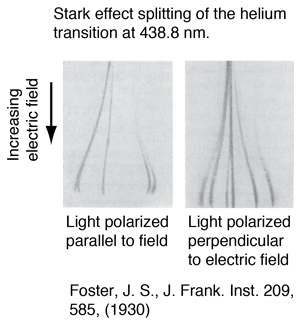 |
The splitting of atomic spectral lines as a result of an externally applied electric field was discovered by Stark, and is called the Stark effect. As the splitting of a line of the helium spectrum shows, the splitting is not symmetric like that of the Zeeman effect. 原子谱线在外部电场作用下发生分裂的现象是由斯塔克发现的,称为斯塔克效应。如氦谱线的分裂所示,这种分裂不像塞曼效应那样对称。
The splitting of the energy levels by an electric field first requires that the field polarizes the atom and then interacts with the resulting electric dipole moment. That dipole moment depends upon the magnitude of Mj, but not its sign, so that the energy levels show splitting proportional to quantum numbers J+1 or J+1/2, for integer and half-integer spins respectively. 电场使能级分裂首先需要使原子极化,然后与由此产生的电偶极矩相互作用。该偶极矩取决于M j的大小,但不取决于其符号,因此能级的分裂与量子数J+1或J+1/2成正比,分别对应整数自旋和半整数自旋。
The Stark effect has been of marginal benefit in the analysis of atomic spectra, but has been a major tool for molecular rotational spectra. 斯塔克效应在原子光谱分析中作用有限,但在分子旋转光谱分析中却是一个重要的工具。
|
Atomic Structure Concepts
Reference
Herzberg
Atomic Spectra
Ch 2, p 114.
| HyperPhysics***** Quantum Physics
HyperPhysics ***** 量子物理 | R Nave |