Bilingual edition: English is preserved and Chinese follows each unit. Terminology uses the confirmed v20260916 glossary; automated semantic review remains traceable.
中英双语版:英文原文完整保留,中文紧随对应单元;术语采用 v20260916 确认表,自动语义审校结果可追溯。

Noise Reduction and Tape Hiss

降噪与磁带嘶嘶声

The fidelity of a tape recording is limited by "tape hiss", high frequency random noise resulting from the fact that the magnetizations of the oxide particles of the magnetic emulsion do not add to exactly zero even in the absence of a recorded signal. Noise reduction systems like the Dolby and dbx systems help to overcome this by pre-emphasis of high frequency, low-intensity music signals upon recording so that they, along with the tape hiss, can be de-emphasized upon playback.

磁带录音的保真度受到“磁带嘶嘶声”(tape hiss)的限制,这是一种由磁带磁性颗粒的磁化不完全抵消所导致的高频随机噪声,即使在没有记录信号的情况下也是如此。降噪系统如Dolby和dbx系统通过在录音时对高频低强度的音乐信号进行预加重,从而在播放时减轻这种噪声和磁带嘶嘶声。
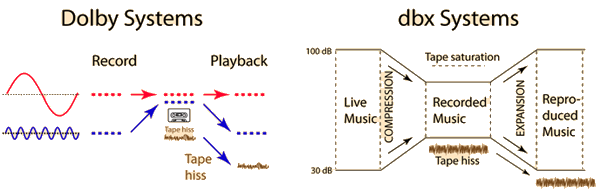
Active graphic. Click on either for more details.
动态图形。点击任一查看更多细节。
Index

Sound reproduction concepts

Tape recording concepts
索引 声学再现概念 磁带录音概念
 
HyperPhysics***** Sound
HyperPhysics ***** 声音
R Nave
Go Back
返回


Tape Hiss

磁带噪声
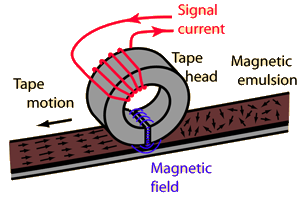
Once the signal is recorded by the tape head, the random variation in magnetization from the oxide granules gives a random noise signal up in the kilohertz range called "tape hiss"

On the unmagnetized tape, the oxide granules in the tape emulsion are almost completely random, but still have enough magnetization to give you a high pitched "frying" sound if you play the blank tape with high gain.

在未磁化的磁带中,磁带乳剂中的氧化物颗粒几乎完全随机分布,但仍有足够的磁化,如果你用高增益播放空白磁带,会发出高频率的‘煎炸’声。
一旦信号被磁头记录,氧化物颗粒中磁化程度的随机变化会在千赫兹范围内产生一种称为‘磁带嘶嘶声’的随机噪声信号

A persistent random noise signal from the residual magnetization of the oxide granules limits the fidelity of magnetic tape recording. Because of the small size and close spacing of the granules, the noise is of high frequency and is descriptively called "tape hiss". Fortunately, noise reduction schemes such as Dolby and dbx can discriminate against this tape hiss to provide higher fidelity tape recordings.

来自氧化物颗粒残留磁化的持续随机噪声信号限制了磁带录音的保真度。由于颗粒尺寸小且间距近,这种噪声具有高频特性,通常被称为“磁带嘶嘶声”。幸运的是,如Dolby和dbx这样的降噪方案可以抑制这种磁带嘶嘶声,从而提供更高保真度的磁带录音。
Index

Sound reproduction concepts

Tape recording concepts
索引 声学再现概念 磁带录音概念
 
HyperPhysics***** Sound
HyperPhysics ***** 声音
R Nave
Go Back
返回


dbx Noise Reduction

dbx 噪声降低

The dbx system is an compression-expansion scheme for increasing dynamic range and for decreasing tape hiss.

dbx系统是一种用于扩大动态范围和减少磁带噪声的压缩-扩展方案。

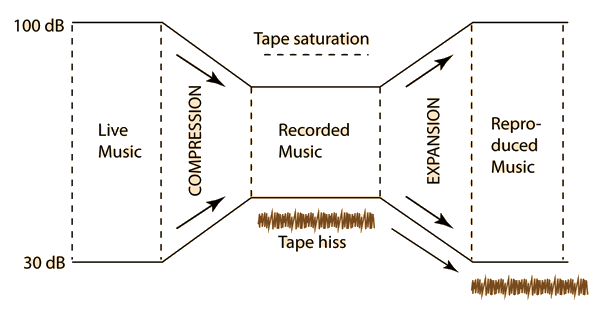
Two inherent problems with recording onto tape cassettes are the limitation on dynamic range for distortion-free recording and the presence of high-frequency tape hiss. The live music to be recorded might have a dynamic range of 70 decibels, but you will do well to get 40 dB of dynamic range recorded on the tape. If you have carefully matched electronics to squeeze or compress the signal to 40 dB before recording and expand it back to 70 dB upon playback you can not only retain more of the dynamic range of the original music but also accomplish some tape noise reduction in the process. Note that soft music signals are made larger than the tape hiss level for recording, and then they are made smaller again on playback. This playback expansion also reduces tape hiss dramatically. Note also that the compression avoids distortion from tape saturation.

使用磁带录音机录音时固有的两个问题在于:为了无失真录音所限制的动态范围以及存在高频的磁带噪声。要录音的现场音乐可能有70分贝的动态范围,但你最好能将40分贝的动态范围记录在磁带上。如果你已经仔细匹配了电子设备,将信号压缩或削峰到40分贝后再进行录音,并在回放时将其恢复到70分贝,你不仅能保留原始音乐更多的动态范围,还能在过程中实现一些磁带噪声的降低。请注意,柔和的音乐信号在录音时会被放大到高于磁带噪声的水平,然后在回放时又被减小。这种回放扩增也显著降低了磁带噪声。另外,压缩过程避免了磁带饱和的失真。
Noise reduction and tape hiss
降噪与磁带嘶嘶声
Index

Sound reproduction concepts

Tape recording concepts
索引 声学再现概念 磁带录音概念
 
HyperPhysics***** Sound
HyperPhysics ***** 声音
R Nave
Go Back
返回