Bilingual edition: English is preserved and Chinese follows each unit. Terminology uses the confirmed v20260916 glossary; automated semantic review remains traceable.
中英双语版:英文原文完整保留,中文紧随对应单元;术语采用 v20260916 确认表,自动语义审校结果可追溯。

Decreasing Distortion with Feedback

通过反馈减少失真

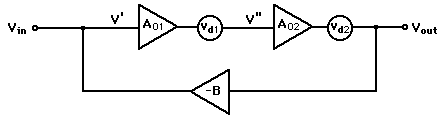
The use of negative feedback can discriminate against sources of noise or distortion within an amplifier. Considering a two-stage amplifer (after Simpson) with sources of distortion vd1 and vd2 inside the feedback loop.

负反馈的使用可以抑制放大器内部的噪声或失真源。考虑一个两阶段放大器(仿照Simpson), 其中反馈环内存在失真源v d1和v d2。
Solving for the output voltage gives
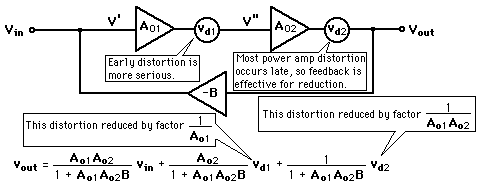
which shows discrimination against the distortion voltages.

Distortion reduction takes the form below for this amplifier, showing that distortion within the feedback loop is discriminated against, with more reduction of distortion which arises near the output.

这种放大器的失真度降低形式如下所示,表明反馈环路内的失真被抑制,靠近输出端的失真得到更显著的降低。
Why use negative feedback?
为何使用负反馈?
求解输出电压得到的是对失真电压的抑制。
Index

Electronics concepts

Feedback concepts

Reference
Simpson
Sec 7.2
索引 电子概念 反馈概念 参考 斯impson 第7章第2节
 
HyperPhysics*****Electricity and magnetism
HyperPhysics ***** 电磁学
R Nave
Go Back
返回


Increasing the Bandwidth

增加带宽

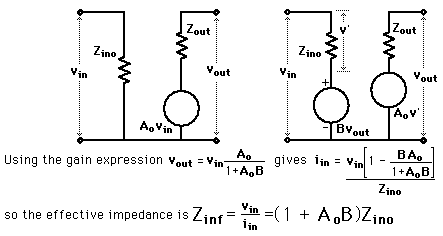
Amplifier gain will generally decrease at higher frequencies, but the contribution of negative feedback in stabilizing voltage gain and making it nearly independent of the open-loop gain is a major contribution to extending the useful frequency range of amplifiers.

放大器的增益在高频时通常会下降,但负反馈在稳定电压增益并使其几乎不依赖于开环增益方面的作用,是扩展放大器有用频率范围的主要因素。
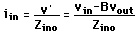
The input impedance is
输入阻抗是
which without negative feedback is Zin0 .
没有负反馈时,阻抗为Z in0。
But with feedback, the current is reduced to
但带有反馈时,电流会降低到
Why use negative feedback?
为何使用负反馈?
Index

Electronics concepts

Feedback concepts

Reference
Simpson
Sec 7.2
索引 电子概念 反馈概念 参考 斯impson 第7章第2节
 
HyperPhysics*****Electricity and magnetism
HyperPhysics ***** 电磁学
R Nave
Go Back
返回