Binary Coded Decimal二进制编码十进制
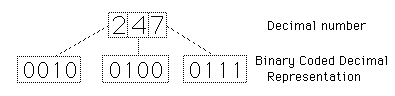
One of the most widely used representations of numerical data is the binary coded decimal (BCD) form in which each integer of a decimal number is represented by a 4-bit binary number (see conversion table). It is particularly useful for the driving of display devices where a decimal output is desired. BCD usually refers to such coding in which the binary digits have their normal values, i.e., 8421. Sometimes it is written "8421 BCD" to clearly distinguish it from other binary codes such as the 4221 Code, but when BCD is used without qualification, the 8421 version is assumed. 数值数据最常用的表示方法之一是二进制编码十进制(BCD)形式,其中每个十进制数的整数部分用4位二进制数表示(见转换表)。它特别适用于需要驱动显示设备以产生十进制输出的情况。BCD通常指的是这种编码方式,其中二进制数字具有正常值,即8421。有时会写成“8421 BCD”以明确区别于其他二进制编码,如4221码,但当BCD未加说明时,默认使用8421版本。
![]()
|
Index Electronics concepts Digital Circuits 索引 电子学概念 数字电路 | ||
|
Go Back
返回 |
Excess-3 Code过3码
In this code, a digit is represented by adding 3 to the number and then converting it to a 4-bit binary number. It can be used for the representation of multi-digit decimal numbers as can BCD. This code along with the 4221 code have some advantages for performing decimal arithmetic. 在该电码中,一个数字是通过将数字加3后转换为4位二进制数来表示的。它也可以用于多数字十进制数的表示,就像BCD一样。该电码与4221电码在进行十进制运算时具有一些优势。
|
Index Electronics concepts Digital Circuits 索引 电子学概念 数字电路 | ||
|
Go Back
返回 |
4221 Code4221电码
There are several codes which use binary numbers to code for single digits in multi-digit decimal numbers. This code assigns the values 4,2,2,1 instead of 8,4,2,1 to the four binary digits. It can properly be called binary coded decimal, but that designation (BCD) is usually reserved for the 8,4,2,1 code. This code is sometimes written 4221 BCD. This code along with the excess-3 code have some advantages for performing decimal arithmetic. 存在几种使用二进制数来表示多位十进制数中单个数字的编码。这种编码将四个二进制数字的值设为4,2,2,1,而不是8,4,2,1。它可以恰当地称为二进制编码十进制,但该名称(BCD)通常用于8,4,2,1编码。这种编码有时也写作4221 BCD。这种编码与超量3编码在进行十进制运算时具有一些优势。
|
Index Electronics concepts Digital Circuits 索引 电子学概念 数字电路 | ||
|
Go Back
返回 |
Gray Code灰码
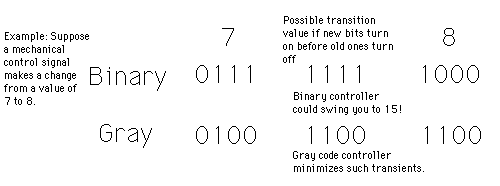
A code designed to minimize errors during the transition between one code value and another, this code changes only one bit from one sequential value to another. It is used for shaft encoders and other applications where mechanical control using a digital code requires the minimizing of stresses which might occur if an erronius value was sent during a transition. The rule for generating the code is: begin with all zeros and change the least significant bit that will bring you to a new state. 一种设计用于在代码值之间转换时最小化错误的代码,这种代码在从一个连续值转换到另一个值时只改变一个比特。它用于转码器和其他需要使用数字代码进行机械控制的应用,其中在转换过程中如果发送了错误的值,可能会产生应力,因此需要最小化这种应力。生成该代码的规则是:从全零开始,改变最低有效位以达到新状态。
![]()
|
Index Electronics concepts Digital Circuits 索引 电子学概念 数字电路 | ||
|
Go Back
返回 |