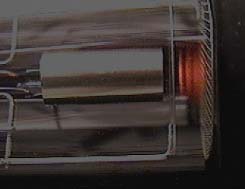
The Franck-Hertz Experiment*弗兰克-赫兹实验
In 1914, James Franck and Gustav Hertz performed an experiment which demonstrated the existence of excited states in mercury atoms, helping to confirm the quantum theory which predicted that electrons occupied only discrete, quantized energy states. Electrons were accelerated by a voltage toward a positively charged grid in a glass envelope filled with mercury vapor. Past the grid was a collection plate held at a small negative voltage with respect to the grid. The values of accelerating voltage where the current dropped gave a measure of the energy necessary to force an electron to an excited state. ![]() 1914年,詹姆斯·弗兰克和古斯塔夫·赫兹进行了一个实验,该实验证明了汞原子中存在激发态,有助于确认量子理论,该理论预测电子只能占据离散的、量化的能量状态。电子被加速电压加速,朝一个带正电的网格移动,该网格位于一个充满汞蒸气的玻璃封套内。穿过网格后,有一个收集板,其相对于网格保持较小的负电压。加速电压在电流下降时的值,可以测量迫使电子进入激发态所需的能量。 *Nobel Prize in physics, 1925
*1925年物理学诺贝尔奖 |
Index
索引 | ||||
|
Go Back
返回 |
The Franck-Hertz Experiment弗兰克-赫兹实验
Electrons are accelerated in the Franck-Hertz apparatus and the collected current rises with accelerated voltage. As the Franck-Hertz data shows, when the accelerating voltage reaches 4.9 volts, the current sharply drops, indicating the sharp onset of a new phenomenon which takes enough energy away from the electrons that they cannot reach the collector. This drop is attributed to inelastic collisions between the accelerated electrons and atomic electrons in the mercury atoms. The sudden onset suggests that the mercury electrons cannot accept energy until it reaches the threshold for elevating them to an excited state. This 4.9 volt excited state corresponds to a strong line in the ultraviolet emission spectrum of mercury at 254 nm (a 4.9eV photon). Drops in the collected current occur at multiples of 4.9 volts since an accelerated electron which has 4.9 eV of energy removed in a collision can be re-accelerated to produce other such collisions at multiples of 4.9 volts. This experiment was strong confirmation of the idea of quantized atomic energy levels. 电子在弗兰克-赫兹装置中被加速,收集电流随加速电压升高而增加。弗兰克-赫兹实验数据表明,当加速电压达到4.9伏时,电流突然下降,表明一种新现象的突然出现,该现象从电子中移除足够的能量,使它们无法到达收集器。这一下降归因于被加速电子与汞原子中电子之间的非弹性碰撞。这种突然的出现表明,汞原子中的电子在达到激发态所需的阈值之前无法接受能量。这一4.9伏的激发态对应于汞在紫外发射光谱中254 nm处的强谱线(一个4.9 eV的光子)。收集电流的下降发生在4.9伏的倍数上,因为被加速电子在碰撞中损失了4.9 eV的能量,可以再次被加速,从而在4.9伏的倍数处产生更多的此类碰撞。该实验是对原子能级量子化概念的有力证实。
|
Index Franck- Hertz Experiment 弗兰克-赫兹实验索引 | ||
|
Go Back
返回 |
Sketch of Franck-Hertz Apparatus弗兰克-赫兹装置草图
![]() |
Index Franck- Hertz Experiment 弗兰克-赫兹实验索引 | ||
|
Go Back
返回 |
Franck-Hertz Data for Mercury汞的弗兰克-赫兹数据
|
Index Franck- Hertz Experiment 弗兰克-赫兹实验索引 | ||||
|
Go Back
返回 |
Franck-Hertz Data for Neon氖的弗兰克-赫兹数据
|
Index Franck- Hertz Experiment 弗兰克-赫兹实验索引 | ||
|
Go Back
返回 |