Bilingual edition: English is preserved and Chinese follows each unit. Terminology uses the confirmed v20260916 glossary; automated semantic review remains traceable.
中英双语版:英文原文完整保留,中文紧随对应单元;术语采用 v20260916 确认表,自动语义审校结果可追溯。

Freefall Velocity vs Distance for Quadratic Drag

二次阻力下的自由下落速度与距离

A freely falling object will be presumed to experience an air resistance force proportional to the square of its speed. The downward direction will be taken as positive, and the velocity as a function of distance y for an object dropped from rest is the object of the calculation. The expressions will be developed for the two forms of air drag which will be used for trajectories
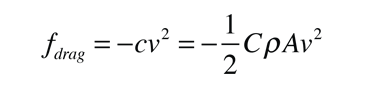
一个自由下落的物体将被假设受到与速度平方成正比的空气阻力力。向下方向取为正,一个从静止下落的物体在距离y处的速度作为函数,是本次计算的对象。将推导出两种空气阻力形式的表达式,这些表达式将用于轨迹计算。

The freefall velocity as a function of time if dropped from rest is given by
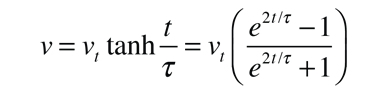
从静止下落时,速度随时间的变化关系为

This equation may be converted to one in which the independent variable is distance instead of time by making use of the expression
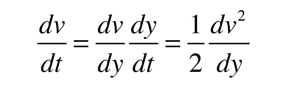
这个方程可以通过利用下列表达式转换为以距离代替时间作为独立变量的方程

This can be used to rewrite the motion equation above as
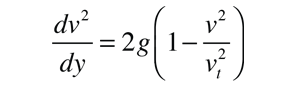
这可以用来重写上面的运动方程为

This equation is solved by the following procedure:
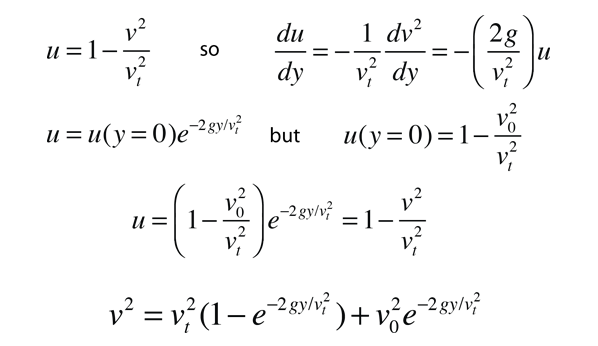
该方程通过以下步骤求解:

This expresses the freefall velocity v in terms of the fall distance y. It has two exponential decay terms so that after a sufficient fall distance, the velocity is essentially the terminal velocity vt. A characteristic length vt2/2g expresses a distance where the velocity approaches vt.

这表达了自由下落速度 v 与下落距离 y 之间的关系。它包含两个指数衰减项,因此在足够大的下落距离后,速度接近终端速度 v_t。一个特征长度 v_t²/(2g) 表示一个速度接近 v_t 的距离。
Index

Fluid friction

Reference
Fowles & Cassiday
Sec. 2.4
索引 流体摩擦 参考 Fowles & Cassiday 第2.4节
 
HyperPhysics***** Mechanics ***** Fluids
HyperPhysics ***** 力学 ***** 流体
R Nave
Go Back
返回


Freefall Velocity vs Height for Quadratic Drag

考虑二次阻力的自由下落速度与高度关系

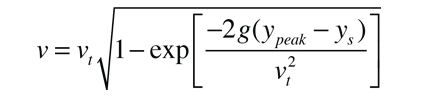
A freely falling object will be presumed to experience an air resistance force proportional to the square of its speed. The downward direction will be taken as positive, and the velocity as a function of the height ys for an object dropped from a peak height ypeak is the object of the calculation. Note that ys is being used as the height above the surface in this case, so it is not the same as the y in the above development. From that development above, the velocity as a function of the distance of fall from the peak height is given by

一个自由下落的物体将被假定受到一个与速度平方成正比的空气阻力力。向下方向取为正,物体从峰顶高度 y_peak 下落时,其高度 y_s 的速度作为函数是计算的对象。请注意,在这种情况下,y_s 是指表面以上的高度,因此它与上面发展的 y 不同。从上面的发展中,物体从峰顶高度下落时的速度作为下落距离的函数为

where y = ypeak - ys. For this application v0=0 since the velocity is zero at the peak height. The expression for v then becomes

其中 y = y peak - y s 。对于这种应用,由于速度在峰值高度处为零,因此 v 0 = 0 。则 v 的表达式变为

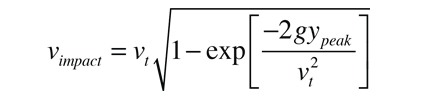
The velocity at impact can then be obtained for ys=0:

碰撞时的速度可以由此得到,当 y_s = 0 时:

These expressions are used in the vertical trajectory calculation.

这些表达式用于垂直轨迹计算。
Index

Fluid friction

Reference
Fowles & Cassiday
Sec. 2.4
索引 流体摩擦 参考 Fowles & Cassiday 第2.4节
 
HyperPhysics***** Mechanics ***** Fluids
HyperPhysics ***** 力学 ***** 流体
R Nave
Go Back
返回