Bilingual edition: English is preserved and Chinese follows each unit. Terminology uses the confirmed v20260916 glossary; automated semantic review remains traceable.
中英双语版:英文原文完整保留,中文紧随对应单元;术语采用 v20260916 确认表,自动语义审校结果可追溯。

Vertical Trajectory

竖直轨迹

Objects moving at high speeds through air encounter air drag proportional to the square of the velocity. Describing the motion of objects under this quadratic drag usually requires numerical techniques rather than straight analytic formuli since the drag force and the gravitational force are not acting along the same line. The case of the vertical trajectory can be treated analytically since the forces are colinear. It is common practice to express the velocity and time in terms of the terminal velocity vt and a characteristic time τ. The characteristic time is defined as the terminal velocity divided by the acceleration of gravity, τ = vt/g.

高速通过空气运动的物体会遇到与速度平方成正比的空气阻力。描述这种二次阻力作用下物体的运动通常需要数值方法而不是直接的解析公式,因为阻力和重力并不沿同一直线作用。垂直轨迹的情况可以解析处理,因为作用力是共线的。通常习惯将速度和时间用终端速度 $ v_t $ 和特征时间 $ au $ 来表示。特征时间定义为终端速度除以重力加速度,$ au = v_t /g $。
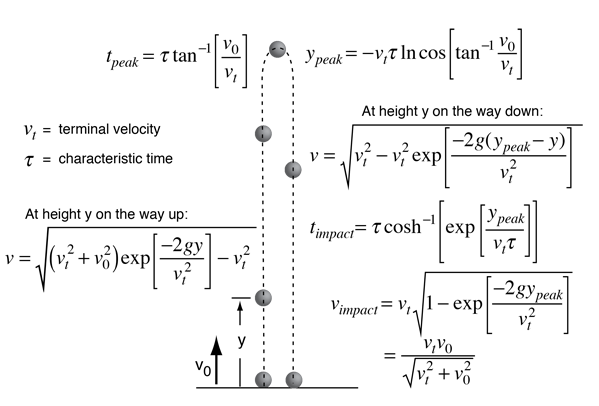
Click on a formula for its development

Two common approaches to the quadratic drag force are:

两种常见的二次阻力处理方法是:
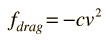
1. Express the drag in terms of a single drag coefficient c:
Calculation
计算
用单一的阻力系数c表示阻力:
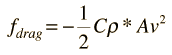
2. Assume that drag is proportional to cross-sectional area and express in terms of area and a shape-dependent drag coefficient C:
Calculation
计算
2. 假设阻力与横截面积成正比,并用面积和一个与形状有关的阻力系数 $ C $ 表达:
点击公式以了解其开发
Index

Fluid friction
索引流体摩擦
 
HyperPhysics***** Mechanics ***** Fluids
HyperPhysics ***** 力学 ***** 流体
R Nave
Go Back
返回


Vertical Trajectory Calculation

垂直轨迹计算

This is a model calculation for a vertical trajectory of a sphere of radius
r = cm and density ρ = kg/m3 = gm/cm3

the mass is m = gm.

质量是 m = 克。
中文译文中的待填/计算数值依次对应:1:m。实际数值以上方原输入框为准。
这是一个垂直轨迹的模型计算,球体半径为 r = cm,密度 ρ = kg/m 3 = gm/cm 3
中文译文中的待填/计算数值依次对应:1:r 2:d 3:dg。实际数值以上方原输入框为准。

Assume the object has a drag coefficient C = (the default value is C = 0.5 for a sphere) and is falling through air with density ρ* = kg/m3 (the default value is 1.29 kg/m3).

假定物体的阻力系数 C = (默认值为 C = 0.5 对于球体) ,并以密度 ρ* = kg/m³ (默认值为 1.29 kg/m³) 通过空气。
中文译文中的待填/计算数值依次对应:1:c 2:da。实际数值以上方原输入框为准。

Under these conditions, it's terminal velocity will be
vt = m/s
vt = km/hr
vt = mi/hr

在这些条件下,它的终端速度将是 v_t = m/s,v_t = km/hr,v_t = mi/hr
中文译文中的待填/计算数值依次对应:1:vt 2:vtk 3:vtc。实际数值以上方原输入框为准。

and its characteristic time is
τ = s.

If this sphere is launched vertically with a velocity of
v0 = m/s = ft/s

如果这个球以初速度 v₀ = m/s = ft/s 垂直发射
中文译文中的待填/计算数值依次对应:1:v0 2:v0c。实际数值以上方原输入框为准。

then on the way up at height y1 = m = ft
it will have velocity v1 = m/s = ft/s

然后在上升过程中,当高度为 y₁ = m = ft 时,它将具有速度 v₁ = m/s = ft/s
中文译文中的待填/计算数值依次对应:1:y1 2:y1c 3:v1 4:v1c。实际数值以上方原输入框为准。

It will reach a peak height ypeak = m = ft
at time tpeak = s

它将在时间 t peak = s 达到峰值高度 y peak = m = ft
中文译文中的待填/计算数值依次对应:1:yp 2:ypc 3:tp。实际数值以上方原输入框为准。

On the way down at height y2 = m = ft
it will have velocity v2 = m/s = ft/s

在高度 y₂ = m = ft 下落时,其速度将为 v₂ = m/s = ft/s
中文译文中的待填/计算数值依次对应:1:y2 2:y2c 3:v2 4:v2c。实际数值以上方原输入框为准。

It will reach the ground at velocity
vimpact = m/s = ft/s = km/hr = mi/hr
at time timpact = s after its peak height.

它将在接地时以速度 v 冲击,单位为 m/s = ft/s = km/hr = mi/hr,时间为 t impact = s,发生在峰值高度之后。
中文译文中的待填/计算数值依次对应:1:vf 2:vfc 3:vfk 4:vfm 5:tf。实际数值以上方原输入框为准。

For comparison, if there were no air friction the projectile would have reached height
h = m = ft
and would impact with the original launch velocity at time t = s.

相比之下,若无空气摩擦,弹体将达到高度 h = m = ft,并在时间 t = s 时以原发射速度撞击。
中文译文中的待填/计算数值依次对应:1:h 2:hc 3:t2。实际数值以上方原输入框为准。
其特征时间是 τ = s。
中文译文中的待填/计算数值依次对应:1:tau。实际数值以上方原输入框为准。
Index

Fluid friction
索引流体摩擦
 
HyperPhysics***** Mechanics ***** Fluids
HyperPhysics ***** 力学 ***** 流体
R Nave
Go Back
返回