Bilingual edition: English is preserved and Chinese follows each unit. Terminology uses the confirmed v20260916 glossary; automated semantic review remains traceable.
中英双语版:英文原文完整保留,中文紧随对应单元;术语采用 v20260916 确认表,自动语义审校结果可追溯。

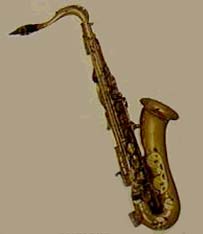
The Saxophone

萨克斯管

The soprano saxophone is 40 cm long and has a range of about 2 1/2 octaves, from A3-flat to E6-flat. The alto sax covers D3 to A5-flat. The family of saxophones patented in 1846 by Adolphe Sax combines the single reed of the clarinet with the bore and fingering patterns of the oboe, producing the tonal qualities of neither. Saxophones are made in eight sizes and pitch levels, spanning the entire spectrum of wind-instrument pitches. The most common are the alto and tenor saxophones. They have been effectively used in jazz bands and popular dance orchestras.

女高音萨克斯管长40厘米,音域约为2又1/2个八度,从A3降音到E6降音。次女高音萨克斯管的音域为D3到A5降音。萨克斯管家族于1846年由阿道夫·萨克斯发明,结合了单簧管的单簧片与双簧管的管身和指孔排列,产生出既非单簧管也非双簧管的音色。萨克斯管有八种尺寸和音高级别,覆盖了整个管乐器的音域。最常见的两种是次女高音萨克斯管和男高音萨克斯管。它们已被有效地用于爵士乐队和流行舞曲管弦乐队中。
Further details
进一步详情
Example waveforms
示例波形
Index

Woodwind instruments

Musical instruments
索引 长笛类乐器 音乐乐器
 
HyperPhysics***** Sound
HyperPhysics ***** 声音
R Nave
Go Back
返回


The Saxophone

萨克斯管

In comparison with the other widely used single reed instrument, the clarinet, the saxophone employs a conical air column compared to the clarinet's cylindrical column. This implies that it sounds all harmonics of the air column rather than just the odd harmonics of a closed cylinder. It also implies that the first upper register is one octave up (2nd harmonic) rather than an octave plus a fifth (3rd harmonic) for the clarinet.

与另一种广泛使用的单簧管乐器——萨克斯管相比,管风琴使用的是圆锥形气柱,而萨克斯管使用的是圆柱形气柱。这表明萨克斯管发出的是气柱的所有谐波,而管风琴则只发出封闭圆柱形气柱的奇数谐波。此外,这也意味着萨克斯管的最低泛音是比管风琴高一个八度(第二谐波)而非一个八度加五度(第三谐波)。

Within a register, opening a hole will shorten the air column and produce a higher note. This sounds simple, but saxophone construction shows that it is not! The precise amount of "shortening" of the air column depends upon the size of the hole. For a large hole, the effective length is essentially the distance from the mouthpiece to the hole, but for smaller holes the length is effectively longer than that. For saxophones, the holes for higher notes (holes nearer the mouthpiece) are small, but they are made progressively larger for lower notes. For the larger of these holes, keys are necessary to accomplish their covering.

在按键内,开孔会缩短空气柱,从而发出更高的音调。这听起来很简单,但萨克斯管的构造却表明并非如此!空气柱的精确缩短量取决于孔的大小。对于大的孔,有效长度基本上是从哨片到孔的距离,但对于小孔,长度实际上会更长。对于萨克斯管来说,高音孔(靠近哨片的孔)较小,但随着低音孔的音高降低,这些孔逐渐变大。对于较大的孔,需要使用按键来覆盖它们。

Ingham suggests that there is a median taper for the cone that affects the tuning of the upper harmonics: "A cone that is too closed renders the upper harmonics progressively sharp, whilst a cone that is too open will overblow flat." p27.

Saxophone illustration
萨克斯管示意图
Ingham认为,锥体的中等锥度会影响上泛音的调谐:‘过于封闭的锥体会使上泛音逐渐变尖,而过于开放的锥体则会使泛音偏低。’ p27。
Index

Woodwind instruments

Musical instruments
索引 长笛类乐器 音乐乐器
 
HyperPhysics***** Sound
HyperPhysics ***** 声音
R Nave
Go Back
返回


Adolphe Sax

阿道夫·萨克斯

Adophe Sax was born on November 6, 1814 in Dinant, Belgium. He was the son of a musical instrument maker, and thus was exposed early to the details of musical instrument design. He sought to make an instrument similar to the clarinet which would produce an upper register an octave up, rather than an octave plus a fifth as in the clarinet. He also sought to make an instrument which would bridge between the strings and woodwinds for orchestral playing, and between the woodwinds and brass in the military band setting. Sax envisioned a total of 14 variations on the saxophone, and obtained patents for his basic design in 1846.

阿道夫·萨克斯于1814年11月6日出生于比利时丁当。他是位音乐乐器制作者之子,因此从小就接触到音乐乐器的设计细节。他试图制造一种类似单簧管的乐器,该乐器能产生比单簧管高一个八度的音域,而单簧管的音域则是比单簧管高一个八度加五度。他同时还希望制造一种能衔接弦乐与木管乐器用于交响乐演奏,以及衔接木管与铜管乐器用于军乐队演奏的乐器。萨克斯设想了14种不同版本的萨克斯管,并于1846年为他的基本设计申请了专利。
Saxophone discussion
萨克斯管讨论
Index

Woodwind instruments

Musical instruments
索引 长笛类乐器 音乐乐器
 
HyperPhysics***** Sound
HyperPhysics ***** 声音
R Nave
Go Back
返回