Crystal Microphone
|
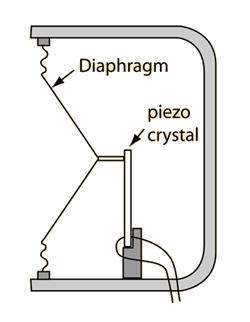
Crystals which demonstrate the piezoelectric effect produce voltages when they are deformed. The crystal microphone uses a thin strip of piezoelectric material attached to a diaphragm. The two sides of the crystal acquire opposite charges when the crystal is deflected by the diaphragm. The charges are proportional to the amount of deformation and disappear when the stress on the crystal disappears. Early crystal microphones used Rochelle salt because of its high output, but it was sensitive to moisture and somewhat fragile. Later microphones used ceramic materials such as barium titanate and lead zirconate. The electric output of crystal microphones is comparatively large, but the frequency response is not comparable to a good dynamic microphone, so they are not serious contenders for the music market.
|
|
Index
Sound reproduction concepts
Reference
White & White
p299. |
| |
Go Back |
Directional Patterns of Microphones
| Characteristic | Omnidirectional | Cardioid | Supercardioid | Hypercardioid | Bidirectional |
Pickup arc
3 dB down | ... | 131° | 115° | 105° | 90° |
Pickup arc
6 dB down |
| ... | 180° | 156° | 141° | 120° |
Relative output at
90° in dB | 0 | -6 | -8.5 | -12 | -inf |
Relative output at
180° in dB | 0 | -inf | -12 | -6 | 0 |
Angle at which
output = 0 | ... | 180° | 127° | 110° | 90° |
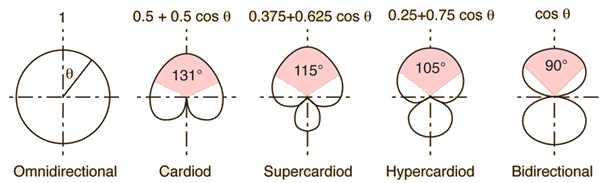
The variety of directional patterns are often characterized by the arc within which they pick up at least half the peak value. In decibels, a drop of 3 dB represents half the power and 6 dB down is one fourth the power.
With any of the microphone mechanisms, different directional patterns of response can be produced. Common directional patterns are called cardiod (for heart shaped) and omnidirectional. There are also "figure-eight" patterns which accept sound from front and rear. The parabolic microphone is unidirectional in the extreme!
One directional technique used is the "stereo microphone" which may be constructed from two condenser microphones attached to each other so that their peak response directions are 90° apart. Although stereo effects may be obtained with two separate microphones, the stereo pair offers a way to get some stereo effect with a single microphone placement.
Index
Sound reproduction concepts
Reference
Huber & Runstein |
| |
Go Back |
Parabolic Microphone
|
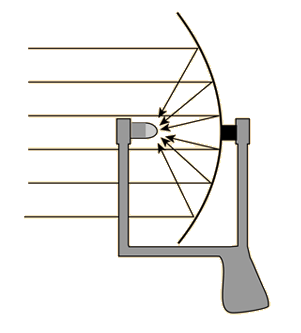
For recording distant bird or animal sounds, or for just plain eavesdropping, it is hard to beat the directionality and sensitivity of the parabolic microphone.
|
|
|
Index
Sound reproduction concepts |
| |
Go Back |