Bilingual edition: English is preserved and Chinese follows each unit. Terminology uses the confirmed v20260916 glossary; automated semantic review remains traceable.
中英双语版:英文原文完整保留,中文紧随对应单元;术语采用 v20260916 确认表,自动语义审校结果可追溯。

Decibels

分贝

The sound intensity I may be expressed in decibels above the standard threshold of hearing I0. The expression is

声音的强度 I 可以表示为比标准听阈 I₀ 高的分贝数。表达式为

The logarithm involved is just the power of ten of the sound intensity expressed as a multiple of the threshold of hearing intensity. Example: If I = 10,000 times the threshold, then the ratio of the intensity to the threshold intensity is 104, the power of ten is 4, and the intensity is 40 dB:

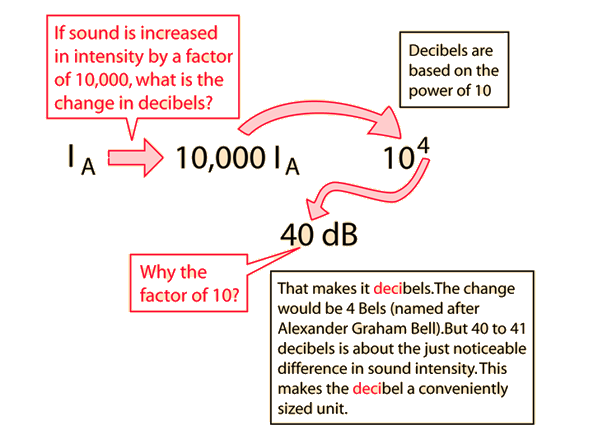
所涉及的对数只是将声音强度表示为听阈强度的倍数的十的幂。例如:如果 I 是阈值强度的 10,000 倍,那么强度与阈值强度的比值是 10⁴,十的幂是 4,强度为 40 dB:

The factor of 10 multiplying the logarithm makes it decibels instead of Bels, and is included because about 1 decibel is the just noticeable difference (JND) in sound intensity for the normal human ear.

乘以10的因子使它成为分贝而不是贝尔,这是因为正常人类听觉中声音强度的可察觉差异(JND)大约为1分贝。

Decibels provide a relative measure of sound intensity. The unit is based on powers of 10 to give a manageable range of numbers to encompass the wide range of the human hearing response, from the standard threshold of hearing at 1000 Hz to the threshold of pain at some ten trillion times that intensity.

分贝提供了一个相对的声强测量。该单位基于10的幂次,以提供一个可管理的数值范围,涵盖人类听觉响应的广泛范围,从标准的1000 Hz听阈到疼痛阈值,后者是该强度的十万亿倍。

Another consideration which prompts the use of powers of 10 for sound measurement is the rule of thumb for loudness: it takes about 10 times the intensity to sound twice as loud.

另一个促使使用10的幂来测量声音的原因是关于响度的常识:要使声音听起来大两倍,大约需要10倍的强度。
Decibel calculation
分贝计算
Dynamic levels of music in dB
音乐动态水平(分贝)
Power in dBm
以dBm为单位的功率
Index

Sound level measurement
索引声音电平测量
 
HyperPhysics***** Sound
HyperPhysics ***** 声音
R Nave
Go Back
返回


Decibels and Logarithms

分贝与对数

The decibel scale is a reflection of the logarithmic response of the human ear to changes in sound intensity:

分贝标度反映了人类耳对声音强度变化的对数响应:

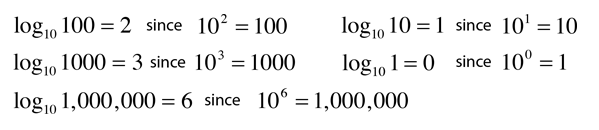
The logarithm to the base 10 used in this expression is just the power of 10 of the quantity in brackets according to the basic definition of the logarithm:

本表达式中使用的以10为底的对数就是括号内量的10的幂次,根据对数的基本定义:

Examples:

例子:
Decibel calculation
分贝计算
Index

Sound level measurement
索引声音电平测量
 
HyperPhysics***** Sound
HyperPhysics ***** 声音
R Nave
Go Back
返回


Decibel Calculation

分贝计算

The sound intensity in decibels above the standard threshold of hearing is calculated as a logarithm. If the intensity as a multiple of threshold is

声强以分贝计,超过标准听阈的声强是通过对数计算得到的。如果声强是阈值的倍数,则
= x 10^

then the intensity in decibels is given by

然后以分贝表示的强度是
dB
分贝

Decibels can also be used to express the relative intensity of two sounds. If one is expressed as a multiple of the other:

分贝也可以用来表示两个声音的相对强度。如果一个声音是另一个声音的倍数关系:
IA = xIB = x 10^xIB

then the difference in decibels is given by

然后分贝差由
IA = dB above IB
I_A = dB above I_B
中文译文中的待填/计算数值依次对应:1:dba。实际数值以上方原输入框为准。

If you know the sound level in decibels at one distance in an open area, then you can estimate the dB level at another distance by making use of the inverse square law.

如果你知道开放区域中某一点距离处的声压级(单位:分贝),则可以利用反平方定律估算另一距离处的分贝级。
Index

Sound level measurement
索引声音电平测量
 
HyperPhysics***** Sound
HyperPhysics ***** 声音
R Nave
Go Back
返回


JND in Sound Intensity

声音强度的Just-Notice-Difference

A useful general reference is that the just noticeable difference in sound intensity for the human ear is about 1 decibel.

对人类耳朵来说,声音强度的可察觉差异大约为1分贝。
JND = 1 decibel

In fact, the use of the factor of 10 in the definition of the decibel is to create a unit which is about the least detectable change in sound intensity.

事实上,在分贝定义中使用10的因子,是为了创建一个单位,该单位大约对应声音强度的最小可检测变化。

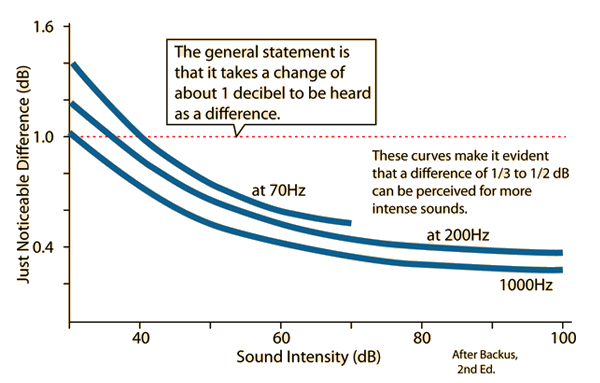
That having been established, it can be noted that there are some variations. The jnd is about 1 dB for soft sounds around 30-40 dB at low and midrange freqencies. It may drop to 1/3 to 1/2 a decibel for loud sounds.

上述情况已确立,可以注意到存在一些差异。对于30-40分贝范围内的低频和中频软声,听觉阈值(jnd)约为1分贝。对于 loud sounds,这一值可能降至1/3到1/2个分贝。

Caution must be used in applying the "one decibel" criterion. It presumes that you are increasing the same sound by one decibel. If you were adding a sound outside the critical band of frequency from this sound, you would be exciting fresh nerve endings, and the one decibel rule can't be presumed to apply. This causes some concern about the perceptual encoding schemes used with modern digital recording which might eliminate some significant audible content by the use of a "one decibel" criterion for dropping content.

在应用“一分贝”准则时必须谨慎。该准则假定你是在对同一声音增加一分贝。如果你添加的是处于该声音临界带以外的其他声音,就会激发新的神经末梢,因此不能假定“一分贝”准则适用。这引发了一些关于现代数字录音中使用的感知编码方案的担忧,这些方案可能会通过使用“一分贝”准则来删除一些显著的可听内容。
Illustration of variations
变化示意图
JND = 1 分贝
Index

Sound level measurement
索引声音电平测量
 
HyperPhysics***** Sound
HyperPhysics ***** 声音
R Nave
Go Back
返回


Variations in Difference Threshold

差异阈值的变化

The above data are from Backus, suggesting that the JND in dB is less for more intense sounds. He is citing Harvey Fletcher's "Speech and Hearing in Communication"(1953),p146, as the actual data source. But you can do a test for yourself of pairs of tones that are stated to be 2dB different at the McGraw-Hill site. This site discusses "Weber's law", which states just the opposite of the implication of the above curves.

Just noticeable difference
可察觉差别
Decibels
分贝
上述数据来自Backus,表明更强烈的声音的分贝阈值(JND)更小。他引用了Harvey Fletcher的《Communication: Speech and Hearing》(1953),第146页,作为实际数据来源。但你可以自行在McGraw-Hill网站上测试一些被声称相差2dB的音调。该网站讨论了“Weber定律”,其内容恰好与上述曲线的含义相反。
Index

Sound level measurement

Reference
Backus
索引声音电平测量参考Backus
 
HyperPhysics***** Sound
HyperPhysics ***** 声音
R Nave
Go Back
返回


Power in dBm and Voltage in dBu

功率在dBm和电压在dBu

The sound intensity measured in the air is typically measured in decibels, partly because the logarithmic nature of decibels makes it possible to express a wide range of sound intensities with a small range of numbers. For the statement of the electric power associated with radio antennae, microwave sources and fiber optic sources, a wide range of numbers is encountered and it is convenient to use a logarithmic scale for that power. With a one milliwatt source as a standard power, the value 0 dBm is assigned to that standard. While that is an arbitrary choice of reference point, it turns out to be a practical reference level for radio applications. Once this standard is established, the relationship to other powers can be calculated in the same way that decibels of sound are handled. For example, 100 milliwatts dissipated in the load is 102 x the standard and is therefore 20 dBm.

在空气中测量的声强通常以分贝为单位,部分原因是分贝的对数性质使得可以用较小的数值范围表达广泛的声强范围。对于无线电天线、微波源和光纤源的电功率表述,会遇到广泛的数值范围,使用对数刻度来表示是方便的。以1毫瓦作为标准功率,将该标准功率赋予0 dBm的值。虽然这是对参考点的任意选择,但结果上它成为无线电应用中的实用参考电平。一旦建立了这个标准,其他功率之间的关系就可以像处理分贝一样进行计算。例如,100毫瓦的负载损耗是标准功率的100倍,因此是20 dBm。

For audio and radio applications, a standard application involved the dissipation of 1 milliwatt in a 600 ohm load. To get this power, corresponding to 0 dBm, a source voltage of 0.775 volts rms is required, and that voltage is often referred to as 0 dBu. This voltage can be obtained by using the AC power relationship for a 600 ohm resistive load in which the power dissipated is 1 milliwatt. For a resistive load the average power is Vrms2/R.

Decibels
分贝
Table of dBm values (Wiki)
分贝毫瓦值表 (维基)
dBm tables
dBm 表
在音频和无线电应用中,一种标准应用涉及在600欧姆负载上耗散1毫瓦。要得到这种功率,对应于0 dBm,需要源电压为0.775伏rms,该电压通常称为0 dBu。这种电压可以通过使用600欧姆电阻性负载的交流电源关系来获得,其中耗散的功率为1毫瓦。对于电阻性负载,平均功率为V rms平方除以R。
Index

Sound level measurement

Reference
Backus
索引声音电平测量参考Backus
 
HyperPhysics***** Sound
HyperPhysics ***** 声音
R Nave
Go Back
返回


计算模块中未附着于文字的输入框:
中文译文中的待填/计算数值依次对应:1:i 2:ib 3:ip 4:db 5:ia 6:iab 7:iap。实际数值以上方原输入框为准。