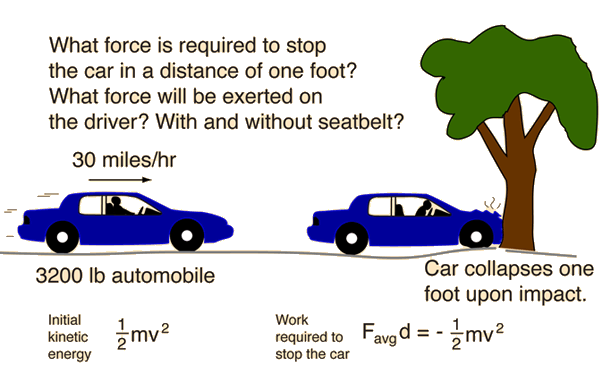
Forces in Car Crashes
汽车碰撞中的力
|
Force on car
汽车上的力 |
Calculation of force on car
汽车上力的计算 |
Example of force on driver
驱动器上的力示例 |
Work-energy principle
索引 功-能原理
| HyperPhysics***** Mechanics
力学 | R Nave |
返回
Forces in Car Crashes汽车碰撞中的力
|
Index Work-energy principle 索引 功-能原理 | |||
|
Go Back
返回 |
Example of Force on Car汽车上的力示例
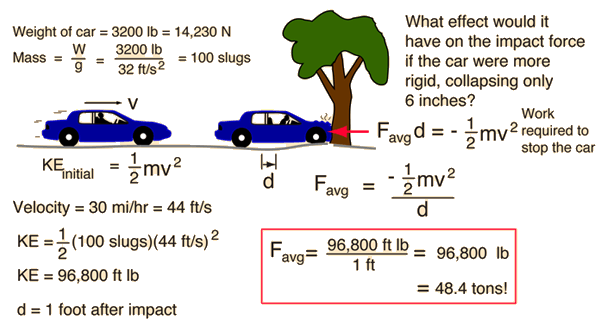 (This initial example is cast in U.S. common units because most U.S. readers can make comparisons to known forces more easily in those terms. The calculation provides the results in SI units as well.) Vary the parameters of the collision改变碰撞参数 Note: these examples of forces during collisions use the average of force over distance rather than the average over time. The profile of force during a collision such as that of a car with a tree can be complex, whether expressed in terms of time or distance. The average over distance is used here because of its relationship to the conservation of energy and the work-energy principle.
注意:这些碰撞过程中力的示例使用的是力在距离上的平均值,而不是在时间上的平均值。例如,汽车与树的碰撞过程中,力的变化可以很复杂,无论是在时间还是距离上表达。这里使用距离上的平均值,是因为它与能量守恒和功-能原理有关。
这个初始例子使用的是美国常用单位,因为大多数美国读者在这些单位下更容易与已知的力进行比较。计算结果也以SI单位形式呈现。 |
Index Work-energy principle 索引 功-能原理 | ||
|
Go Back
返回 |
Calculation of Force on Car汽车上的力的计算
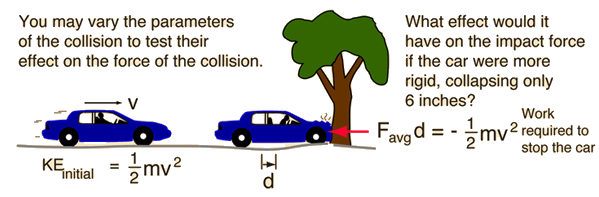 You may change any data value. Clicking outside the box will then initiate a calculation of the impact force and conversion of the data value to the other types of units. Discussion of car crash scenario汽车碰撞场景讨论 如果汽车的重量为 N = 磅,对应质量 = 千克 = 斤/秒²,且汽车以速度 v = 米/秒 = 公里/小时 = 英里/小时行驶,那么在距离 d= 米 = 英尺内停止的碰撞将导致平均冲击力为。您可以更改任何数据值。点击框外将启动冲击力的计算并将数据值转换为其他单位类型。 中文译文中的待填/计算数值依次对应:1:w 2:wc 3:m 4:mc 5:v 6:vk 7:vc 8:d 9:dc。实际数值以上方原输入框为准。 |
Index Work-energy principle 索引 功-能原理 | ||
|
Go Back
返回 |