Bilingual edition: English is preserved and Chinese follows each unit. Terminology uses the confirmed v20260916 glossary; automated semantic review remains traceable.
中英双语版:英文原文完整保留,中文紧随对应单元;术语采用 v20260916 确认表,自动语义审校结果可追溯。

Corrosion as an Electrochemical Process

腐蚀作为电化学过程

A piece of bare iron left outside where it is exposed to moisture will rust quickly. It will do so even more quickly if the moisture is salt water. The corrosion rate is enhanced by an electrochemical process in which a water droplet becomes a voltaic cell in contact with the metal, oxidizing the iron.
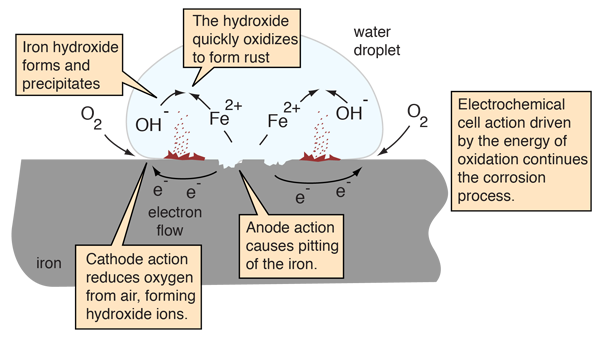
一块暴露在潮湿环境中的生铁会很快生锈。如果潮湿的是盐水,生锈速度会更快。这种腐蚀是通过一种电化学过程增强的,其中一滴水会与金属接触形成伏打电池,氧化铁。

Considering the sketch of a water droplet (after Ebbing), the oxidizing iron supplies electrons at the edge of the droplet to reduce oxygen from the air. The iron surface inside the droplet acts as the anode for the process

考虑水滴的示意图(参考Ebbing),氧化的铁在滴边缘提供电子,将空气中的氧气还原。滴内的铁表面作为该过程的阳极。

Fe(s) -> + Fe2+(aq) + 2e-

Fe(s) → Fe²⁺(aq) + 2e⁻

The electrons can move through the metallic iron to the outside of the droplet where

电子可以穿过金属铁移动到滴落物的外部 where

O2(g) + 2H2O(l) + 4e- -> 4OH-(aq)

O₂(g) + 2H₂O(l) + 4e⁻ → 4OH⁻(aq)

Within the droplet, the hydroxide ions can move inward to react with the iron(II) ions moving from the oxidation region. Iron(II) hydroxide is precipitated.

在液滴内部,氢氧根离子可以向内移动,与从氧化区域迁移来的铁(II)离子反应,生成氢氧化铁沉淀。

Fe2+(aq) + 2OH-(aq) -> Fe(OH)2(s)

Fe²⁺(aq) + 2OH⁻(aq) → Fe(OH)₂(s)

Rust is then quickly produced by the oxidation of the precipitate.

然后迅速由沉淀物的氧化产生锈。

4Fe(OH)2(s) + O2(g) -> 2Fe2O3 •H2O(s) + 2H2O(l)

4Fe(OH)₂(s) + O₂(g) → 2Fe₂O₃·H₂O(s) + 2H₂O(l)

The rusting of unprotected iron in the presence of air and water is then inevitable because it is driven by an electrochemical process. However, other electrochemical processes can offer some protection against corrosion. For magnesium rods can be used to protect underground steel pipes by a process called cathodic protection.

Cathodic protection from corrosion
阴极保护防锈
在空气和水存在的情况下,未受保护的铁生锈是不可避免的,因为这一过程由电化学过程驱动。然而,其他电化学过程可以提供一定的防锈保护。例如,可以通过称为阴极保护的工艺,用镁棒来保护地下钢管。
Index

Oxidation/
Reduction concepts


Electrochemistry concepts

Reference
Hill & Kolb
Ch 8

Ebbing
Ch 19
索引 氧化还原概念 电化学概念 参考 Hill & Kolb 第8章 Ebbing 第19章
 
HyperPhysics***** Electricity and Magnetism ***** Chemistry
HyperPhysics ***** 电磁学 ***** 化学
R Nave
Go Back
返回


Cathodic Protection Against Corrosion

阴极保护防锈

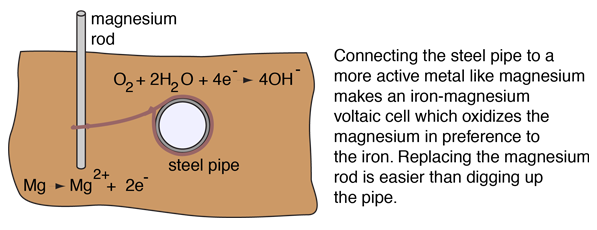
Underground steel pipes offer the strength to transport fluids at high pressures, but they are vulnerable to corrosion driven by electrochemical processes. A measure of protection can be offered by driving a magnesium rod into the ground near the pipe and providing an electrical connection to the pipe. Since the magnesium has a standard potential of -2.38 volts compared to -.41 volts for iron, it can act as a anode of a voltaic cell with the steel pipe acting as the cathode. With damp soil serving as the electrolyte, a small current can flow in the wire connected to the pipe. The magnesium rod will be eventually consumed by the reaction

地下钢管道具有在高压下输送流体的强度,但它们容易受到由电化学过程引起的腐蚀。可以通过将镁棒插入地面靠近管道,并与管道提供电气连接来提供保护措施。由于镁的标准电极电势为-2.38伏,而铁的标准电极电势为-0.41伏,镁可以作为伏打电池的阳极,钢管道作为阴极。湿土壤充当电解质,连接到管道的导线中可以流过一个小电流。镁棒最终将被反应消耗。

Mg(s) -> + Mg2+(aq) + 2e-

Mg(s) → Mg²⁺(aq) + 2e⁻

while the steel pipe as the cathode will be protected by the reaction

而钢管作为阴极将受到该反应的保护

O2(g) + 2H2O(l) + 4e- -> 4OH-(aq).

O₂(g) + 2H₂O(l) + 4e⁻ → 4OH⁻(aq)。
Index

Oxidation/
Reduction concepts


Electrochemistry concepts

Reference
Hill & Kolb
Ch 8

Ebbing
Ch 19
索引 氧化还原概念 电化学概念 参考 Hill & Kolb 第8章 Ebbing 第19章
 
HyperPhysics***** Electricity and Magnetism ***** Chemistry
HyperPhysics ***** 电磁学 ***** 化学
R Nave
Go Back
返回