Bilingual edition: English is preserved and Chinese follows each unit. Terminology uses the confirmed v20260916 glossary; automated semantic review remains traceable.
中英双语版:英文原文完整保留,中文紧随对应单元;术语采用 v20260916 确认表,自动语义审校结果可追溯。

Electrochemical Cells

电化学电池

An extremely important class of oxidation and reduction reactions are used to provide useful electrical energy in batteries. A simple electrochemical cell can be made from copper and zinc metals with solutions of their sulfates. In the process of the reaction, electrons can be transferred from the zinc to the copper through an electrically conducting path as a useful electric current.

非常重要的氧化还原反应类别用于在电池中提供有用的电能。可以用铜和锌金属及其硫酸盐溶液制作一个简单的电化学电池。在反应过程中,电子可以通过一个电导路径从锌传递到铜,形成有用的电流。

An electrochemical cell can be created by placing metallic electrodes into an electrolyte where a chemical reaction either uses or generates an electric current. Electrochemical cells which generate an electric current are called voltaic cells or galvanic cells, and common batteries consist of one or more such cells. In other electrochemical cells an externally supplied electric current is used to drive a chemical reaction which would not occur spontaneously. Such cells are called electrolytic cells.

一个电化学电池可以通过将金属电极放入电解质中来制造,其中化学反应要么使用要么产生电流。产生电流的电化学电池称为伏打电池或原电池,常见的电池由一个或多个这样的电池组成。在其他电化学电池中,外部提供的电流用于驱动一个不会自发发生的化学反应。这类电池称为电解电池。

Dry cells
干电池
Lead-acid batteries
铅酸电池
Index

Oxidation/
Reduction concepts


Electrochemistry concepts

Reference
Hill & Kolb
Ch 8

Ebbing
Ch 19
索引 氧化还原概念 电化学概念 参考 Hill & Kolb 第8章 Ebbing 第19章
 
HyperPhysics***** Electricity and Magnetism ***** Chemistry
HyperPhysics ***** 电磁学 ***** 化学
R Nave
Go Back
返回


Voltaic Cells

伏打电池

An electrochemical cell which causes external electric current flow can be created using any two different metals since metals differ in their tendency to lose electrons. Zinc more readily loses electrons than copper, so placing zinc and copper metal in solutions of their salts can cause electrons to flow through an external wire which leads from the zinc to the copper.
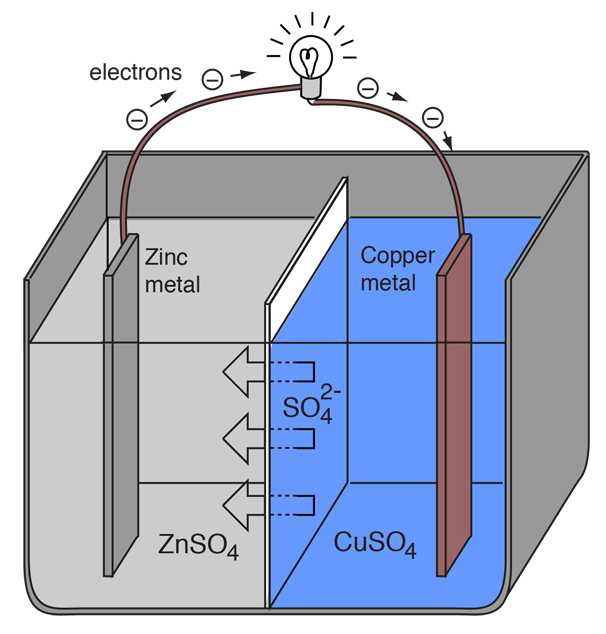
一个能够引起外部电流流动的电化学电池可以使用任何两种不同的金属来制作,因为金属在失去电子的倾向上存在差异。锌比铜更容易失去电子,因此将锌和铜金属放入它们盐的溶液中,可以使电子通过外部导线从锌流向铜。
Add annotation to illustration
为插图添加注释

As a zinc atom provides the electrons, it becomes a positive ion and goes into aqueous solution, decreasing the mass of the zinc electrode. On the copper side, the two electrons received allow it to convert a copper ion from solution into an uncharged copper atom which deposits on the copper electrode, increasing its mass. The two reactions are typically written

锌原子提供电子后,自身成为正离子并进入水溶液,导致锌电极的质量减少。而在铜电极侧,获得的两个电子使铜离子从溶液中还原为中性铜原子,并沉积在铜电极上,使铜电极的质量增加。这两个反应通常写成

Zn(s) -> Zn2+(aq) + 2e-

Zn(s) → Zn²⁺(aq) + 2e⁻

Cu2+(aq) + 2e- -> Cu(s)

Cu²⁺(aq) + 2e⁻ → Cu(s)

The letters in parentheses are just reminders that the zinc goes from a solid (s) into a water solution (aq) and vice versa for the copper. It is typical in the language of electrochemistry to refer to these two processes as "half-reactions" which occur at the two electrodes.

括号中的字母只是提醒锌从固体(s)转变为水溶液(aq),而铜则相反。在电化学语言中,通常将这两个过程称为“半反应”,发生在两个电极上。

Zn(s) -> Zn2+(aq) + 2e-

Zn(s) → Zn²⁺(aq) + 2e⁻
The zinc "half-reaction" is classified as oxidation since it loses electrons. The terminal at which oxidation occurs is called the "anode". For a battery, this is the negative terminal.
锌的“半反应”被归类为氧化反应,因为它失去了电子。发生氧化的终端称为“阳极”。对于电池来说,这即是负极。
The copper "half-reaction" is classified as reduction since it gains electrons. The terminal at which reduction occurs is called the "cathode". For a battery, this is the positive terminal.
铜的“半反应”被归类为还原反应,因为它获得了电子。发生还原反应的电极称为“ cathode ”。对于电池来说,这是正极。

Cu2+(aq) + 2e- -> Cu(s)

Cu²⁺(aq) + 2e⁻ → Cu(s)

In order for the voltaic cell to continue to produce an external electric current, there must be a movement of the sulfate ions in solution from the right to the left to balance the electron flow in the external circuit. The metal ions themselves must be prevented from moving between the electrodes, so some kind of porous membrane or other mechanism must provide for the selective movement of the negative ions in the electrolyte from the right to the left.

为了使伏打电池继续产生外部电流,溶液中的硫酸根离子必须从右向左移动,以平衡外部电路中的电子流动。金属离子本身必须被防止在电极之间移动,因此需要某种多孔膜或其他机制,以实现电解质中负离子从右向左的选择性移动。

Energy is required to force the electrons to move from the zinc to the copper electrode, and the amount of energy per unit charge available from the voltaic cell is called the electromotive force (emf) of the cell. Energy per unit charge is expressed in volts (1 volt = 1 joule/coulomb).

要使电子从锌移到铜电极,需要施加力,该过程所需的能量称为伏打电池的电动势(emf)。单位电荷的 energy 可用伏特表示(1 伏特 = 1 焦耳/库仑)。

Clearly, to get energy from the cell, you must get more energy released from the oxidation of the zinc than it takes to reduce the copper. The cell can yield a finite amount of energy from this process, the process being limited by the amount of material available either in the electrolyte or in the metal electrodes. For example, if there were one mole of the sulfate ions SO42- on the copper side, then the process is limited to transferring two moles of electrons through the external circuit. The amount of electric charge contained in a mole of electrons is called the Faraday constant, and is equal to Avogadro's number times the electron charge:

显然,要从电池中获得能量,必须从锌的氧化过程中释放出的电能大于还原铜所消耗的电能。电池只能从这一过程释放有限的能量,该过程受到电解质或金属电极中可用物质的量的限制。例如,如果铜侧有1摩尔硫酸根离子SO₄²⁻,则该过程仅能通过外部电路转移2摩尔电子。一摩尔电子所含的电荷量称为法拉第常数,等于阿伏伽德罗常数乘以电子电荷:
Faraday constant = F = NAe = 6.022 x 1023 x 1.602 x 10-19 = 96,485 Coulombs/mole

The energy yield from a voltaic cell is given by the cell voltage times the number of moles of electrons transferred times the Faraday constant.

伏打电池产生的能量由电池电压乘以转移的电子摩尔数再乘以法拉第常数得到。

Electrical energy output = nFEcell

电能输出 = nFE电池

The cell emf Ecell may be predicted from the standard electrode potentials for the two metals. For the zinc/copper cell under the standard conditions, the calculated cell potential is 1.1 volts.

电池的电动势E_cell可能根据两种金属的标准电极电势进行预测。对于锌/铜电池在标准条件下,计算得到的电池电动势为1.1伏特。
Dry cells
干电池
Lead-acid batteries
铅酸电池
法拉第常数 = F = N A e = 6.022 x 10 23 x 1.602 x 10 -19 = 96,485 库仑/摩尔
Index

Oxidation/
Reduction concepts


Electrochemistry concepts

Reference
Hill & Kolb
Ch 8

Ebbing
Ch 19
索引 氧化还原概念 电化学概念 参考 Hill & Kolb 第8章 Ebbing 第19章
 
HyperPhysics***** Electricity and Magnetism ***** Chemistry
HyperPhysics ***** 电磁学 ***** 化学
R Nave
Go Back
返回


Details of the Daniell Cell

丹尼尔电池的细节

English chemist John Frederick Daniell developed a voltaic cell in 1836 which used zinc and copper and solutions of their ions.

英国化学家约翰·弗雷德里克·丹尼尔于1836年研制出一种伏打电池,该电池使用锌和铜以及它们的离子溶液。
Voltaic cell discussion
伏打电池讨论
Index

Oxidation/
Reduction concepts


Electrochemistry concepts

Reference
Hill & Kolb
Ch 8

Ebbing
Ch 19
索引 氧化还原概念 电化学概念 参考 Hill & Kolb 第8章 Ebbing 第19章
 
HyperPhysics***** Electricity and Magnetism ***** Chemistry
HyperPhysics ***** 电磁学 ***** 化学
R Nave
Go Back
返回