Ionization Energies
电离能
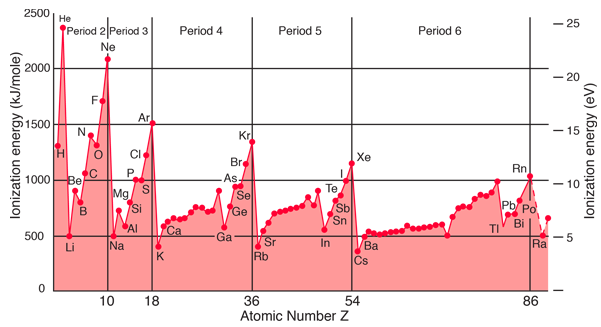
The ionization energy or ionization potential is the energy necessary to remove an electron from the neutral atom. It is a minimum for the alkali metals which have a single electron outside a closed shell. It generally increases across a row on the periodic maximum for the noble gases which have closed shells. For example, sodium requires only 496 kJ/mol or 5.14 eV/atom to ionize it while neon, the noble gas immediately preceding it in the periodic table, requires 2081 kJ/mol or 21.56 eV/atom. The ionization energy is one of the primary energy considerations used in quantifying chemical bonds.
电离能或电离势是指从中性原子中移除一个电子所需的能量。它对于碱金属来说是最小的,因为这些金属外层有一个电子处于闭壳层。在同一周期中,电离能通常随着行的推进而增加,对于 noble gases(惰性气体)来说,它们的闭壳层结构导致电离能达到周期表中的最大值。例如,钠需要仅496 kJ/mol 或 5.14 eV/atom 的能量来电离,而紧随其后的惰性气体氖则需要2081 kJ/mol 或 21.56 eV/atom 的能量来电离。电离能是量化化学键时主要考虑的能量因素之一。
The ionization energy for any element may be found by clicking on its chemical symbol in the periodic table.
任何元素的电离能可通过在元素周期表中点击其化学符号来查找。
1 kJ/mol = 0.010364 eV/atom
Chemical bond concepts
Reference
Ebbing
索引 化学键概念 参考 Ebbing
| HyperPhysics***** Chemistry
HyperPhysics ***** 化学 | R Nave |
返回