Bilingual edition: English is preserved and Chinese follows each unit. Terminology uses the confirmed v20260916 glossary; automated semantic review remains traceable.
中英双语版:英文原文完整保留,中文紧随对应单元;术语采用 v20260916 确认表,自动语义审校结果可追溯。

Chemical Bond Energy Considerations

化学键能考虑

A chemical bond forms when it is energetically favorable, i.e., when the energy of the bonded atoms is less than the energies of the separated atoms. Some of the types of tabulated data associated with chemical bonds are:

当形成化学键是能量上有利的,即当结合原子的能量低于分离原子的能量时,化学键形成。与化学键相关的某些类型的数据表包括:

Ionization energy: the energy required to remove an electron from a neutral atom.

电离能:从中性原子中移除一个电子所需的能量。

Electron affinity: the energy change when a neutral atom attracts an electron to become a negative ion.

Electronegativity: the ability of an atom in a molecule to draw bonding electrons to itself.

电负性:原子在分子中吸引共用电子的能力。
电子亲和能:中性原子吸引一个电子形成负离子时的能量变化。
Index

Bond concepts
索引键概念
 
HyperPhysics***** Chemistry
HyperPhysics ***** 化学
R Nave
Go Back
返回


Ionization Energy and Electron Affinity

电离能和电子亲和能

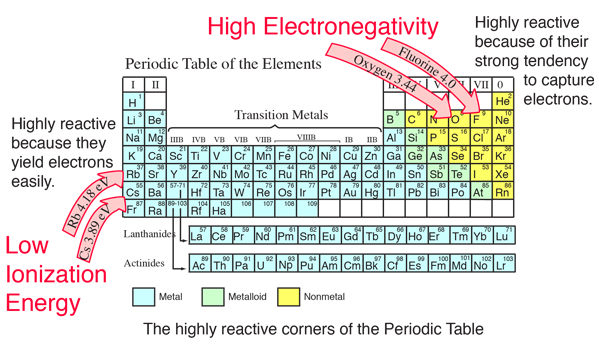
The ionization energy or ionization potential is the energy necessary to remove an electron from the neutral atom. It is a minimum for the alkali metals which have a single electron outside a closed shell. It generally increases across a row on the periodic maximum for the noble gases which have closed shells. For example, sodium requires only 496 kJ/mol or 5.14 eV/atom to ionize it while neon, the noble gas immediately preceding it in the periodic table, requires 2081 kJ/mol or 21.56 eV/atom. The ionization energy can be thought of as a kind of counter property to electronegativity in the sense that a low ionization energy implies that an element readily gives electrons to a reaction, while a high electronegativity implies that an element strongly seeks to take electrons in a reaction.

电离能或电离势是指从中性原子中移除一个电子所需的能量。它在碱金属中达到最小值,这些金属外层有一个电子处于闭壳层。一般来说,沿着周期表的一行,电离能随着接近惰性气体而增加,惰性气体具有闭壳层。例如,钠需要496 kJ/mol或5.14 eV/atom的能量来电离,而周期表中紧接钠的惰性气体氖则需要2081 kJ/mol或21.56 eV/atom的能量来电离。电离能可以看作是电负性的一种反向性质,因为低电离能意味着元素容易在反应中给出电子,而高电负性则意味着元素在反应中强烈地寻求电子。

The electron affinity is a measure of the energy change when an electron is added to a neutral atom to form a negative ion. For example, when a neutral chlorine atom in the gaseous form picks up an electron to form a Cl- ion, it releases an energy of 349 kJ/mol or 3.6 eV/atom. It is said to have an electron affinity of -349 kJ/mol and this large number indicates that it forms a stable negative ion. Small numbers indicate that a less stable negative ion is formed. Groups VIA and VIIA in the periodic table have the largest electron affinities.
电子亲和能是中性原子获得一个电子形成负离子时能量变化的度量。例如,当气态的中性氯原子获得一个电子形成Cl⁻离子时,会释放出349 kJ/mol或3.6 eV/atom的能量。它被说具有-349 kJ/mol的电子亲和能,这个大的数值表明它能形成稳定的负离子。小数值则表明形成的负离子不够稳定。元素周期表中VIA和VIIA族具有最大的电子亲和能。

1 kJ/mol = .010364 eV/atom
Graph of ionization energies of the elements
元素电离能的图表
Table of electron affinities
电子亲和力表
1 kJ/mol = 0.010364 eV/atom
Index

Bond concepts
索引键概念
 
HyperPhysics***** Chemistry
HyperPhysics ***** 化学
R Nave
Go Back
返回


Electronegativity

电负性

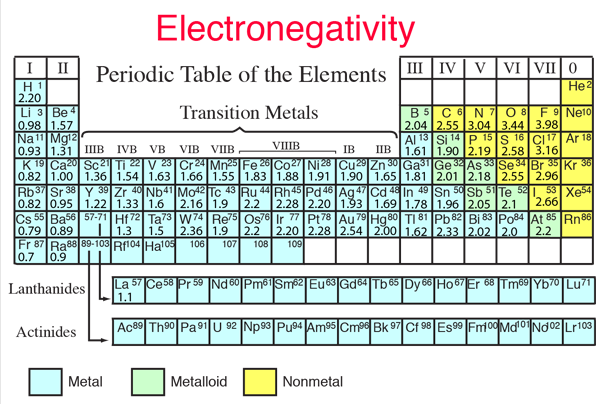
Electronegativity is a measure of the ability of an atom in a molecule to draw bonding electrons to itself. The most commonly used scale of electronegativity is that developed by Linus Pauling in which the value 4.0 is assigned to fluorine, the most electronegative element. Lithium, at the other end of the same period on the periodic table, is assigned a value of 1. Electronegativity generally increases from left to right on the periodic table and decreases from top to bottom. Metals are the least electronegative of the elements. The Pauling electronegativities for the elements are often included as a part of the chart of the elements.

电负性是衡量原子在分子中吸引成键电子能力的指标。最常用的电负性尺度是林纳斯·鲍林开发的尺度,在该尺度中,氟被赋予值4.0,这是最电负的元素。在元素周期表的同一周期中,锂被赋予值1。电负性通常在周期表中从左到右增加,从上到下减少。金属是元素中电负性最低的。元素的鲍林电负性值通常包含在元素周期表的图表中。

An important application of electronegativity is in the prediction of the polarity of a chemical bond. Because hydrogen has an electrognegativity of 2.1 and chlorine has an electronegativity of 3.0, they would be expected to form a polar molecule with the chlorine being the negative side of the dipole. The difference between the electronegativities of Na(0.9) and Cl(3.0) are so great that they form an ionic bond. The hydrogen molecule on the other hand, with zero electronegativty difference, becomes the classic example of a covalent bond.

电负性的一个重要应用是在预测化学键的极性方面。因为氢的电负性为2.1,而氯的电负性为3.0,因此它们预计会形成一个极性分子,其中氯是负极的一端。钠(0.9)和氯(3.0)的电负性差异很大,因此它们形成离子键。而氢分子则由于电负性差异为零,成为共价键的典型例子。

After fluorine, oxygen is the next highest in electronegativity at 3.44, and this has enormous consequences in practice. Since oxygen is the most abundant element on the Earth, its high chemical activity makes it a part of most common substances. It's electronegativity leads to the polar nature of the water molecule and contributes to the remarkable properties of water.

氟之后,氧的电负性为3.44,是第二高的,这在实践中有着巨大的影响。由于氧是地球上最丰富的元素之一,其高化学活性使其成为大多数常见物质的一部分。它的电负性导致了水分子的极性,并赋予了水显著的特性。
Periodic Table
元素周期表
Electron affinity
电子亲和力
Electronegativity Table
电负性表
Index

Bond concepts
索引键概念
 
HyperPhysics***** Chemistry
HyperPhysics ***** 化学
R Nave
Go Back
返回


Periodic Table
元素周期表
Electron affinity
电子亲和力
Index

Bond concepts
索引键概念
 
HyperPhysics***** Chemistry
HyperPhysics ***** 化学
R Nave
Go Back
返回