Determining the Mass of an Extended Oject
确定扩展物体的质量
The mass of an extended object can be found by using the conditions for equilibrium of torques. If the object is first balanced to find its center of mass, then the entire weight of the object can be considered to act at that center of mass. If the object is then shifted a measured distance away from the center of mass and again balanced by
hanging a known mass on the other side
of the pivot point, the unknown mass of
the object can be determined by
balancing the torques.
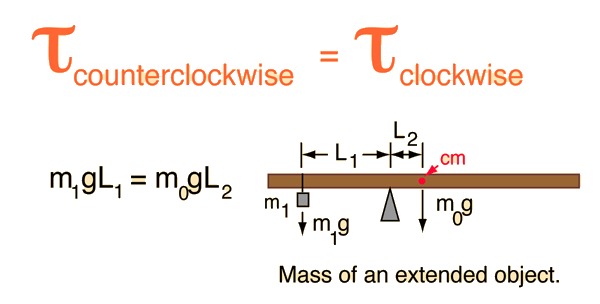
But since g appears on both sides of the equation, it can be factored out and just the masses and lengths used for the calculation.
但由于重力加速度g出现在方程的两边,因此可以将其提取出来,仅使用质量和长度进行计算。
一个延伸物体的质量可以通过使用力矩平衡的条件来确定。如果首先将物体平衡以找到其质心,那么物体的整个重量可以认为作用在该质心上。如果物体然后被移离质心一个已测量的距离,并再次通过在支点另一侧悬挂已知质量来平衡,物体的未知质量可以通过平衡力矩来确定。m1 L1 = m0 L2 质量1 × 杠杆1 = 质量 × 杠杆2 kg × m = kg × m 你可以输入上述任何数量的值。输入完毕后,点击你希望计算的量的活动文本。直到你点击所需的量之前,数据值不会被强制保持一致。
中文译文中的待填/计算数值依次对应:1:m1 2:L1 3:m2 4:L2。实际数值以上方原输入框为准。
Torque equilibrium examples
索引:力矩平衡示例
| HyperPhysics***** Mechanics
力学 | R Nave |
返回