Bilingual edition: English is preserved and Chinese follows each unit. Terminology uses the confirmed v20260916 glossary; automated semantic review remains traceable.
中英双语版:英文原文完整保留,中文紧随对应单元;术语采用 v20260916 确认表,自动语义审校结果可追溯。

Lifting Board: Example

举板示例

If you have to lift a 50 lb, 10 foot board, common sense prompts you to pick up the long board at its center because it balances more easily and is more easily handled.

如果你要举起一块50磅、10英尺长的板,常识会提示你应将其在中心处提起,因为这样更容易平衡和操控。

Some of the physical ideas behind this common sense are that the weight effectively acts at the center of mass, and you don't have to exert extra torques to keep the board in equilibrium. If it is supported at the center, the weight of the board has a zero lever arm with respect to the point of support.

一些常识背后的物理思想是,重量实际上作用在质心上,并且你不需要额外施加力矩来保持板处于平衡状态。如果板被支撑在质心处,板的重量相对于支撑点的力臂为零。

If you were able to lift the board by it's end, with your fingers extending 6 inches under the board, how much force would you have to exert?

如果你能将板子举起来,手指伸入板下6英寸,你需要施加多大的力?
Index

Torque equilibrium examples
索引:力矩平衡示例
 
HyperPhysics***** Mechanics
力学
R Nave
Go Back
返回


Balance

平衡

Balance is a concept which implies equilibrium of torques. If you are dealing with a single object, the concept of balance implies that an object is supported in such a way that its weight does not produce any torque about the point of support. Since the weight can be considered to be concentrated at the center of mass for purposes of calculating torque, it follows that in order to have zero torque, the weight must have zero lever arm and that happens only if it is in line with the point of support (directly above or directly below).

平衡的概念意味着力矩的平衡。如果处理的是一个单一物体,平衡的概念意味着物体以一种方式被支撑,使得其重量不会关于支撑点产生任何力矩。由于在计算力矩时,重量可以被视为集中于质心,因此要使力矩为零,重量必须具有零力臂,这只有在重量与支撑点在同一直线上时才能实现(即直接上方或直接下方)。

Common sense tells you to pick up a long board under its center to balance it. What happens if you try to pick it up by one end?

常识告诉我们,应在长板的中心处提起它以保持平衡。如果尝试在一端提起它会怎样呢?
Index

Torque equilibrium examples
索引:力矩平衡示例
 
HyperPhysics***** Mechanics
力学
R Nave
Go Back
返回


Lifting a board by its end

举板其一端

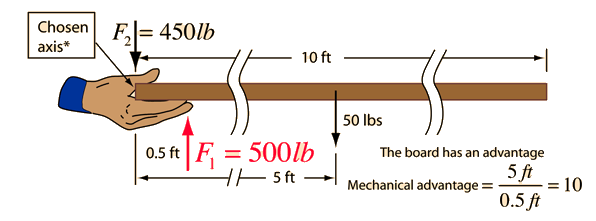
If you were able to lift the board by it's end, with your fingers extending 6 inches under the board, how much force would you have to exert?

如果你能将板子举起来,手指伸入板下6英寸,你需要施加多大的力?

A force of 500 pounds to lift a 50 pound board??

500磅的力才能提起一块50磅的板?

But your thumb would get off more easily. It would only have to exert 450 lb.

但你的拇指会更容易脱开。它只需要施加450磅的力。

Another way of stating why it is unreasonable to lift boards like this is to say that the board has a large mechanical advantage over your hand in terms of torque.

另一种说明为什么这样举板是不合理的说法是,板在力矩方面对你的手有较大的机械优势。
Index

Torque equilibrium examples
索引:力矩平衡示例
 
HyperPhysics***** Mechanics
力学
R Nave
Go Back
返回


Lifting a board by its end

举板其一端

You don't lift boards by their ends because the board has a long lever arm and your fingers have a short lever arm. In this example, the board is said to have a mechanical advantage of 10 because its lever arm is 10 times longer. Since the torques must be equal for equilibrium, you have to exert a force 10 times as large.

你不能用板子的两端来举板,因为板子有较长的力臂,而你的手指有较短的力臂。在这个例子中,板子的机械优势为10,因为它的力臂是10倍长。由于力矩必须相等以维持平衡,因此你需要施加10倍大的力。
Index

Torque equilibrium examples
索引:力矩平衡示例
 
HyperPhysics***** Mechanics
力学
R Nave
Go Back
返回