Coriolis Force
科里奥利力

|
 |
索引
| HyperPhysics***** Mechanics ***** Rotation
HyperPhysics ***** 力学 ***** 转动 | R Nave |
返回
Coriolis Force科里奥利力
|
Index
索引 | ||||
|
Go Back
返回 |
Example: Centrifugal and Coriolis例子:离心力和科里奥利力
|
Index
索引 | ||
|
Go Back
返回 |
Example: Centrifugal and Coriolis例子:离心力和科里奥利力
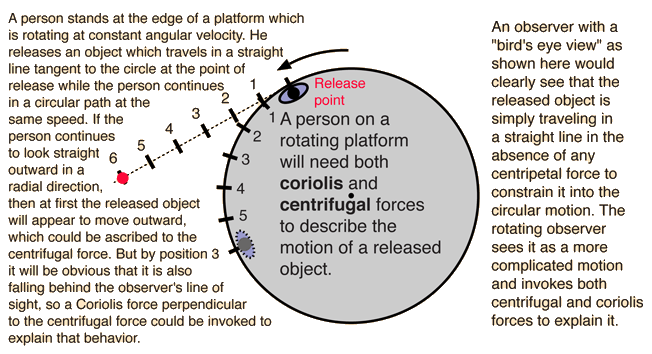
Equidistant marks on tangential and circular paths show the effects of centrifugal and coriolis forces as seen by person in rotating frame.
 在切线路径和圆周路径上等间距的标记,展示了在旋转参考系中观察到的离心力和科里奥利力的效果。 |
Index
索引 | ||
|
Go Back
返回 |
Centrifugal Force离心力
Whereas the centripetal force is seen as a force which must be applied by an external agent to force an object to move in a curved path, the centrifugal and coriolis forces are "effective forces" which are invoked to explain the behavior of objects from a frame of reference which is rotating. 尽管向心力被看作是必须由外部作用力施加给物体,使其沿曲线路径运动的力,而离心力和科里奥利力则是‘有效力’,它们被用来解释从旋转参考系中物体的行为。
The centrifugal force is a useful concept when the most convenient reference frame is one which is moving in a curved path, and therefore experiencing a centripetal acceleration. Since the car above will be experiencing a centripetal acceleration v2/r, then an object of mass m on the seat will require a force mv2/r toward the center of the circle to stay at the same spot on the seat. From the reference frame of a person in the car, there seems to be an outward centrifugal force mv2/r acting to move the mass radially outward. In practical descriptive terms, you would say that your carton of eggs is more likely to slide outward if you have a higher speed around the curve (the velocity squared factor) and more likely to slide outward if you go around a sharper curve (the inverse dependence upon r). 向心力是一个有用的概念,当最方便的参考系是那个沿着曲线路径运动的参考系,因此体验到向心加速度时。由于上面的汽车正在经历向心加速度v²/r,因此坐在车座上的质量为m的物体需要一个力mv²/r指向圆心,以保持在车座上的同一位置。从车内乘客的参考系来看,似乎有一个向外的离心力mv²/r作用,使质量向外径向移动。在实际描述中,如果你在弯道处速度更高(速度平方因素),或者弯道更急(半径的反比关系),你的鸡蛋盒更可能向外滑动。
|
Index
索引 | ||||
|
Go Back
返回 |

