Bilingual edition: English is preserved and Chinese follows each unit. Terminology uses the confirmed v20260916 glossary; automated semantic review remains traceable.
中英双语版:英文原文完整保留,中文紧随对应单元;术语采用 v20260916 确认表,自动语义审校结果可追溯。

Differential Equations

微分方程

A differential equation is an equation which contains the derivatives of a variable, such as the equation
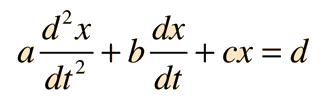
微分方程是包含变量导数的方程,例如方程

Here x is the variable and the derivatives are with respect to a second variable t. The letters a, b, c and d are taken to be constants here. This equation would be described as a second order, linear differential equation with constant coefficients. It is second order because of the highest order derivative present, linear because none of the derivatives are raised to a power, and the multipliers of the derivatives are constant. If x were the position of an object and t the time, then the first derivative is the velocity, the second the acceleration, and this would be an equation describing the motion of the object. As shown, this is also said to be a non-homogeneous equation, and in solving physical problems, one must also consider the homogeneous equation.

这里x是变量,导数是关于第二个变量t的。这里的字母a、b、c和d被当作常数。这个方程可以描述为一个二阶、线性的常系数微分方程。它二阶是因为最高阶导数的存在,线性是因为导数没有被提升到某个幂次,而导数的系数是常数。如果x是物体的位置,t是时间,那么一阶导数是速度,二阶导数是加速度,这个方程就是描述物体运动的方程。如所示,这也被称为非齐次方程,在解决物理问题时,还必须考虑齐次方程。
Index
索引
 
HyperPhysics****HyperMath*****Differential equations
HyperPhysics **** HyperMath ***** 微分方程
R Nave
Go Back
返回


First Order Homogeneous DE

一阶齐次微分方程

A first order homogeneous differential equation involves only the first derivative of a function and the function itself, with constants only as multipliers. The equation is of the form

一阶齐次微分方程仅涉及函数的第一次导数和函数本身,常数仅作为乘数。该方程的形式为

and can be solved by the substitution

并且可以通过变量替换来求解

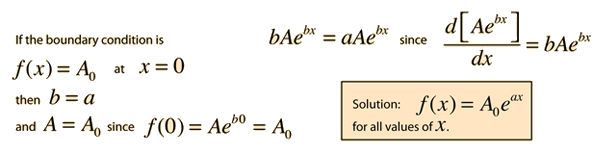
The solution which fits a specific physical situation is obtained by substituting the solution into the equation and evaluating the various constants by forcing the solution to fit the physical boundary conditions of the problem at hand. Substituting gives


Applications

应用
First order non-homogeneous equation
一阶非齐次方程
为特定物理情况找到解,是将解代入方程,并通过强制解满足问题的物理边界条件来确定各种常数。代入后得到
Index
索引
 
HyperPhysics****HyperMath*****Differential equations
HyperPhysics **** HyperMath ***** 微分方程
R Nave
Go Back
返回


General Solution to a D.E.

微分方程的通解
The general solution to a differential equation must satisfy both the homogeneous and non-homogeneous equations. It is the nature of the homogeneous solution that the equation gives a zero value. If you find a particular solution to the non-homogeneous equation, you can add the homogeneous solution to that solution and it will still be a solution since its net result will be to add zero. This does not mean that the homogeneous solution adds no meaning to the picture; the homogeneous part of the solution for a physical situation helps in the understanding of the physical system. A solution can be formed as the sum of the homogeneous and non-homogeneous solutions, and it will have a number of arbitrary (undetermined) constants. Such a solution is called the general solution to the differential equation. For application to a physical problem, the constants must be determined by forcing the solution to fit physical boundary conditions. Once a general solution is formed and then forced to fit the physical boundary conditions, one can be confident that it is the unique solution to the problem, as gauranteed by the uniqueness theorem.
微分方程的通解必须同时满足齐次和非齐次方程。齐次解的性质是其结果为零。如果你找到了非齐次方程的一个特解,你可以将齐次解加到该解上,这样仍然会是一个解,因为其净结果是加上零。这并不意味着齐次解对整体没有意义;对于物理情况,解的齐次部分有助于理解物理系统。一个解可以由齐次解和非齐次解之和构成,并且会包含若干任意(未确定)常数。这样的解被称为微分方程的通解。对于物理问题的应用,常数必须通过强迫解符合物理边界条件来确定。一旦形成了通解并强迫其符合物理边界条件,就可以确信它就是该问题的唯一解,这由唯一性定理保证。
Index
索引
 
HyperPhysics****HyperMath*****Differential equations
HyperPhysics **** HyperMath ***** 微分方程
R Nave
Go Back
返回


Boundary Conditions

边界条件
The boundary conditions on a differential equation are the constraining values of the function at some particular value of the independent variable. For example, if the equation involves the velocity, the boundary condition might be the initial velocity, the velocity at time t=0. In order to have a complete solution, there must be a boundary condition for each order of the equation - two boundary conditions for a second order equation, only one necessary for a first order differential equation. If a solution to a differential equation is found which satisfies all the boundary conditions, then it is the only solution to that equation - this is called the uniqueness theorem. Therefore, a reasonable approach to finding solutions to differential equations in physical problems is to use a trial solution and try to force it to fit the boundary conditions. If successful, then this approach finds the unique solution.
微分方程的边界条件是函数在某些特定独立变量值处的约束值。例如,如果方程涉及速度,边界条件可能是初始速度,或在时间t=0时的速度。为了得到完整的解,每个方程的阶数必须有一个边界条件——对于二阶方程需要两个边界条件,而对于一阶方程仅需要一个边界条件。如果找到一个解,该解满足所有边界条件,那么这就是该方程的唯一解——这被称为唯一性定理。因此,解决物理问题中微分方程的合理方法是使用试探解,并尝试使其符合边界条件。如果成功,这种方法就能找到唯一的解。
Index
索引
 
HyperPhysics****HyperMath*****Differential equations
HyperPhysics **** HyperMath ***** 微分方程
R Nave
Go Back
返回


Uniqueness Theorem

唯一性定理

For the differential equations applicable to physical problems, it is often possible to start with a general form and force that form to fit the physical boundary conditions of the problem. This kind of approach is made possible by the fact that there is one and only one solution to the differential equation, i.e., the solution is unique.

对于适用于物理问题的微分方程,通常可以从一般形式出发,通过施加问题的物理边界条件来迫使该形式适应具体问题。这种做法的可行性源于微分方程只有一个解,即解是唯一的。

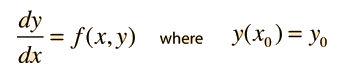
Stated in terms of a first order differential equation, if the problem

以一阶微分方程的形式表述,如果问题

meets the condition such that f(x,y) and the derivative of y is continuous in a given rectangle of (x,y) values, then there is one and only one solution to the equation which will meet the boundary conditions.

如果函数 f(x,y) 以及 y 的导数在某个 (x,y) 值域的矩形区域内连续,则方程将有且仅有一个解,该解将满足边界条件。
Index
索引
 
HyperPhysics****HyperMath*****Differential equations
HyperPhysics **** HyperMath ***** 微分方程
R Nave
Go Back
返回


Differential Equation Terminology

微分方程术语

Some general terms used in the discussion of differential equations:

在微分方程讨论中使用的一些通用术语:

Order: The order of a differential equation is the highest power of derivative which occurs in the equation, e.g., Newton's second law produces a 2nd order differential equation because the acceleration is the second derivative of the position.

顺序:微分方程的阶数是方程中出现的最高阶导数的次数,例如牛顿第二定律产生一个二阶微分方程,因为加速度是位置的二阶导数。

Linear and nonlinear: A differential equation is said to be linear if each term in the equation has only one order of derivative, e.g., no term has both y and the derivative of y with respect to time. Also, no derivative is raised to a power.

线性与非线性:若方程中的每一项只包含一个导数阶次,则称该微分方程为线性方程,例如,不存在同时包含y和y对时间的导数的项。此外,导数也不被提升到某次幂。

Homogeneous and nonhomogeneous: A differential equation is said to be homogeneous if there is no isolated constant term in the equation, e.g., each term in a differential equation for y has y or some derivative of y in each term.

齐次与非齐次:若微分方程中没有孤立的常数项,则称该微分方程为齐次的,例如,微分方程中每个关于y的项都包含y或其导数。
Index
索引
 
HyperPhysics****HyperMath*****Differential equations
HyperPhysics **** HyperMath ***** 微分方程
R Nave
Go Back
返回