Bilingual edition: English is preserved and Chinese follows each unit. Terminology uses the confirmed v20260916 glossary; automated semantic review remains traceable.
中英双语版:英文原文完整保留,中文紧随对应单元;术语采用 v20260916 确认表,自动语义审校结果可追溯。

First Order Non-homogeneous Differential Equation

一阶非齐次微分方程

An example of a first order linear non-homogeneous differential equation is

一个一阶线性非齐次微分方程的例子是

Having a non-zero value for the constant c is what makes this equation non-homogeneous, and that adds a step to the process of solution. The path to a general solution involves finding a solution to the homogeneous equation (i.e., drop off the constant c), and then finding a particular solution to the non-homogeneous equation (i.e., find any solution with the constant c left in the equation). The solution to the homogeneous equation is

具有非零常数c的值使这个方程非齐次,这使得求解过程多了一步。求解通解的路径涉及找到齐次方程的解(即去掉常数c),然后找到非齐次方程的特解(即找到任何保留常数c在方程中的解)。齐次方程的解是

By substitution you can verify that setting the function equal to the constant value -c/b will satisfy the non-homogeneous equation.

通过代入你可以验证,将函数设为常数 -c/b 将满足非齐次方程。

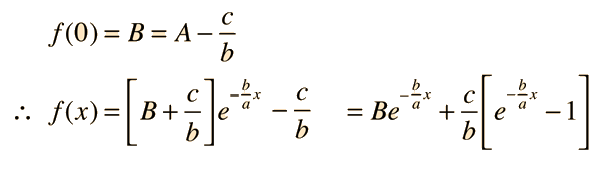
It is the nature of differential equations that the sum of solutions is also a solution, so that a general solution can be approached by taking the sum of the two solutions above. The final requirement for the application of the solution to a physical problem is that the solution fits the physical boundary conditions of the problem. The most common situation in physical problems is that the boundary conditions are the values of the function f(x) and its derivatives when x=0. Boundary conditions are often called "initial conditions". For the first order equation, we need to specify one boundary condition. For example:

微分方程的性质决定了解的和也是解,因此可以通过将上述两个解相加来逼近通解。将解应用于物理问题的最后要求是该解满足问题的物理边界条件。在物理问题中,最常见的边界条件是当x=0时函数f(x)及其导数的值。边界条件通常被称为“初始条件”。对于一阶方程,需要指定一个边界条件。例如:

Substituting at x=0 gives:

在x=0处代入得:
Example of capacitor charging
电容器充电示例
Index
索引
 
HyperPhysics****HyperMath*****Differential equations
HyperPhysics **** HyperMath ***** 微分方程
R Nave
Go Back
返回


Charging a Capacitor

给电容器充电

An application of non-homogeneous differential equations

非均匀微分方程的应用
A first order non-homogeneous differential equation

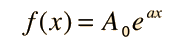
has a solution of the form :
.
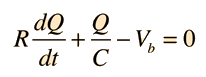
For the process of charging a capacitor from zero charge with a battery, the equation is

.

Using the boundary condition Q=0 at t=0 and identifying the terms corresponding to the general solution, the solutions for the charge on the capacitor and the current are:

利用 t=0 时 Q=0 的边界条件,并识别一般解中对应的项,可以得到电容器上的电荷和电流的解:
.

In this example the constant B in the general solution had the value zero, but if the charge on the capacitor had not been initially zero, the general solution would still give an accurate description of the change of charge with time. The discharge of the capacitor is an example of application of the homogeneous differential equation.

在本例中,一般解中的常数B的值为零,但如果电容器初始所带电荷不为零,一般解仍能准确描述电荷随时间的变化。电容器的放电过程是齐次微分方程应用的一个例子。
一个一阶非齐次微分方程的解形式为:。对于用电池给电容器从零电荷充电的过程,方程为:。
Index
索引
 
HyperPhysics****HyperMath*****Differential equations
HyperPhysics **** HyperMath ***** 微分方程
R Nave
Go Back
返回


Capacitor Discharge

电容器放电

An application of homogeneous differential equations

同质微分方程的应用
A first order homogeneous differential equation

has a solution of the form :
.

For the process of discharging a capacitor C, which is initially charged to the voltage of a battery Vb, the equation is

对于电容器C放电的过程,其方程为

Using the boundary condition and identifying the terms corresponding to the general solution, the solutions for the charge on the capacitor and the current are:

利用边界条件并识别一般解中对应的项,电容器上的电荷和电流的解为:
.

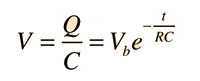
Since the voltage on the capacitor during the discharge is strictly determined by the charge on the capacitor, it follows the same pattern.

由于电容器放电时的电压严格由电容器上的电荷决定,因此遵循相同的模式。
.
一阶齐次微分方程的解形式为:。
Index
索引
 
HyperPhysics****HyperMath*****Differential equations
HyperPhysics **** HyperMath ***** 微分方程
R Nave
Go Back
返回