Bilingual edition: English is preserved and Chinese follows each unit. Terminology uses the confirmed v20260916 glossary; automated semantic review remains traceable.
中英双语版:英文原文完整保留,中文紧随对应单元;术语采用 v20260916 确认表,自动语义审校结果可追溯。

Storing Energy in a Capacitor

在电容器中储存能量

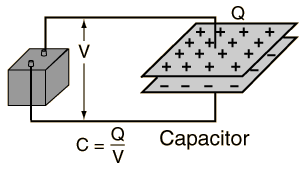
The energy stored on a capacitor can be expressed in terms of the work done by the battery. Voltage represents energy per unit charge, so the work to move a charge element dq from the negative plate to the positive plate is equal to V dq, where V is the voltage on the capacitor. The voltage V is proportional to the amount of charge which is already on the capacitor.

电容器中储存的能量可以表示为电池所做的功。电压代表单位电荷的能量,因此将电荷元dq从负极板移到正极板所做的功等于V dq,其中V是电容器上的电压。电压V与电容器上已有的电荷量成正比。
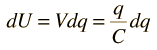
Element of energy stored:
储能元素:

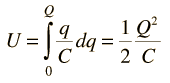
If Q is the amount of charge stored when the whole battery voltage appears across the capacitor, then the stored energy is obtained from the integral:

如果Q是当整个电池电压加在电容器两端时所储存的电荷量,那么储存的能量可通过积分得到:
More detail
更多内容
Calculation
计算

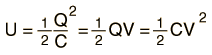
This energy expression can be put in three equivalent forms by just permutations based on the definition of capacitance C=Q/V.

这种能量表达式可以通过基于电容定义 C=Q/V 的排列组合,表示为三种等效形式。
But the battery energy output is QV! Where did half of the energy go?
但电池的输出能量是QV!其中一半的能量去哪了?
Index

Capacitor Concepts
索引电容器概念
 
HyperPhysics***** Electricity and Magnetism
HyperPhysics ***** 电学和磁学
R Nave
Go Back
返回


Storing Energy in a Capacitor

在电容器中储存能量

When the switch is closed to connect the battery to the capacitor, there is zero voltage across the capacitor since it has no charge buildup. The voltage on the capacitor is proportional to the charge

当开关闭合将电池连接到电容器时,电容器两端的电压为零,因为此时没有电荷积累。电容器上的电压与电荷量成正比。

Storing energy on the capacitor involves doing work to transport charge from one plate of the capacitor to the other against the electrical forces. As the charge builds up in the charging process, each successive element of charge dq requires more work to force it onto the positive plate. Summing these continuously changing quantities requires an integral.

在电容器上储存能量涉及将电荷从电容器的一个极板运输到另一个极板,这需要克服电气力做功。随着充电过程中的电荷积累,每个后续的电荷元素dq都需要更多的功来将其强制放到正极板上。将这些不断变化的量求和需要进行积分。
Calculation
计算
More detail on integral
积分的详细说明

Note that the total energy stored QV/2 is exactly half of the energy QV which is supplied by the battery, independent of R!

注意,电容器中储存的总能量 QV/2 恰好是电池提供的能量 QV 的一半,与电阻 R 无关!
Index

Capacitor Concepts
索引电容器概念
 
HyperPhysics***** Electricity and Magnetism
HyperPhysics ***** 电学和磁学
R Nave
Go Back
返回


Capacitor Energy Integral

电容器能量积分

Transporting differential charge dq to the plate of the capacitor requires work

将微小电荷dq传输到电容器的极板需要做功
dU = Vdq
dU = Vdq(专名或术语)

But as the voltage rises toward the battery voltage in the process of storing energy, each successive dq requires more work. Summing all these amounts of work until the total charge is reached is an infinite sum, the type of task an integral is essential for. The form of the integral shown above is a polynomial integral and is a good example of the power of integration.

但随着电压逐渐接近电池电压,在储存能量的过程中,每增加一微小电量dq都需要更多的功。将所有这些功累加直到总电荷达到时,这实际上是一个无限级数,这种任务正是积分所必需的。上式所示的积分形式是一个多项式积分,是积分强大作用的一个良好例子。
Charging a capacitor
给电容器充电
Calculation
计算
Index

Capacitor Concepts
索引电容器概念
 
HyperPhysics***** Electricity and Magnetism
HyperPhysics ***** 电学和磁学
R Nave
Go Back
返回


Where did half of the capacitor charging energy go?

电容器充电时,其中一半的能量去哪了?

The problem of the "energy stored on a capacitor" is a classic one because it has some counterintuitive elements. To be sure, the battery puts out energy QVb in the process of charging the capacitor to equilibrium at battery voltage Vb. But half of that energy is dissipated in heat in the resistance of the charging pathway, and only QVb/2 is finally stored on the capacitor at equilibrium. The counter-intuitive part starts when you say "That's too much loss to tolerate. I'm just going to lower the resistance of the charging pathway so I will get more energy on the capacitor." This doesn't work, because the energy loss rate in the resistance I2R increases dramatically, even though you do charge the capacitor more rapidly. It's not at all intuitive in this exponential charging process that you will still lose half the energy into heat, so this classic problem becomes an excellent example of the value of calculus and the integral as an engineering tool.

'电容器上储存的能'这个问题是一个经典问题,因为它包含一些反直觉的元素。毋庸置疑,电池在给电容器充电至电池电压V_b的过程中,会输出能量QV_b。但其中一半的能量会以热量的形式在充电路径的电阻中损耗,最终只有QV_b/2储存在电容器上。当你说'这太大的损耗无法接受,我将降低充电路径的电阻,从而让更多的能量储存在电容器上'时,这种反直觉的部分就出现了。这并不奏效,因为电阻中的能量损耗率I²R会急剧增加,即使你加快了充电速度。在指数充电过程中,你仍然会损失一半的能量到热量中,这并不直观,因此这个经典问题成为微积分和积分作为工程工具价值的绝佳例子。

Part of the intuitive part that goes into setting up the integral is that getting the first element of charge dq onto the capacitor plates takes much less work because most of the battery voltage is dropping across the resistance R and only a tiny energy dU = dqV is stored on the capacitor. Proceeding with the integral, which takes a quadratic form in q, gives a summed energy on the capacitor Q2/2C = CVb2/2 = QVb/2 where the Vb here is the battery voltage. So the bottom line is that you have to put out 2 joules from the battery to put 1 joule on the capacitor, the other joule having been irretrievably lost to heat - the 2nd Law of Thermodynamics bites you again, regardless of your charging rate. The non-intuitive nature of this problem is the reason that the integral approach is valuable.
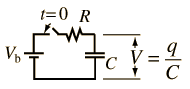
Transporting differential charge dq to the plate of the capacitor requires work

将微小电荷dq传输到电容器的极板需要做功
dU = Vdq
dU = Vdq(专名或术语)

设定积分时的直观部分之一是,将第一个电荷元素dq放到电容器极板上所需的工作量很小,因为大部分电池电压都在电阻R上降压,只有极小的能量dU = dqV储存在电容器上。继续进行这个积分,其形式为关于q的二次函数,得到电容器上的总能量Q²/(2C) = CV_b²/(2) = QV_b/2,其中V_b是电池电压。总之,你必须从电池中输出2焦耳,才能将1焦耳储存在电容器中,另外1焦耳则不可挽回地以热量形式损失掉——热力学第二定律再次对你发起了攻击,无论你以多快的速度充电。这个问题的非直观性质正是积分方法价值所在的原因。

Though it will not be shown here, if you proceed further with this problem by making the charging resistance so small that the initial charging current is extremely high, a sizable fraction of the charging energy is actually radiated away as electromagnetic energy. This crosses the threshold into antenna theory because not all the loss in charging was thermodynamic - but still the loss in the process was half the energy supplied by the battery in charging the capacitor.

So the energy supplied by the battery is E = CVb2, but only half that is on the capacitor - the other half has been lost to heat, or in the extremely low charging resistance case, to heat and electromagnetic energy.

所以电池提供的能量是 E = CV²,但只有其中一半储存在电容器中——另一半以热量损失,或者在极低的充电电阻情况下,还以电磁能量形式损失。
Charging a capacitor
给电容器充电
Calculation
计算
尽管这里不会展示,如果你继续解决这个问题,使充电电阻非常小以至于初始充电电流极高,实际上有一相当大的充电能量会被辐射出去作为电磁能量。这跨越了天线理论的阈值,因为并非所有的充电损耗都是热力学的——但充电过程中的损耗仍等于电池供给充电电容器能量的一半。
Index

Capacitor Concepts
索引电容器概念
 
HyperPhysics***** Electricity and Magnetism
HyperPhysics ***** 电学和磁学
R Nave
Go Back
返回