Static Friction静摩擦
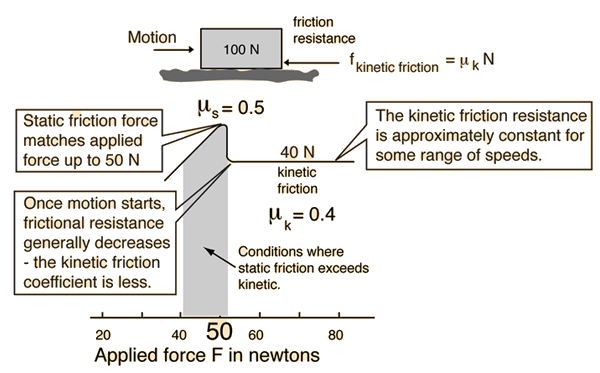
Static frictional forces from the interlocking of the irregularities of two surfaces will increase to prevent any relative motion up until some limit where motion occurs. It is that threshold of motion which is characterized by the coefficient of static friction. The coefficient of static friction is typically larger than the coefficient of kinetic friction. 静摩擦力来自两个表面不规则部分的相互咬合,会增加以防止任何相对运动,直到达到某个极限,此时运动开始。这个运动开始的阈值由静摩擦因数来表征。静摩擦因数通常比动摩擦因数大。
![]() In making a distinction between static and kinetic coefficients of friction, we are dealing with an aspect of "real world" common experience with a phenomenon which cannot be simply characterized. The difference between static and kinetic coefficients obtained in simple experiments like wooden blocks sliding on wooden inclines roughly follows the model depicted in the friction plot from which the illustration above is taken. This difference may arise from irregularities, surface contaminants, etc. which defy precise description. When such experiments are carried out with smooth metal blocks which are carefully cleaned, the difference between static and kinetic coefficients tends to disappear. When coefficients of friction are quoted for specific surface combinations are quoted, it is the kinetic coefficient which is generally quoted since it is the more reliable number. 在区分静摩擦系数和动摩擦系数时,我们是在处理一个与现实世界常见经验有关的方面,而这一现象无法简单地加以描述。在简单的实验中,如木块在木制斜面上滑动时,静摩擦系数与动摩擦系数的差异大致遵循摩擦图中所描绘的模型,该图被用来制作上面的示意图。这种差异可能源于表面不规则性、表面污染物等,这些因素难以精确描述。当使用光滑的金属块并仔细清洁时,静摩擦系数与动摩擦系数的差异往往会消失。当引用特定表面组合的摩擦系数时,通常引用的是动摩擦系数,因为这是更可靠的数据。
|
Index Friction concepts 摩擦概念索引 | ||
|
Go Back
返回 |
Kinetic Friction动能摩擦
When two surfaces are moving with respect to one another, the frictional resistance is almost constant over a wide range of low speeds, and in the standard model of friction the frictional force is described by the relationship below. The coefficient is typically less than the coefficient of static friction, reflecting the common experience that it is easier to keep something in motion across a horizontal surface than to start it in motion from rest.
![]() 当两个表面相对运动时,摩擦阻力在低速范围内几乎保持恒定,而在摩擦的标准模型中,摩擦力由下式描述。系数通常小于静摩擦系数,这反映了常见的经验,即保持物体在水平面上运动比从静止开始运动更容易。 |
Index Friction concepts 摩擦概念索引 | ||
|
Go Back
返回 |
Friction Plot摩擦图
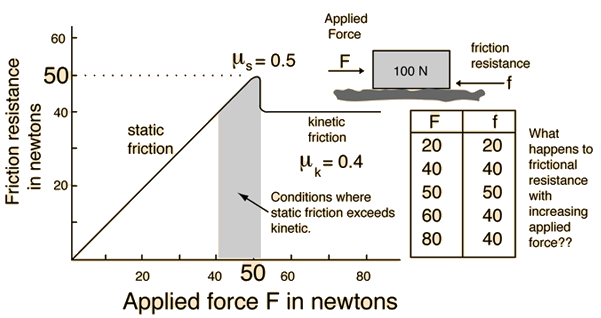
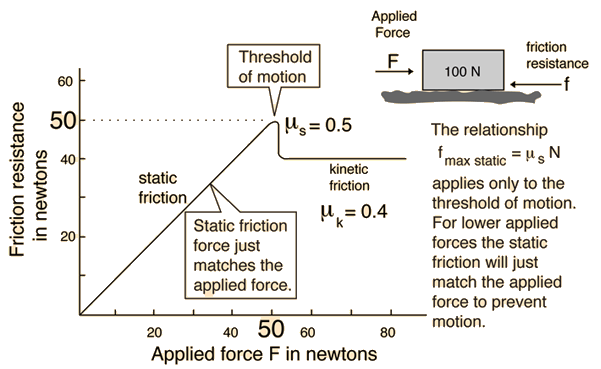
Static friction resistance will match the applied force up until the threshold of motion. Then the kinetic frictional resistance stays about constant. This plot illustrates the standard model of friction. 静摩擦力会与施加的力相平衡,直到达到运动的阈值。之后,动摩擦力保持大致不变。这张图展示了摩擦力的标准模型。
![]() The above plot, though representing a simplistic view of friction, agrees fairly well with the results of simple experiments with wooden blocks on wooden inclines. The experimental procedure described below equates the vector component of the weight down the incline to the coefficient of friction times the normal force produced by the weight on the incline. 尽管该图代表了摩擦的简化观点,但它与木块在木制斜面上进行简单实验所得结果基本一致。下面描述的实验过程将斜面上重力的矢量分量等同于摩擦系数乘以重力对斜面产生的正压力。
![]() Having taken a large number of students through this experiment, I can report that the coefficient of static friction obtained is almost always greater than the coefficient of kinetic friction. Typical results for the woods I have used are 0.4 for the static coefficient and 0.3 for the kinetic coefficient. 在带过大量学生进行这个实验后,我可以报告说,得到的静摩擦因数几乎总是大于动摩擦因数。我所使用的木材的典型结果是静摩擦因数为0.4,动摩擦因数为0.3。
When carefully standardized surfaces are used to measure the friction coefficients, the difference between static and kinetic coefficients tends to disappear, indicating that the difference may have to do with irregular surfaces, impurities, or other factors which can be frustratingly non-reproducible. To quote a view counter to the above model of friction: 当使用经过仔细标准化的表面来测量摩擦系数时,静摩擦系数与动摩擦系数之间的差异往往消失,这表明这种差异可能与表面的不规则性、杂质或其他因素有关,这些因素往往难以重复出现。据反对上述摩擦模型的观点认为:‘许多人认为启动物体时需要克服的摩擦力(静摩擦)大于维持其滑动所需的力(滑动摩擦),但在干燥金属的情况下,很难观察到任何差异。这种观点可能源于经验,例如在物体表面有少量油或润滑剂存在,或者物体例如通过弹簧或其他弹性支撑物支撑,使得物体似乎被卡住。’ 理查德·费曼、理查德·菲利普斯·莱顿和米切尔·桑德斯,《费曼物理学讲义》第一卷,第12-5页,阿迪逊-韦斯莱出版社,1964年。
|
Index Friction concepts Reference Jones & Childers, 2nd Ed. Sec 4.8 索引 摩擦概念 参考 Jones & Childers,第2版 第4.8节 | ||
|
Go Back
返回 |
Rolling Friction滚动摩擦
A rolling wheel requires a certain amount of friction so that the point of contact of the wheel with the surface will not slip. The amount of traction which can be obtained for an auto tire is determined by the coefficient of static friction between the tire and the road. If the wheel is locked and sliding, the force of friction is determined by the coefficient of kinetic friction and is usually significantly less. 一个滚动的轮子需要一定的摩擦力,使得轮子与表面的接触点不会打滑。汽车轮胎能获得的牵引力由轮胎与路面之间的静摩擦因数决定。如果轮子被锁死并滑动,摩擦力由动摩擦因数决定,通常显著较小。
Assuming that a wheel is rolling without slipping, the surface friction does no work against the motion of the wheel and no energy is lost at that point. However, there is some loss of energy and some deceleration from friction for any real wheel, and this is sometimes referred to as rolling friction. It is partly friction at the axle and can be partly due to flexing of the wheel which will dissipate some energy. Figures of 0.02 to 0.06 have been reported as effective coefficients of rolling friction for automobile tires, compared to about 0.8 for the maximum static friction coefficient between the tire and the road. 假设轮子纯滚动,表面摩擦力不会对抗轮子的运动做功,此时也没有能量损失。然而,对于任何实际的轮子,摩擦力都会导致一些能量损失和减速,这种现象有时被称为滚动摩擦。它部分来源于轴的摩擦,也可能部分来源于轮胎的变形,这会消耗一些能量。有报道指出,汽车轮胎的有效滚动摩擦系数在0.02到0.06之间,相比之下,轮胎与路面之间的最大静摩擦系数约为0.8。
|
Index Friction concepts 摩擦概念索引 | ||
|
Go Back
返回 |