Friction摩擦
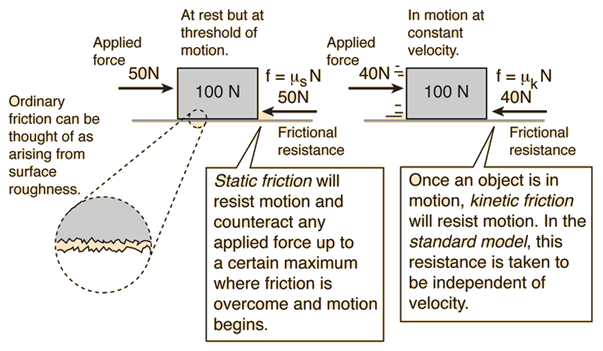
Frictional resistance to the relative motion of two solid objects is usually proportional to the force which presses the surfaces together as well as the roughness of the surfaces. Since it is the force perpendicular or "normal" to the surfaces which affects the frictional resistance, this force is typically called the "normal force" and designated by N. The frictional resistance force may then be written: 两个固体物体之间相对运动的摩擦阻力通常与使表面相互接触的力以及表面的粗糙度成正比。由于是垂直或‘法线’方向的力影响摩擦阻力,这个力通常被称为‘法向力’,并用N表示。因此,摩擦阻力可以写成:
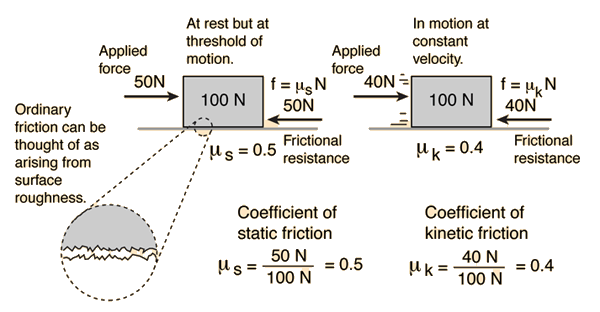
The frictional force is also presumed to be proportional to the coefficient of friction. However, the amount of force required to move an object starting from rest is usually greater than the force required to keep it moving at constant velocity once it is started. Therefore two coefficients of friction are sometimes quoted for a given pair of surfaces - a coefficient of static friction and a coefficent of kinetic friction. The force expression above can be called the standard model of surface friction and is dependent upon several assumptions about friction. 摩擦力也被假定与摩擦系数成正比。然而,使静止的物体开始运动所需的力通常大于物体一旦开始运动后保持匀速运动所需的力。因此,对于给定的两个表面,有时会引用两个摩擦系数——静摩擦系数和动摩擦系数。上述力的表达式可以称为表面摩擦的标准模型,并且依赖于关于摩擦的几个假设。
While this general description of friction (which I will refer to as the standard model) has practical utility, it is by no means a precise description of friction. Friction is in fact a very complex phenomenon which cannot be represented by a simple model. Almost every simple statement you make about friction can be countered with specific examples to the contrary. Saying that rougher surfaces experience more friction sounds safe enough - two pieces of coarse sandpaper will obviously be harder to move relative to each other than two pieces of fine sandpaper. But if two pieces of flat metal are made progressively smoother, you will reach a point where the resistance to relative movement increases. If you make them very flat and smooth, and remove all surface contaminants in a vacuum, the smooth flat surfaces will actually adhere to each other, making what is called a "cold weld". 尽管这种对摩擦的总体描述(我将称之为标准模型)在实践中很有用,但它绝不是对摩擦的精确描述。实际上,摩擦是一种非常复杂的现象,无法用一个简单的模型来表示。几乎每一个关于摩擦的简单陈述都可以用具体的反例来反驳。说粗糙的表面经历更多的摩擦听起来似乎合理——两块粗糙的砂纸显然比两块细腻的砂纸更难相对运动。但如果将两块平板金属逐渐磨平,你会达到一个点,其中相对运动的阻力会增加。如果使它们非常平滑,并在真空中去除所有表面污染物,那么平滑的表面实际上会相互粘附,这被称为‘冷焊’。
|
Index Friction concepts Plot of standard model Reference Jones & Childers, 2nd Ed. Sec 4.8 索引 摩擦 概念 图表 标准模型 参考 Jones & Childers,第二版 第4.8节 | |||
|
Go Back
返回 |
Friction and Surface Roughness摩擦与表面粗糙度
![]() In general, the coefficients of friction for static and kinetic friction are different. 一般来说,静摩擦系数和动摩擦系数是不同的。
Like all simple statements about friction, this picture of friction is too simplistic. Saying that rougher surfaces experience more friction sounds safe enough - two pieces of coarse sandpaper will obviously be harder to move relative to each other than two pieces of fine sandpaper. But if two pieces of flat metal are made progressively smoother, you will reach a point where the resistance to relative movement increases. If you make them very flat and smooth, and remove all surface contaminants in a vacuum, the smooth flat surfaces will actually adhere to each other, making what is called a "cold weld". Once you reach a certain degree of mechanical smoothness, the frictional resistance is found to depend on the nature of the molecular forces in the area of contact, so that substances of comparable "smoothness" can have significantly different coefficients of friction. 如同所有关于摩擦的简单陈述一样,这种摩擦的图像过于简化。说粗糙的表面经历更多的摩擦听起来似乎合理——两块粗糙的砂纸显然比两块细腻的砂纸更难相对移动。但是,如果将两块平板金属逐渐磨平,你会达到一个点,此时相对运动的阻力会增加。如果使它们非常平滑且光滑,并在真空中去除所有表面污染物,那么完全平滑的表面实际上会相互粘合,这被称为“冷焊”。一旦达到一定程度的机械光滑度,摩擦阻力被发现取决于接触区域的分子力性质,因此具有相似“光滑度”的物质可以有显著不同的摩擦系数。
An easily observed counterexample to the idea that rougher surfaces exhibit more friction is that of ground glass versus smooth glass. Smooth glass plates in contact exhibit much more frictional resistance to relative motion than the rougher ground glass. 一个容易观察到的反驳‘粗糙表面摩擦力更大’观点的例子是玻璃地面与光滑玻璃的对比。接触的光滑玻璃板相对于相对运动表现出比更粗糙的玻璃地面更大的摩擦阻力。
|
Index Friction concepts Coefficients of friction Plot of friction force Reference Jones & Childers, 2nd Ed. Sec 4.8 索引 摩擦 概念 摩擦系数 摩擦力图 参考 Jones & Childers,第二版 第4.8节 | ||
|
Go Back
返回 |
Coefficients of Friction摩擦系数
Friction is typically characterized by a coefficient of friction which is the ratio of the frictional resistance force to the normal force which presses the surfaces together. In this case the normal force is the weight of the block. Typically there is a significant difference between the coefficients of static friction and kinetic friction. 摩擦通常由摩擦系数来表征,该系数是摩擦阻力力与压紧两个表面的法向力之比。在这种情况下,法向力是块的重量。通常静摩擦系数与动摩擦系数之间存在显著差异。
Note that the static friction coefficient does not characterize static friction in general, but represents the conditions at the threshold of motion only. 需要注意的是,静摩擦系数并不一般地表征静摩擦,而仅代表运动阈值条件下的情况。
|
Index Friction concepts Relation to surface roughness Plot of friction force 摩擦概念索引与表面粗糙度关系摩擦力图示 | ||
|
Go Back
返回 |
Normal Force正压力
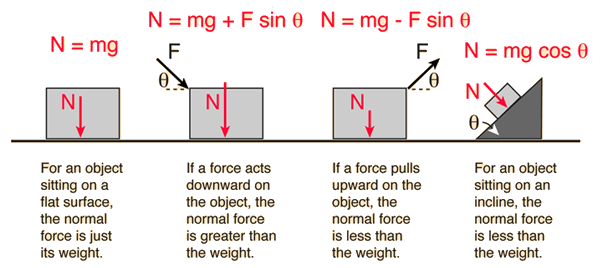
Frictional resistance forces are typically proportional to the force which presses the surfaces together. This force which will affect frictional resistance is the component of applied force which acts perpendicular or "normal" to the surfaces which are in contact and is typically referred to as the normal force. In many common situations, the normal force is just the weight of the object which is sitting on some surface, but if an object is on an incline or has components of applied force perpendicular to the surface, then it is not equal to the weight. 摩擦阻力通常与使接触面相互压紧的力成正比。影响摩擦阻力的这个力是作用在接触面上的施加力的分量,且垂直或‘法线’于接触面,通常称为法向力。在许多常见情况下,法向力仅仅是物体静置于某表面时的重量,但如果物体位于斜面上或有施加力的分量垂直于表面,则法向力不等于重量。
![]() The above cases are the commonly encountered situations for objects at rest or in straight line motion. For curved motion, there are cases like a car on a banked curve where the normal force is determined by the dynamics of the situation. In that case, the normal force depends upon the speed of the car as well as the angle of the bank. 上述情况是物体静止或做直线运动时常见的状况。对于曲线运动,例如银行曲线上的汽车,法向力由情境的动力学决定。在这种情况下,法向力不仅取决于汽车的速度,还取决于曲线的倾斜角。
|
Index Friction concepts 摩擦概念索引 | ||
|
Go Back
返回 |